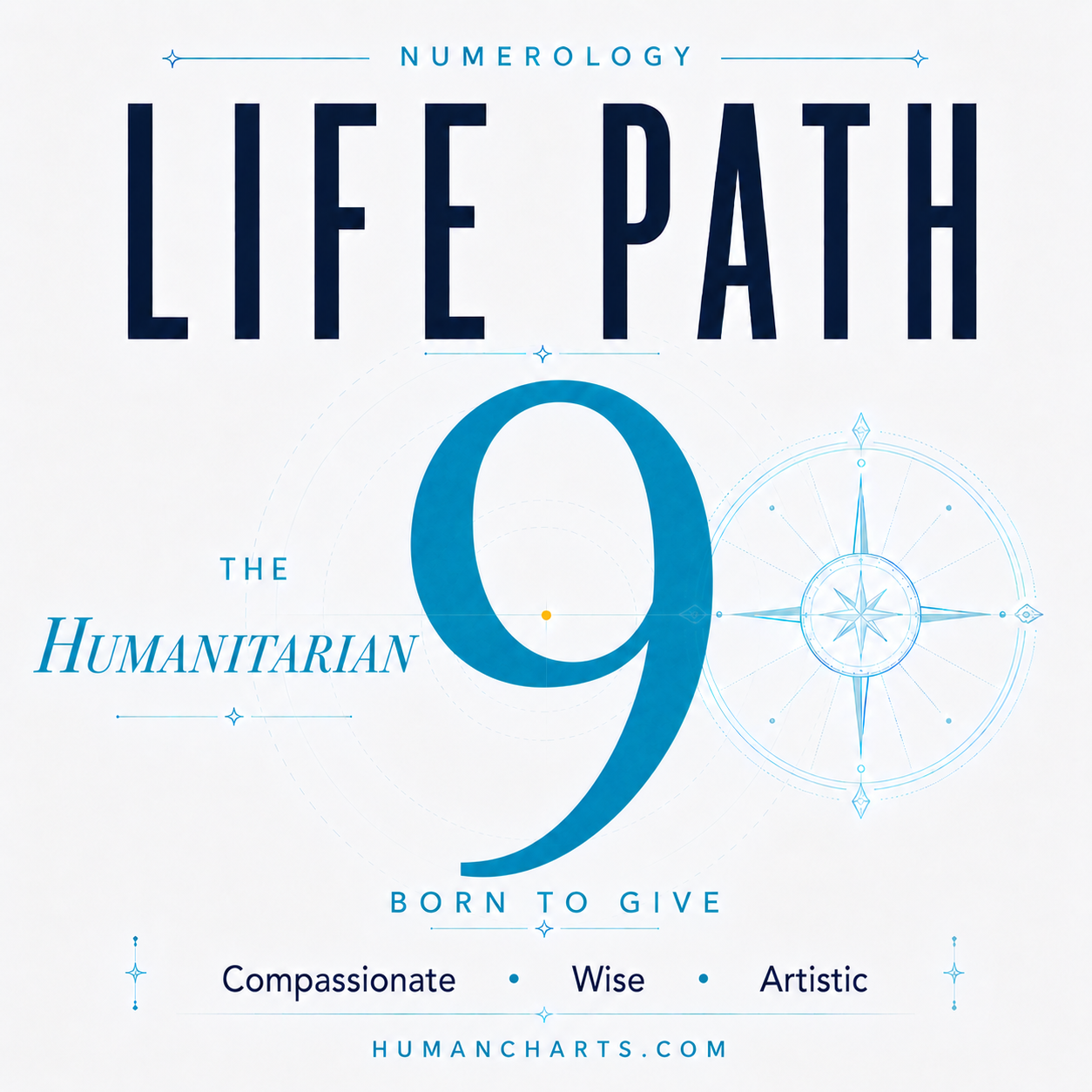
Life Path 9 at a Glance
Each row is a tap-through. Skim the data, then jump to the deeper section on whichever line you want to read more about.
- The Path: The Humanitarian
- Themes and Traits: Service, art, wisdom, completion, broad-spectrum vision
- Strengths: Compassionate, wise, artistic, integrating, generous
- Weaknesses: Martyring, disillusioned, self-sacrificing, hard to receive, ungrounded
- Interests: Art, philanthropy, teaching, cultural travel, wisdom traditions, causes
- Career & Business: Artist, teacher, philanthropist, activist, writer, healer, leader of a cause
- Relationships: Wide-hearted — the work is learning to receive what is given
- Spiritual Lesson: Give freely — but stay full enough to keep giving
- Famous Life Path 9s: Mahatma Gandhi, Carl Jung, Bob Marley, Morgan Freeman
Life Path 9 is the Path of the Humanitarian — and the Path of the Artist. Some people are wired to give. They feel for the suffering of strangers, they see the wide arc of how things connect, and they have a long-arc willingness to put their own life in service of something larger than themselves. They are also wired to create — and the creation, when it lands cleanly, is itself a form of giving.
Life Path 9 is the Numerology label for that wiring. It is the last single digit in Numerology — the path of completion, integration, and what the previous eight numbers were preparing the carrier to do with what they had learned. The Path of the Humanitarian is about wisdom earned through experience, art built through living, and service that compounds because the giver has lived enough to know what other people actually need.
If your birth date reduces to 9, here is what that usually looks like in practice:
- You feel for people who are not in the room. The pain of strangers reaches you in a way other paths do not always understand.
- You see the wide pattern. The big picture is your native frame; the small details are where the path has to do the work.
- You have an artistic instinct — visual, musical, literary, structural — even if you do not formally make art. The aesthetic of the room, the meal, the conversation matters.
- You struggle when life asks for narrow, transactional engagement. The path needs room for the wide arc.
- You become most yourself when you have a body of work or a body of service that is for other people — and that the world receives from you without you needing to grasp for the receiving.
Definition: Life Path 9 is the final single-digit life path in Numerology, calculated by reducing the digits of a person’s birth date to a single number. Life Path 9 carriers are oriented around service, art, wisdom, completion, and the disciplined giving of what they have learned. The path’s central work is learning to give freely while staying full enough to keep giving — and to recognize that art and service are the same gesture rendered through different forms.
Life Path 9 is the Path of the Humanitarian. It is also the Path of the Artist. In classical Numerology these are two names for the same mechanism — the carrier is here to give, and the giving takes the form of either direct service or made work, often both. It is calculated from a person’s birth date and represents the most important number in their numerology chart — the structural orientation that governs how they are designed to learn and grow across a lifetime.
Before reading further — a synthesis note. Your Life Path is one of the most important numbers in your Numerology chart. But Numerology is one of several systems that describe a full design. Your Human Design (energy type, authority, profile, channels, gates) and your Western Astrology (Sun, Moon, Rising, and the rest of the placements) each add their own structural inputs. The patterns on this page describe what Life Path 9 brings — the core orientation around service, art, and wisdom that integrates. How that orientation actually shows up in your career, your relationships, and your decisions is shaped by the synthesis of all the systems together, not by Life Path 9 alone.
In Numerology, each of the nine base life paths (1 through 9) represents a distinct developmental arc. Life Path 9 is the last in the sequence — the path of completion. Where Life Path 1 is built to initiate and Life Path 5 is built to gather range, Life Path 9 is built to integrate what the previous numbers have produced and to give it back. The 9 is the carrier whose life is supposed to compound into something other people can use.
The mechanism of Life Path 9 is giving. The engine runs on the wide-arc capacity to feel what other people are going through, the artistic capacity to render that feeling into a transmissible form, and the wisdom capacity to know what is actually being asked for rather than what is being explicitly requested. The shadow of the path is mistaking giving for self-erasure: pouring the work out without ever learning to receive, and arriving at the end of the path empty and quietly resentful about it.
To find your Life Path, reduce your birth month, day, and year separately to a single digit each (preserving any master number 11, 22, or 33), then add the three and reduce the sum. If your final number is 9, you are a Life Path 9. The full method with worked examples for every path lives at How to Calculate Your Life Path Number.
Life Path 9 carries a consistent set of themes that show up across the carrier’s lifetime, regardless of upbringing, culture, or career. These are the structural traits the path is built from.
- Compassion. A built-in attunement to suffering, including suffering that is not in the room. The path feels what is happening across distance.
- Art. An artistic instinct that shows up across mediums — visual, musical, literary, performative, structural. The 9 is making something with the way the 9 is living.
- Wisdom. A capacity to integrate what was learned across phases of life into a body of understanding other people can use.
- Generosity. A natural pleasure in giving — knowledge, money, time, access. The path runs on it.
- Broad-spectrum vision. A native frame at the wide angle. The forest is obvious; the trees take work.
- Idealism. A belief that the world can be better than it currently is — and a low tolerance for cynicism that says it cannot.
- Old-soul quality. A sense that the carrier has lived more lives than the calendar accounts for. The eyes go further back than the face.
- Letting go. A path of endings as well as completions. The 9 is the carrier who has to learn to release.
Life Path 9 carriers are designed to:
- Make work that reaches across cultures, classes, and generations because the path is wired for the wide audience
- Hold a long-arc service to a cause across the decades the cause requires
- Integrate what was learned across the early phases of life into a body of wisdom or art that compounds
- Feel what other people are feeling and render it into a form they can receive
- Give without requiring the receiver to perform gratitude for the giving
Strong work shows up where the wide audience matters and the giving is structurally part of the work. Artists use the path’s broad reach to make work that lands across languages and decades. Humanitarians use the path’s compassion to sustain effort that other paths would burn out from. Teachers and elders use the path’s integrative wisdom to transmit what cannot be reduced to a syllabus. The 9 is not built for transactional, narrow-stakes work where the giving has to be metered and counted — it is built for situations where the carrier can offer what they have and let it be received without negotiating the receiving.
When this path is operating cleanly, Life Path 9 carriers do not need to be loud about what they are giving. The work itself is the transmission — the song, the book, the company built around a giving structure, the patient listening at the bedside, the framework the next generation gets to operate inside. People around the carrier often realize the 9’s contribution slowly — the path tends to leave behind more than it asks for in the moment, and the value compounds after the carrier has moved on or moved through. The trap of the path is that the giving feels structurally correct and the receiving does not, so the carrier can spend decades pouring out and never learning how to be poured into.
The shadow of Life Path 9 is the predictable distortion that appears when the path’s mechanics are overdriven. Common patterns:
- Martyrdom. Service hardens into self-sacrifice with a private ledger underneath. The carrier gives and quietly counts what was not given back.
- Disillusionment. Idealism that was real meets a world that does not live up to it, and the path collapses into cynicism the carrier never wanted to feel.
- Inability to receive. The mechanism that pours out cannot reverse. Compliments, money, care, support all land badly and get deflected.
- Self-erasure. The wide-angle attention to other people leaves no room for the carrier’s own life. Years pass without anyone asking what the 9 wants.
- Holding on past completion. The path of endings has trouble ending. Relationships, jobs, projects continue long past their natural close because the 9 cannot let go.
- Ungroundedness. The big picture comes easily; the small daily life is harder. Money, body, schedule, paperwork all get neglected.
- Resentment. Quiet anger at the world for not noticing what the 9 has given. Real and structural — and corrosive when not addressed.
- Spiritual bypass. The wide perspective can become a way to avoid the unmoving practical thing the carrier actually needs to face.
The repair pattern is not to suppress the path’s mechanics. The giving is correct. The repair is in noticing when giving has become self-erasure, when idealism has become disappointment, and when service has become a way to avoid the question of what the carrier wants for themselves. The earlier in life this discernment develops, the more the path compounds into bodies of work and acts of service that the world receives gratefully. The later it develops, the more the carrier spends decades giving from an empty cup with a private feeling that nobody quite saw the gift.
Most Life Path 9 carriers recognize the difference between giving and self-erasure in their forties or fifties — often after a major loss, a major completion, or a major artistic release reveals how much the carrier had been pouring out without refilling. The path does not eliminate the pull toward giving — it cannot — but the carrier learns to receive with the same discipline they give with, and to hold the cup full enough that the pouring can continue.
Life Path 9 carriers are designed to:
- Learn to receive — compliments, money, care, attention — without deflecting
- Ask for what the carrier wants directly, not as a translation of what the receiver might need
- Distinguish between service that compounds and service that drains
- Let go of what is complete — including bodies of work, relationships, and identities the path has outgrown
Life Path 9 interests track the path’s mechanism: art, service, wisdom, and the wide-arc attention to what other people are going through. Carriers tend to be pulled toward activities that produce something for other people, that engage the artistic instinct, or that deepen the carrier’s understanding of how the wide world actually works. These are the activities the path returns to across decades because the engine of the 9 needs them.
- Art-making. Visual art, music, writing, performance, design, food. The 9 is happy when something is being shaped that someone else will receive.
- Philanthropy and giving. Donations of money, time, knowledge, or access. The path takes structural pleasure in transferring what the carrier has to where it can do good.
- Teaching and mentorship. Workshops, classes, one-on-one transmission, writing for other people learning what the carrier has learned.
- Travel for cultural understanding. Not vacation — immersion. Languages, neighborhoods, food traditions, religious practices. The 9 wants to understand how the wider world lives.
- Wisdom traditions. Religious study, philosophy, contemplative practice, spiritual reading. The path needs material that integrates what experience produces.
- Long-form storytelling. Novels, biographies, documentary, deep journalism. Formats that let an arc come into focus.
- Causes and activism. A specific arc of public service that the carrier returns to across the years — environmental, civil rights, education, public health, animal welfare.
- Beauty and aesthetics. Music collections, gardens, libraries, well-set tables, considered environments. The 9 lives partly through what is beautiful.
Strong interests reveal alignment. When a Life Path 9 carrier is doing the work the path was built for, the interests pull in the same direction as the career and the relationships. When they are misaligned, the interests pull one way and the rest of the life pulls another — and the carrier feels split.
Life Path 9 is built for work that has a giving structure built into it. The path tends to perform at its peak when the chart’s owner is producing something other people receive — art, teaching, service, a built structure that serves a public — and is operating at the wide reach the path naturally produces. It tends to perform poorly in narrow transactional work where the giving has to be metered and counted, or in cultures that treat compassion as inefficiency. The actual career format depends on the synthesis with the rest of the chart — the careers below are where Life Path 9’s mechanism is most directly engaged, not the only places it shows up. Many Life Path 9 carriers do their giving quietly inside roles that are not officially humanitarian: as a manager who actually mentors, a salesperson who serves the customer rather than the quota, a parent whose work at home is the structural service everything else rests on. The mechanism is the same; the format varies.
Careers where Life Path 9’s mechanism is most directly engaged include:
- Artist — visual, musical, literary, performing, designing
- Writer, novelist, essayist, poet
- Teacher, professor, mentor, workshop leader
- Therapist, counselor, healer, hospice worker
- Philanthropist, nonprofit leader, foundation officer
- Activist, advocate, public servant, NGO leader
- Spiritual teacher, faith leader, contemplative practitioner
- Filmmaker, documentary maker, long-form journalist
- Founder of a mission-driven business or social enterprise
Misaligned environments include high-volume transactional work with no relational layer, cultures that punish wide-angle thinking as unfocus, roles that ask the carrier to suppress the artistic instinct, and any environment that treats giving as a structural inefficiency.
In careers, Life Path 9 carriers are designed to:
- Build a body of work that has the carrier’s specific giving signature on it
- Negotiate compensation that reflects the wide-arc value the carrier produces, not just the narrow visible deliverables
- Distinguish between work that compounds and work that drains
- Let the work that is complete actually complete — release it to the world rather than holding onto it past the point of usefulness
In close relationships, Life Path 9 tends to show up as a partner who gives generously, sees the wide arc of the partnership across the years, and struggles structurally with receiving what is offered. The path’s compassion is exactly the input intimate partnership requires — the 9 sees what the partner is going through and responds without being asked. How this plays out in any specific relationship depends on the rest of the chart — but the core Life Path 9 pattern of giving-without-receiving shows up consistently across carriers.
Common challenges include the inability-to-receive trap (compliments, gifts, attention all get deflected), self-erasure inside the partnership (years pass without the carrier asking for what they want), holding on past the natural completion (relationships continue long after they have run their arc because the 9 cannot let go), idealizing the partner (the wide imagination of who the partner could be replaces the patient attention to who the partner is), and the burnout that arrives when the giving exceeds what the carrier has been refilling.
The release in relationships is the discipline of receiving. The carrier learns to let the partner give without negotiating the giving, to accept care without immediately reciprocating, and to ask for what they want without translating it into what would be good for the partner. Healthy Life Path 9 partnerships involve a carrier who has practiced receiving and a partner who values the wide-arc giving without requiring the carrier to disappear inside it.
Life Path 9 carriers are designed to:
- Receive what is given without deflecting, apologizing for, or immediately reciprocating
- Distinguish between giving that nourishes the partnership and giving that depletes the carrier
- Let go of relationships that are complete, with grief rather than guilt
- Build a self that exists outside the role of giver — interests, projects, identity that does not require service to be real
The teaching of Life Path 9 is structural. The lesson is that giving is the discipline — and receiving is the harder discipline. The path’s engine runs on the wide-angle compassion that produces art and service. That engine pours out forever if the carrier has built the practice of refilling. It pours out and runs dry if the carrier has not. The work of the path is not less giving. The work is the receiving — letting the world give back, letting the partner give back, letting the body and the rest give back. The fuller the cup, the longer the pouring can continue.
For most Life Path 9 carriers, this teaching arrives the hard way. Years of pouring out that produced beautiful work and a quiet exhaustion. Years of service that the world received gratefully and the carrier never felt fully received for. Years of holding on to bodies of work or relationships past the natural completion because letting go felt like betrayal of the giving itself. The release is not detachment. It is the discipline of completion — letting what is complete actually complete, receiving what is offered without negotiating the offer, and continuing to give from a cup that is allowed to be full.
Decision-making is the discipline. For Life Path 9, the discipline is choosing what to give to, choosing what to release, and choosing to receive what the world is trying to put back. The art is the gift. The gift is the work. The 9 who learns to receive is the 9 who keeps giving for the long arc the path can actually sustain.
The pattern is consistent across fields: a body of work that reached past the carrier’s own life into other people’s, an artistic or humanitarian giving that compounded across decades, and a level of wide-arc attention to the human condition that other paths did not attempt. Below are 18 well-documented Life Path 9 figures across humanitarian work, art, music, film, sports, and business — each verified with the HumanCharts tri-reduction method (reduce month, day, and year separately, preserving any master, then sum and reduce).
- Mahatma Gandhi (Oct 2, 1869) — leader of India’s independence movement and the modern face of nonviolent resistance. Life Path 9 service at structural scale — a body of work that became a method other movements then used for the next century.
- Jimmy Carter (Oct 1, 1924) — 39th US President and founder-supporter of Habitat for Humanity. The longest post-presidency humanitarian arc in US history — Life Path 9 service applied to building houses with his own hands into his late nineties.
- Carl Jung (Jul 26, 1875) — Swiss psychiatrist and founder of analytical psychology. Life Path 9 wisdom expressed as a body of work — archetypes, the collective unconscious, individuation — that became the structural language other healers operate inside.
- Bob Marley (Feb 6, 1945) — reggae musician whose work reached across cultures, classes, and political affiliations. Life Path 9 art rendered as global voice — the music was the message and the message was the music.
- Ray Charles (Sep 23, 1930) — pioneering R&B and soul musician who reorganized the boundary between gospel, blues, country, and jazz. Life Path 9 artist at the integrative level.
- Prince (Jun 7, 1958) — singer, songwriter, multi-instrumentalist. Life Path 9 artistry at extreme range — composed, produced, played, performed, mentored other artists, owned the masters. Gave the work without giving the self.
- Whitney Houston (Aug 9, 1963) — singer whose voice became one of the most-awarded instruments in popular music history. Life Path 9 artistry rendered as the standard the next generation measured itself against.
- Cher (May 20, 1946) — singer and actress across six decades of public reinvention. Life Path 9 long-arc artistry — kept giving the work in new forms past the point where most paths would have stopped.
- Adele (May 5, 1988) — singer-songwriter whose albums have broken decades-old records. Life Path 9 voice that reaches across age and culture without compromise — the wide reach of the path expressed as a single instrument.
- Morgan Freeman (Jun 1, 1937) — actor; the voice that has narrated so much of late-20th and early-21st century cinema. Life Path 9 wisdom rendered as presence — what the camera caught was the trust the path produces.
- Robert Redford (Aug 18, 1936) — actor, director, and founder of the Sundance Film Festival and the Sundance Institute. Life Path 9 service applied to the structural support of independent filmmakers across generations.
- Bill Murray (Sep 21, 1950) — actor and comedian whose career has spanned screwball comedy, art-house drama, and decades of mythologized public moments. Life Path 9 in its mystic-clown form.
- Jim Carrey (Jan 17, 1962) — actor, comedian, and visual artist whose later work has moved decisively into painting and contemplation. Life Path 9 trajectory — from the performance into the inner work.
- Richard Pryor (Dec 1, 1940) — comedian; one of the most structurally influential stand-ups in American history. Life Path 9 truth-telling rendered as comedy that hurt and healed at the same time.
- Christopher Nolan (Jul 30, 1970) — director; Memento, Inception, Interstellar, Oppenheimer. Life Path 9 inquiry rendered as cinema — films about time, memory, consciousness, and the moral structure of the bomb.
- Serena Williams (Sep 26, 1981) — 23 Grand Slam singles titles. Life Path 9 mastery applied at championship scale — a career that reorganized what a tennis player could look like and what a Black woman in the sport could become.
- Marc Benioff (Sep 25, 1964) — co-founder and CEO of Salesforce; pioneering the 1-1-1 philanthropy model (1% time, 1% product, 1% equity given). Life Path 9 service embedded in the structural architecture of the business itself.
- Reid Hoffman (Aug 5, 1967) — co-founder of LinkedIn, partner at Greylock, host of Masters of Scale. Life Path 9 networked giving — the explicit philosophical project of helping operators help other operators.
What does Life Path 9 mean in Numerology?
Life Path 9 in Numerology is the Path of the Humanitarian — and the Path of the Artist. It is calculated by reducing a person’s birth date to a single digit, and it represents an orientation toward service, art, wisdom, and the disciplined giving of what the carrier has learned. Life Path 9 carriers are structurally wired to give — through art, through service, through teaching, through whatever form their specific life has shaped them to offer.
How do I know if I’m a Life Path 9?
Reduce your birth month, day, and year each to a single digit, add the three numbers together, and reduce the total to a single digit. If the final number is 9, you are a Life Path 9. For example, December 18, 1977: Month = 1 + 2 = 3, Day = 1 + 8 = 9, Year = 1 + 9 + 7 + 7 = 24 → 6. Sum: 3 + 9 + 6 = 18 → 9. For the complete method including how to handle master numbers (11, 22, 33), see How to Calculate Your Life Path Number.
Why is Life Path 9 also called the Path of the Artist?
In classical Numerology, the 9 is the last single digit — the path of completion. The same mechanism that produces the humanitarian orientation produces the artistic instinct. Both are forms of giving: the humanitarian gives service, the artist gives made work. Most Life Path 9 carriers operate across both forms even when they identify with only one — the artist who is also a teacher, the humanitarian who has an artistic sensibility about how the work is structured. The path itself does not distinguish the two.
What careers suit Life Path 9?
Careers built around giving, art, and wide-arc service. Artists, writers, teachers, therapists, philanthropists, activists, spiritual teachers, filmmakers, long-form journalists, healers, and founders of mission-driven businesses. Life Path 9 carriers do not thrive in narrow transactional work where compassion is treated as inefficiency or where the giving has to be metered and counted.
What is the shadow of Life Path 9?
The shadow of Life Path 9 includes martyrdom, disillusionment, inability to receive, self-erasure, holding on past completion, ungroundedness, resentment, and spiritual bypass. These appear when the path’s natural giving outruns the carrier’s practice of receiving — when service has become self-erasure and idealism has hardened into private disappointment. The repair is not less giving but better receiving: letting the world give back so the carrier can keep pouring out.
A Direct Transmission from MATTEEN
“Life Path 9 is here to give. The art is the gift. The gift is the work. The mistake is thinking giving means emptying — that the carrier has to be drained for the giving to count. The cup has to be full before it can be poured, and the discipline of staying full is the part the path does not get taught. Receive with the same skill you give with. Let what is complete actually complete. The 9 who learns to receive is the 9 who keeps giving for the long arc the path was built for.”
— Matteen Terrany
Unlock Your Life Path Number
Your Life Path is the foundation. Calculate yours and start working with it.
The art is the gift. The gift is the work.