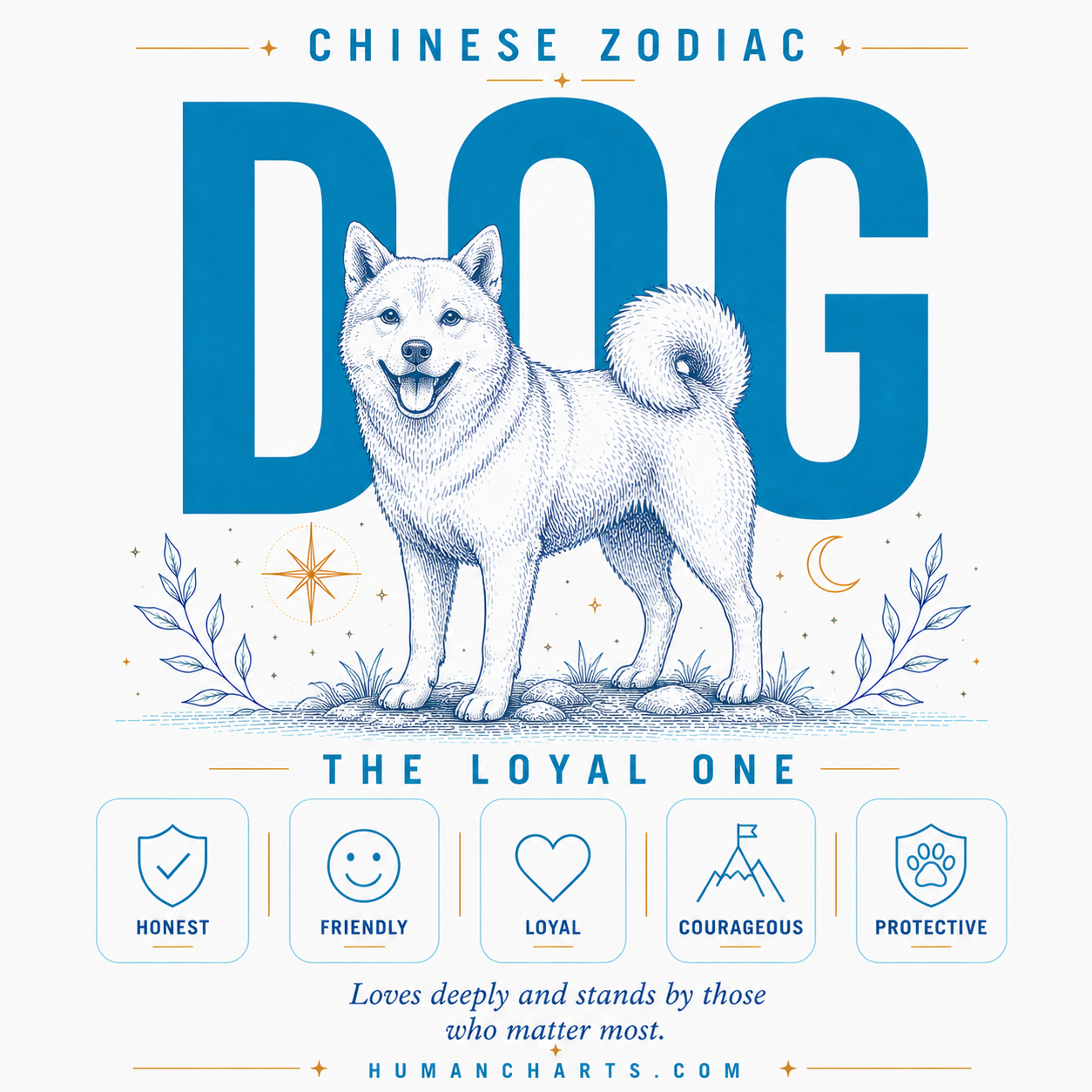
The Dog Chinese Zodiac at a Glance
- The Animal: The Dog — The Loyal One
- Years: 1934, 1946, 1958, 1970, 1982, 1994, 2006, 2018, 2030
- How It Works: Earth (fixed) · Yang · The Dog · Identify, commit, hold
- Optimal Decision-Making: Identify who you are protecting · commit to them · hold the loyalty
- “Don’t Take It So Personally” Is Wrong For You: Why the cultural advice misnames your instrument
- Five Elements: Wood · Fire · Earth · Metal · Water variations
- Strengths: Loyal, honest, courageous, dependable, justice-oriented
- Challenges: Anxious, pessimistic, critical, stubborn, takes on other people’s battles
- Career & Business: Public service, law, advocacy, medicine, teaching, military, trusted operator
- Relationships: Need partners who can hold loyalty as a shared standard, not a private demand
- Famous Dogs: Mother Teresa, Michael Jackson, Madonna, Donald Trump, Steven Spielberg
The Dog Chinese Zodiac in Plain English
The Dog is the Loyal One. Some people are wired to figure out who they are responsible to and then build their entire life around honoring that responsibility. They take the people, the principles, the community they have chosen — and they hold the line. When the people they protect are threatened, the Dog moves. The Dog’s discipline is loyalty. The Dog’s gift is reliability.
Dog is the Chinese Astrology label for that wiring. It is the eleventh animal in the twelve-year zodiac cycle and one of the most honest, courageous, and justice-oriented of the twelve. The Dog (狗, gǒu) is considered in Chinese tradition the most trustworthy of the animals — the one whose word, once given, becomes structural.
If you were born in a Dog year (1934, 1946, 1958, 1970, 1982, 1994, 2006, 2018, 2030), here is what that usually looks like in practice:
- You decide who you are loyal to early and you stay there. The bond, once chosen, becomes a structural commitment, not a feeling that fluctuates.
- You read injustice fast. When something is wrong — for a friend, a colleague, a stranger you happen to witness — your body registers it before your mind has named it.
- You worry more than other people realize. The anxiety is the cost of caring about outcomes for the people in your circle.
- You struggle in environments where loyalty is treated as naive or where the rules keep shifting depending on who is in the room.
- You become most yourself when there is a person, a cause, a community, or a principle you are clearly serving — and when the people around you respect that the loyalty is the architecture, not a sentimentality.
Listen to MATTEEN on the Dog Chinese Zodiac — a mechanical breakdown of the eleventh animal in the Chinese zodiac, how loyalty operates as the engine of the path, why the protective response is the design and not a defect, and how Dog carriers learn to use their justice radar without burning out inside it.
Definition: The Dog (狗, gǒu) is the eleventh animal in the twelve-year Chinese zodiac cycle. Its fixed element is Earth, its polarity is Yang, and it is associated with loyalty, honesty, courage, justice, and protective devotion. Dog carriers operate through a loyalty radar — they identify who they are responsible for, commit to that group, and hold the commitment even when it costs them. The Dog’s decision-making instrument is alignment with loyalty and justice — the question “who am I protecting, and what is right by them?” is structurally the work, and every other decision flows from the answer.
The Dog is the eleventh animal in the twelve-year Chinese zodiac cycle, following the Rooster and preceding the Pig. In Chinese tradition, the Dog (狗, gǒu) is associated with loyalty, honesty, justice, courage, and the protective devotion that turns a household, a team, or a community into something safe. The Dog is the animal most often described as humanity’s truest companion — and in the zodiac, that same quality becomes a structural orientation.
Before reading further — a synthesis note. Chinese Astrology is one of several systems that describe a full design. Your Western Astrology (Sun, Moon, Rising, and the rest of the placements), Human Design, and Numerology Life Path each add their own structural inputs. The patterns on this page describe what the Dog brings — the core orientation around loyalty, honesty, and protective justice. How that orientation actually shows up in your career, your relationships, and your decisions is shaped by the synthesis of all the systems together, not by the Chinese Zodiac alone.
In Chinese cosmology, the twelve animals each represent a distinct developmental pattern. Where the Rooster operates through principle and the Pig operates through generosity, the Dog operates through allegiance and the willingness to defend what the allegiance protects. The Dog is what makes a structure trustworthy — the friend who keeps the secret, the colleague who stays through the bad quarter, the citizen who notices the injustice and refuses to look away.
The mechanism of the Dog is loyalty combined with justice. The engine runs on identifying who is yours, committing to them, and holding the line on their behalf even when the cost falls on the Dog. Where the Tiger acts on instinct and the Snake acts on strategy, the Dog acts on responsibility. The shadow of the path is the cost of running an unusually protective and justice-oriented instrument inside a world that often treats loyalty as old-fashioned and protectiveness as overreaction — the Dog can be misread as anxious, controlling, or too serious when in fact the carrier is honoring a structural commitment.
Dog Years. The Dog years in the Chinese zodiac fall every 12 years: 1934, 1946, 1958, 1970, 1982, 1994, 2006, 2018, and 2030 are the most recent and the next. The Chinese New Year shifts each year — typically late January or early February — so people born in January or early-to-mid February of a “Dog year” may actually belong to the previous animal. If your birth date falls in January or early February of a Dog year, check it against the specific Chinese New Year cutoff for that year.
Every Chinese zodiac animal is built from four structural components: its fixed element, its yin/yang polarity, its symbol, and its position in the twelve-year cycle. Here is how the Dog is built.
- Symbol. The dog — vigilant, devoted, ready to defend what has been entrusted to it.
- Fixed element. Earth. The Dog’s underlying nature is groundedness, reliability, and structural stability — the qualities that make the loyalty durable.
- Yin/Yang. Yang. Active, outward-facing, ready to move. The Dog does not wait to be asked — when the people the Dog is responsible for are in trouble, the Dog moves.
- Position in zodiac. Eleventh of twelve — near the end of the cycle, often associated with maturation, accountability, and the responsibility that comes with experience.
- Lucky colors. Red, green, purple.
- Lucky numbers. 3, 4, 9.
The Dog’s combination of Earth (groundedness, reliability) and Yang (active, outward) is the structural key. Earth by itself is stable but passive; Earth animated by Yang becomes the protective stance — stable footing that moves outward when the people on the Earth are threatened. This is the Dog’s signature: a deep, calm reliability that turns into immediate active defense when loyalty calls for it. The protectiveness is not aggression — it is structural ground showing up as motion.
Mechanically, the Dog operates in three phases: identify, commit, and hold. The identification phase clarifies who the Dog is responsible for — the family, the friends, the colleagues, the cause, the community, the principle. The commitment phase converts that identification into a structural bond — once chosen, the bond is not casually revisited. The holding phase is the long arc: staying loyal across years, across the costs, across the moments when loyalty is inconvenient or expensive. The holding is most of the work.
Everything in life is a function of decision-making. Every life unfolds through the decisions made within it. For the Dog Chinese Zodiac, the decision-making instrument is alignment with loyalty and justice — what serves the people the Dog is responsible for. The Dog asks two questions: who am I protecting? and what is right by them? — and decides accordingly. The loyalty radar IS the instrument. The discipline is to trust what the radar reads and to act on it, even when the cost of acting falls on the Dog.
Most cultures treat decision-making as a neutral, individualistic calculation — what is best for me, what is most efficient, what minimizes friction. The Dog is built differently. For the Dog, decisions are made inside an allegiance. The question is never just what do I want? — it is what does this serve, and who am I serving with it? When the allegiance is clear, the decision usually is too. When the allegiance is blurry, the Dog cannot decide cleanly — and no amount of pros-and-cons analysis will substitute.
How to make decisions well with this instrument:
- Identify who you are protecting first. Before you can decide anything important, name the people, principles, or community the decision is in service of. The clarity at that layer collapses most of the apparent complexity at the surface.
- Trust the justice signal. When something feels wrong — for someone you are responsible for, or for a stranger whose situation the radar has picked up — the read is usually correct. Do not let the cultural pressure to “stay neutral” override what the instrument is telling you.
- Distinguish your circle from every circle. The Dog’s loyalty is structurally finite. Trying to be loyal to everyone at the same intensity collapses the instrument. The discipline is choosing the circle you can actually hold, and holding it.
- Hold the loyalty even when it costs you. The decisions that test the Dog are the ones where loyalty is expensive — when staying loyal means losing the promotion, the friendship with the new crowd, the easier path. Those are the decisions the design is built for. The cost is part of the structure, not a sign you chose wrong.
Everyday decisions and major decisions operate on the same instrument; only the stakes differ. Small decisions train the radar across days — noticing which colleague you covered for, which friend you defended, which principle you held quietly. Major decisions — career, partnership, structural commitments — test whether the loyalty you say you hold is the loyalty you actually hold when the cost arrives. The Dog who tries to make major decisions by optimizing for personal advantage will produce moves the loyalty radar would not have endorsed, and the carrier will live with the dissonance for years. The Dog who decides from inside the allegiance produces a life of unusual integrity — and an unusual capacity to look back at the major calls without regret.
The discipline is not loyalty for loyalty’s sake. The discipline is honoring the actual architecture of how the instrument works.
The phrase “don’t take it so personally” gets used universally — usually delivered to someone whose protective response has just made other people uncomfortable. “Stop fighting other people’s battles.” “Why do you care so much?” “It’s not your problem.” For you, all of it is wrong advice. The personal stake IS the design. Your loyalty is how your decision-making instrument knows what matters.
The cultural advice to “don’t take it so personally” generally describes a different decision-making instrument — one that operates on detached self-interest, where caring less is treated as a sign of maturity. For some carriers, that detachment is correct. For you, it is structural betrayal of the instrument. The Dog reads the situation through the lens of who is being affected and what is right by them. Strip the personal stake out and the radar has nothing to read — the decision-making collapses into the same flat optimization everyone else is running, and the Dog stops being a Dog.
When people tell you to “stop fighting other people’s battles,” they may be operating from a different design where battles are private. Or they may simply be uncomfortable with how clearly the injustice is registering on your radar — because once you have named it, they cannot pretend they did not see it too. Either way, the advice misnames your work. The protectiveness is not oversensitivity. The justice response is not drama. They are the structural mechanism your decision-making runs on.
For you, take it personally. Fight the battles your radar picks up. Refuse the cultural pressure to dampen the loyalty into something more “professional” or more “chill” — the dampening is the cost, not the upgrade.
Chinese Astrology pairs each animal’s fixed element with a year-specific element from the Five Elements system (Wood, Fire, Earth, Metal, Water) on a 60-year master cycle. This means every Dog is not just a Dog — they are a Wood Dog, Fire Dog, Earth Dog, Metal Dog, or Water Dog depending on which year inside the 60-year cycle they were born. The fixed Earth element gives the Dog its core nature; the year-specific element shades how that core is expressed.
- Wood Dog (1934, 1994) — more cooperative, expressive, and open. Wood softens the Dog’s seriousness and produces a more outwardly warm, community-engaged version of the path.
- Fire Dog (1946, 2006) — more passionate, charismatic, and combative. Fire on the Dog’s loyalty produces the most fiery, publicly active variation — Dogs who fight visibly on behalf of the people they protect.
- Earth Dog (1958, 2018) — the double-Earth combination. The most steady, reliable, and grounded of the Dog variations. Earth on Earth produces the carrier whose loyalty is so structural it feels like geology.
- Metal Dog (1910, 1970) — more disciplined, principled, and uncompromising. Metal sharpens the Dog’s justice radar and produces the most rigorously ethical variation — the carrier whose word is unbreakable.
- Water Dog (1922, 1982) — more intuitive, emotionally fluent, and reflective. Water softens the Dog’s hard edge and produces the most empathic of the variations — the loyalty expressed through deep listening as much as defense.
When you read about a Dog’s traits, the fixed Earth-Yang nature is the foundation. The year-specific element is the modifier. A 1970 Metal Dog will read differently than a 2006 Fire Dog even though both share the underlying mechanism.
The Dog carries a consistent set of themes that show up across a carrier’s lifetime, regardless of upbringing, culture, or career. These are the structural traits the sign is built from.
- Loyalty. A built-in commitment to the people, principles, and communities the carrier has chosen. Once given, the loyalty does not casually withdraw.
- Honesty. A structural inability to run sustained dishonesty. The Dog can hold a confidence, but cannot perform a falsehood without it costing them.
- Justice orientation. A high-resolution radar for what is fair, what is right, and what is being done to people who cannot defend themselves. The radar runs whether the carrier wants it to or not.
- Courage. A willingness to stand in the harder position when loyalty calls for it. Not bravado — structural willingness to take the cost.
- Protectiveness. A native instinct to shield the vulnerable. Family, friends, colleagues, strangers in trouble — the radar registers and the body moves.
- Friendliness. A warm, sociable presence with the people inside the circle. The Dog’s loyalty includes the daily warmth of showing up.
- Anxiety. A persistent worry about outcomes for the people the carrier is responsible for. The anxiety is the cost of caring at this resolution.
- Dependability. A structural reliability — the Dog who said they would do it does it. The word is the architecture.
- Pessimism, sometimes. A tendency to anticipate what could go wrong, especially for the people in the circle. The watchfulness has a darker register the carrier lives with.
- Critical edge. A willingness to name what is not working — about the situation, the institution, the people around them. The honesty has teeth.
Dog carriers are designed to:
- Hold a commitment across the years it takes for the commitment to mature into a body of trust
- Make decisions that prioritize the people they are responsible for and live with those decisions without regret
- Read injustice fast and respond before the situation has hardened
- Build the kind of structural trustworthiness that turns a household, a team, or an institution into something safe
- Stand in the harder position when loyalty calls for it — and absorb the cost when the cost arrives
Strong work shows up where loyalty, honesty, and protective responsibility matter. Teachers and mentors use the path’s reliability to build relationships students return to decades later. Doctors, nurses, and caregivers use the protectiveness to hold patients across the long arc of care. Public servants, advocates, and lawyers use the justice radar to fight the battles the system would otherwise quietly lose. Military, police, and first responders use the courage to stand where the cost of standing is highest. The Dog is not built for environments that reward shifting alliances or strategic neutrality — it is built for situations where the carrier’s specific reliability and justice are the structural value.
When this path is operating cleanly, Dog carriers do not need to perform their loyalty. The work itself transmits it — the colleague who never left, the friend who showed up at 2 a.m., the parent who held the line, the citizen who told the truth. People around the carrier often sense that something foundational is being held even when no one is naming it out loud. The trap of the path is that this reliability is real and easy to take for granted, so carriers who never learn to ask what they need in return can spend decades being the structural reliability everyone leans on without ever being the one being held back.
The shadow of the Dog is the predictable distortion that appears when the path’s mechanics are overdriven. Common patterns:
- Loyalty hardens into self-sacrifice. The willingness to take the cost becomes the unconscious habit of always taking the cost. The carrier disappears underneath the people they are protecting.
- Anxiety becomes chronic. The worry that serves the protectiveness becomes the worry that erodes the carrier’s nervous system. The body cannot stand down.
- Pessimism becomes default. The anticipation of what could go wrong stops being a useful early-warning signal and becomes a baseline pessimism that colors everything.
- Justice becomes self-righteousness. The radar that registers injustice becomes the inner voice that makes the carrier the moral authority on every situation — including ones the carrier was not asked to weigh in on.
- Critical edge becomes corrosive. The honesty that protects starts being delivered as judgment that the people in the circle cannot receive cleanly.
- Protectiveness becomes control. The instinct to shield becomes the instinct to manage — the carrier deciding what the protected people should do, rather than letting them decide for themselves.
- Loyalty extended too widely. The Dog who tries to be loyal to everyone at once dilutes the bond and ends up being structurally loyal to no one. The radar fragments.
- Stubbornness. Once the Dog has decided who is in the circle and what is right, revisiting the decision is structurally hard — even when the evidence has changed.
The repair pattern is not to suppress the path’s mechanics. The loyalty is correct. The protectiveness is correct. The repair is in noticing when loyalty has become self-erasure, when protectiveness has become control, and when justice has become self-righteousness. The earlier in life this discernment develops, the more the path compounds into the structural trust, the durable relationships, and the bodies of public service the Dog’s reliability was built to produce. The later it develops, the more the carrier spends decades exhausted, anxious, and quietly resentful that the people they protected never noticed the cost.
Dog carriers are designed to:
- Distinguish between loyalty that strengthens the carrier and loyalty that erases the carrier
- Stay loyal without taking responsibility for outcomes that belong to other people’s decisions
- Recognize when anxiety has stopped being a useful signal and started being a chronic state
- Ask for what they need back from the relationships they are holding, instead of waiting for the people inside to notice
The Dog is built for work that has a service, justice, or protective layer. The path tends to perform at its peak when the carrier is operating in fields that reward reliability, honesty, long-arc commitment, and willingness to advocate for people who need advocacy. It tends to perform poorly in environments that reward shifting alliances, strategic neutrality, or the kind of optimization that treats loyalty as a cost to be minimized. The actual career format depends on the synthesis with the rest of the chart — the careers below are where the Dog’s mechanism is most directly engaged, not the only places it shows up. Many Dog carriers do their protective work quietly inside roles that are not officially protective: as the senior employee whose loyalty is the institutional memory, the friend whose reliability is the architecture of a whole social circle, the parent whose protective ferocity shapes a child’s sense of safety for the rest of their life. The mechanism is the same; the format varies.
Careers where the Dog’s mechanism is most directly engaged include:
- Public servant, civil servant, public defender, advocate
- Lawyer, especially in civil rights, employment, family law, or trial work
- Doctor, nurse, paramedic, caregiver, hospice worker
- Teacher, mentor, coach, social worker, counselor
- Military, police, firefighter, search-and-rescue, first responder
- Journalist, especially investigative or accountability-focused
- Human-resources lead, ombuds, ethics officer, compliance
- Activist, organizer, union representative, community leader
- Trusted operator inside a founder team — chief of staff, second-in-command, the person who makes the structure work
Misaligned environments include cultures that reward shifting allegiances, sales environments that ask the carrier to perform a stance they do not hold, political work that treats principles as bargaining chips, and any role that requires the carrier to look away from injustice in order to keep their position.
In careers, Dog carriers are designed to:
- Build a body of work or a body of relationships that the carrier’s reliability is the structural asset of, not a vulnerability inside
- Choose institutions whose stated values the carrier can actually defend — the misalignment between values and practice is structurally corrosive for the Dog
- Distinguish between healthy loyalty to colleagues and over-extension that costs the carrier their own life
- Ask for what they need in return — recognition, security, real authority — instead of assuming the loyalty will be reciprocated unprompted
In close relationships, the Dog tends to show up as a partner who brings unusual loyalty, honesty, protective devotion, and a structural need for the partner to honor the bond as the architecture of the relationship rather than a sentimental optional. The carrier reads the partner at a high resolution for safety, fairness, and reciprocity — and registers fast when the bond is not being held mutually. How this plays out in any specific relationship depends on the rest of the chart — but the core Dog pattern of devoted loyalty combined with active protectiveness shows up consistently across carriers.
Common challenges include over-extension (the Dog gives more than is asked and then quietly resents that the giving was not noticed), difficulty receiving care (the carrier is built to give protection, not to receive it, and intimacy requires receiving), criticism that lands harder than the carrier intended (the honesty has more weight than the carrier realizes), anxiety that the partner experiences as pressure (the worry about outcomes for the partner becomes hovering), stubbornness once a position has been taken (the Dog’s grip on what they believe is right is firm), and the structural hardship of letting the partner make decisions the Dog believes are mistakes (the protective instinct fights against autonomy).
The release in relationships is the discipline of letting the partner hold their own life, including the parts the Dog would have managed differently. The carrier learns to be loyal to the partner without taking responsibility for the partner’s choices, to protect without controlling, and to receive care without immediately repaying it. Healthy Dog partnerships involve a carrier who has practiced asking for what they need back, and a partner who can hold the loyalty as the architecture without ever taking it for granted.
Dog carriers are designed to:
- Choose partners who can honor loyalty as a shared standard, not a private demand
- Practice asking for care back — explicitly, before the resentment has built up
- Distinguish between protectiveness that serves the partner and control that overrides them
- Recognize stubbornness as it arises and ask whether holding the position is serving the relationship or replacing it
The pattern is consistent across fields: a body of work or a public life built on loyalty, honesty, protective service, or a justice radar other paths did not have. Below are 14 well-documented Dog figures across politics, religion, music, film, sports, and business — each verified against the Chinese New Year cutoffs for their birth years.
A Direct Transmission from MATTEEN
“Everything in your life is a function of decision-making. Every life unfolds through the decisions made within it. The Dog’s decision-making instrument is the loyalty radar — who am I protecting, and what is right by them? The mistake is thinking the radar is oversensitivity, that the protective response is overreaction, that taking it personally is the problem. The taking-it-personally IS the instrument. Most Dog carriers spend a decade trying to dampen the radar to fit into rooms that reward detachment. The harder discipline is trusting what the radar is reading and acting on it — even when the cost falls on you. Identify who you are protecting. Commit to them. Hold the loyalty even when it costs you. That is the architecture.”
— Matteen Terrany
Frequently Asked Questions About the Dog Chinese Zodiac
Unlock Your Full Chinese Zodiac
Your Chinese zodiac animal is one structural layer of your design. Your Western Astrology, Human Design, and Numerology Life Path add the rest. Calculate your full reading and start working with it.
Want to learn about the other Chinese zodiac animals? See the complete guide to all 12 animals →
The loyalty is the architecture. The holding is everything.