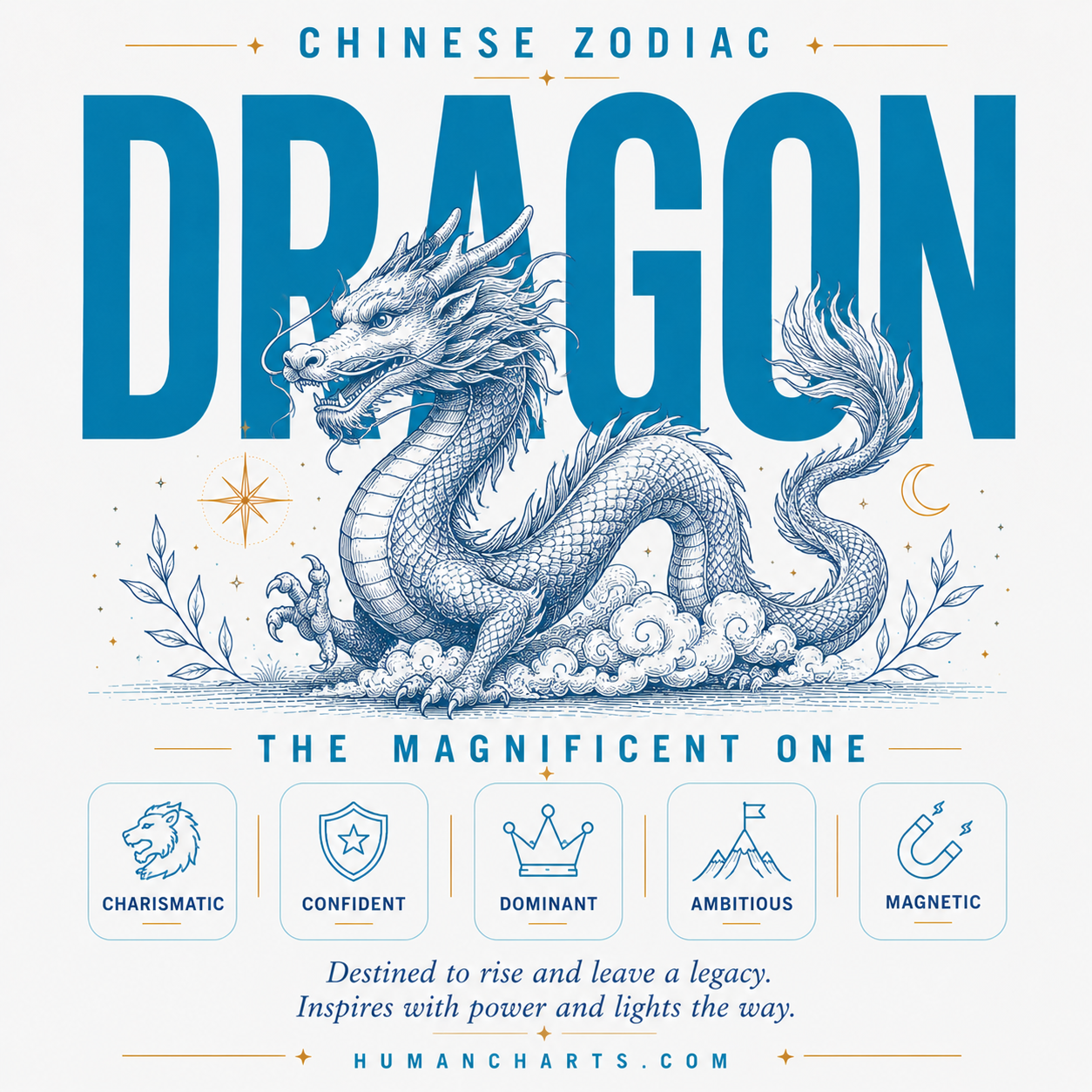
The Dragon Chinese Zodiac at a Glance
- The Animal: The Dragon — The Powerful One
- Years: 1928, 1940, 1952, 1964, 1976, 1988, 2000, 2012, 2024
- How It Works: Earth (fixed) · Yang · The Dragon · Envision, move, manifest
- Optimal Decision-Making: See the future · move toward it with full presence · attract what’s needed
- “Stay Humble” Is Wrong For You: Why the cultural advice misnames your instrument
- Five Elements: Wood · Fire · Earth · Metal · Water variations
- Strengths: Charismatic, ambitious, confident, magnetic, visionary
- Challenges: Arrogant, dominating, impatient, isolated by scale
- Career & Business: Founder, leader, performer, visionary builder, public figure
- Relationships: Need partners who can hold the scale — partners who shrink the vision are structurally exhausting
- Famous Dragons: John Lennon, Bruce Lee, Salvador Dalí, Rihanna, Maya Angelou
The Dragon Chinese Zodiac in Plain English
The Dragon is the Powerful One. Some people are wired to see what does not yet exist and move toward it as if it already does. They walk into a room and the room reorganizes around them. They imagine an outcome and the path to it begins to draw itself. When they commit to a vision, other people, resources, and opportunities arrive — not because the Dragon recruited them but because the Dragon’s presence made the future visible enough that others wanted to be part of it. The Dragon’s discipline is vision. The Dragon’s gift is magnetism.
Dragon is the Chinese Astrology label for that wiring. It is the fifth animal in the twelve-year zodiac cycle and the only mythological creature among the twelve — the others are all real animals. In Chinese cosmology, the Dragon (龙, lóng) is the most auspicious sign, associated with power, luck, imperial authority, and the capacity to bring rain, abundance, and structural change.
If you were born in a Dragon year (1928, 1940, 1952, 1964, 1976, 1988, 2000, 2012, 2024), here is what that usually looks like in practice:
- You see futures other people cannot see — and you move toward them whether or not anyone else believes them yet.
- You are visible by default. Even when you try to take up less space, you take up more space than the average person in the room.
- People are drawn to you. Some are drawn by the vision; some are drawn by the confidence; some are drawn by the size of the field you operate in. The pull is not something you have to manufacture.
- You struggle in environments that ask you to stay small, blend in, or wait for permission before moving toward what you can see.
- You become most yourself when you have a vision big enough to require everything you’ve got — and a position public enough that your presence is part of the work.
Listen to MATTEEN on the Dragon Chinese Zodiac — a mechanical breakdown of the fifth animal in the Chinese zodiac, how vision operates as the engine of the path, why visibility is not a side effect but a structural requirement, and how Dragon carriers learn to use their power without collapsing under cultural pressure to stay small.
Definition: The Dragon (龙, lóng) is the fifth animal in the twelve-year Chinese zodiac cycle and the only mythological creature among the twelve. Its fixed element is Earth, its polarity is Yang, and it is associated with power, luck, charisma, ambition, vision, and imperial authority. Dragon carriers operate through vision — the future they can see calls the decision into being. The Dragon’s decision-making instrument is the vision combined with full presence — what the Dragon imagines, the Dragon moves toward, and the resources arrive by attraction rather than by recruitment.
The Dragon is the fifth animal in the twelve-year Chinese zodiac cycle, following the Rabbit and preceding the Snake. In Chinese tradition, the Dragon (龙, lóng) is associated with power, luck, vision, imperial authority, and abundance. It is the most auspicious sign in the zodiac — the only mythological creature among the twelve, historically associated with the emperor and with the structural forces that bring rain and prosperity.
Before reading further — a synthesis note. Chinese Astrology is one of several systems that describe a full design. Your Western Astrology (Sun, Moon, Rising, and the rest of the placements), Human Design, and Numerology Life Path each add their own structural inputs. The patterns on this page describe what the Dragon brings — the core orientation around vision, charisma, and magnetic presence. How that orientation actually shows up in your career, your relationships, and your decisions is shaped by the synthesis of all the systems together, not by the Chinese Zodiac alone.
In Chinese cosmology, the twelve animals each represent a distinct developmental pattern. Where the Rabbit moves through diplomacy and the Snake operates through patience, the Dragon initiates through vision and presence. The Dragon is what calls a future into being by being visibly committed to it — and what gathers the people, resources, and conditions required for that future to actually arrive. The Dragon does not strategize toward the future the way the Snake does or persuade toward it the way the Rabbit does. The Dragon shows up as if the future is already real, and the world reorganizes around the assumption.
The mechanism of the Dragon is vision combined with presence. The engine runs on imagining what does not yet exist, moving toward it with full visibility, and trusting that what is needed will be drawn in by the gravity of the commitment. Where the Tiger acts on instinct and the Snake acts on strategy, the Dragon acts on vision. The shadow of the path is the cost of running such a large instrument inside a world that often punishes scale — the Dragon can be misread as arrogant, dismissed as unrealistic, or pressured by family and culture to stay smaller than the design is built to operate at.
Dragon Years. The Dragon years in the Chinese zodiac fall every 12 years: 1928, 1940, 1952, 1964, 1976, 1988, 2000, 2012, and 2024 are the most recent. The Chinese New Year shifts each year — typically late January or early February — so people born in January or early-to-mid February of a “Dragon year” may actually belong to the previous animal. If your birth date falls in January or early February of a Dragon year, check it against the specific Chinese New Year cutoff for that year.
Every Chinese zodiac animal is built from four structural components: its fixed element, its yin/yang polarity, its symbol, and its position in the twelve-year cycle. Here is how the Dragon is built.
- Symbol. The dragon — mythological, scaled, capable of flight, traditionally associated with the emperor, with rain, and with the structural forces of fortune and change.
- Fixed element. Earth. The Dragon’s underlying nature is grounded power — vision rooted in substance rather than fantasy, scale held by structural weight.
- Yin/Yang. Yang. Active, expressive, outward. The Dragon initiates and projects.
- Position in zodiac. Fifth of twelve — the position associated with the establishment of the full power of the cycle, the auspicious peak.
- Lucky colors. Gold, silver, hoary.
- Lucky numbers. 1, 6, 7.
The Dragon’s combination of Earth (substance, grounding) and Yang (outward expression, initiation) is the structural key. Yang by itself can be performative — Yang held inside Earth is power with weight. This is the Dragon’s signature: a vision that is not fantasy because the carrier carries enough substance to make the vision actually arrive. The visibility is not vanity — it is the work. When the Dragon is visible, the people, resources, and opportunities required for the vision can find their way in.
Mechanically, the Dragon operates in three phases: envision the future, move toward it with full presence, and manifest by attracting what’s needed. The vision phase sees a future that does not yet exist — clearly, in detail, and with conviction. The presence phase commits to that future visibly, walking toward it as if it is already real. The manifestation phase is the gravity that the visible commitment generates — people, resources, alliances, opportunities arrive because the Dragon’s presence has made the future feel inevitable. The Dragon does not recruit. The Dragon makes the vision real enough that the world walks into it.
Everything in life is a function of decision-making. Every life unfolds through the decisions made within it. For the Dragon Chinese Zodiac, the decision-making instrument is vision combined with full presence. The Dragon decides through what it can build, what it can imagine, what doesn’t exist yet but should. The future the Dragon can see calls the decision into being. The discipline is to trust the vision when it arrives, to move toward it visibly, and to refuse to scale the vision down to match the room’s comfort with smaller futures.
Most cultures treat decision-making as a calculation among existing options. The Dragon is built differently. For the Dragon, the options that already exist are usually too small. The body and the imagination collaborate to generate a future option that the present cannot see — and the decision is structurally between living toward that future option or accepting a smaller one. By the time the Dragon recognizes the vision, the decision has already begun making itself.
How to make decisions well with this instrument:
- Trust the vision when it arrives. When you find yourself seeing a future no one else can see yet, do not interpret it as grandiosity. For your design, the vision is the data. The imagination is the instrument. The future you can see is the option your body has generated for you to choose. Take it seriously the first time, not the third time.
- Move toward the vision with full presence. The Dragon’s vision does not arrive by stealth. It requires visible commitment — the public statement, the resource allocation, the structural move. Partial commitment to a Dragon-sized vision produces no manifestation. The vision is a function of the presence behind it.
- Refuse to shrink the vision to fit the room. The cultural pressure to “be realistic” or “stay humble” or “don’t get ahead of yourself” is structurally wrong for you. Shrinking the vision to match other people’s comfort produces decisions your design would never have endorsed. The cost compounds across years of unused capacity.
- Trust the manifestation timeline. The Dragon’s vision arrives ahead of the resources required to fulfill it. The discipline is to commit before the resources are visible — because the commitment is what calls them in. Waiting for the resources to arrive before committing reverses the mechanism and produces nothing.
Everyday decisions and major decisions operate on the same instrument; only the scale differs. Small decisions train the Dragon to listen for the vision in low-stakes contexts. Major decisions — career, partnership, the structural commitments that shape a life — require the Dragon to trust the vision when the cost of being wrong feels significant and the cultural pressure to stay safe is loudest. The Dragon who tries to make major decisions on the basis of what already exists will choose options too small for the design and spend decades quietly resentful of a life that fits. The Dragon who respects the actual mechanism — vision first, presence second, manifestation by attraction — builds lives that other people experience as luck.
The discipline is not arrogance for arrogance’s sake. The discipline is honoring the actual rhythm of how the instrument works.
The phrase “stay humble” gets used universally — as if visibility is always vanity and as if smaller is always more virtuous. For you, it is wrong advice. Your instrument is the vision, and your visibility is the apparatus that turns the vision into manifestation. What looks like “getting ahead of yourself” from the outside is the actual work your design is built to do.
The cultural advice to “stay humble” or “don’t get ahead of yourself” or “stay in your lane” generally describes a different decision-making instrument — the smaller-scale, more incremental, more consensus-shaped instrument that some other animals operate on. For those carriers, the advice is correct. For you, the instrument is different. The Dragon’s vision does not arrive in measured increments. It arrives at scale, ahead of the resources, and the commitment to the vision is what calls the resources in. Suppressing the visibility to fit cultural humility norms produces a Dragon whose visionary capacity never gets used.
When other people say “stay humble,” they may be operating from a smaller-scale instrument, or they may simply be uncomfortable with the size of the future your design is showing you. Either way, the advice misnames your work. The visibility is not vanity. The scale is not grandiosity. They are the structural mechanism your decision-making runs on. The Dragon who collapses the vision to be palatable is not being virtuous — the Dragon is structurally refusing to use the instrument the design provided.
For you, trust the vision. Move toward it with full presence. Refuse the cultural pressure to be smaller than the future you can actually see.
Chinese Astrology pairs each animal’s fixed element with a year-specific element from the Five Elements system (Wood, Fire, Earth, Metal, Water) on a 60-year master cycle. This means every Dragon is not just a Dragon — they are a Wood Dragon, Fire Dragon, Earth Dragon, Metal Dragon, or Water Dragon depending on which year inside the 60-year cycle they were born. The fixed Earth element gives the Dragon its core nature; the year-specific element shades how that core is expressed.
- Wood Dragon (1904, 1964) — more creative, expansive, and growth-oriented. Wood softens the Dragon’s authority and produces a more generative, idea-driven version of the path.
- Fire Dragon (1916, 1976) — the most dramatic, charismatic, and theatrical of the Dragon variations. Fire intensifies the Dragon’s presence and produces operators with unmistakable magnetism.
- Earth Dragon (1928, 1988) — the double-earth combination. More grounded, practical, and durable. Earth on Earth produces the most structurally weighty of the Dragon variations — vision rooted in substance, ambition with patience.
- Metal Dragon (1940, 2000) — more disciplined, principled, and uncompromising. Metal sharpens the Dragon’s edge and produces the most authoritative of the variations.
- Water Dragon (1952, 2012) — more strategic, perceptive, and emotionally intelligent. Water deepens the Dragon’s vision and produces operators who read the larger field with unusual clarity.
When you read about a Dragon’s traits, the fixed Earth-Yang nature is the foundation. The year-specific element is the modifier. A 1976 Fire Dragon will read differently than a 2000 Metal Dragon even though both share the underlying mechanism.
The Dragon carries a consistent set of themes that show up across a carrier’s lifetime, regardless of upbringing, culture, or career. These are the structural traits the sign is built from.
- Charisma. A built-in magnetism. The carrier walks into a room and the room reorganizes around them, with or without the carrier’s permission.
- Vision. A capacity to see futures that do not yet exist and to hold them clearly enough that other people can begin to see them too.
- Ambition. A native drive toward scale — bigger projects, bigger structures, bigger lives. The Dragon does not naturally aim small.
- Confidence. A baseline assumption that the future the carrier can see is achievable. This is the substrate underneath the visible presence.
- Luck. Chinese tradition treats the Dragon as the luckiest sign — and there is a structural mechanism to the luck. The Dragon’s visible commitment to a vision attracts the conditions for the vision to arrive. What looks like luck is the manifestation phase working.
- Magnanimity. A natural generosity at scale. When the Dragon wins, the Dragon distributes — and the distribution itself is part of the design’s coherence.
- Dominance. A capacity to take charge that arrives whether or not the role formally calls for it. Other people often defer to the Dragon by default.
- Magnetism. People, resources, and opportunities arrive without the carrier having to recruit them. The presence does the gathering.
- Visionary capacity. A long-arc imagination — the Dragon sees not the next quarter but the next decade, not the next move but the structural endpoint.
Dragon carriers are designed to:
- See futures that do not yet exist and commit to them visibly enough that other people can join
- Lead, found, and initiate structures other people then operate inside
- Attract the people, resources, and opportunities required for large visions without exhausting themselves recruiting
- Hold scale — projects, organizations, public positions — without flinching at the visibility the scale requires
- Distribute power, resources, and recognition generously when the structure they built is producing returns
Strong work shows up where vision and presence matter. Founders use the path’s vision to build companies that other people then come to work inside. Artists and performers use the path’s magnetism to hold audiences across decades. Public figures, leaders, and movement-builders use the path’s visibility to make futures feel inevitable enough that other people commit to them. The Dragon is not built for invisible, back-of-house, incremental work — it is built for situations where the carrier’s specific vision and visible presence are the engine.
When this path is operating cleanly, Dragon carriers do not need to perform their power. The work itself transmits it — the company that exists because the founder said it would, the body of art that exists because the artist committed to it years before the audience could see it, the institution that exists because the Dragon held the vision long enough for the structure to form. People around the carrier often experience the carrier as larger than the carrier feels — and that gap is structurally correct. The Dragon’s presence is part of the work; the work is not separate from the Dragon’s visibility. The trap of the path is that this scale is real and easy to suppress under cultural pressure, so carriers who collapse the vision to fit cultural humility norms can spend decades operating at a fraction of the design’s capacity.
The shadow of the Dragon is the predictable distortion that appears when the path’s mechanics are overdriven. Common patterns:
- Confidence hardens into arrogance. The vision that draws other people in becomes the certainty that talks over them.
- Vision becomes fantasy. The capacity to see what does not yet exist drifts away from the substance required to manifest it. The future stays imaginary.
- Ambition becomes overreach. The drive toward scale stops being calibrated by what the body can actually carry, and the Dragon takes on commitments that collapse under their own weight.
- Charisma becomes domination. The magnetism that gathers people becomes the pull that doesn’t let them leave or disagree.
- Magnanimity becomes paternalism. The native generosity becomes the assumption that the carrier knows what everyone else needs.
- Dominance becomes isolation. The default deference other people show the Dragon means the carrier rarely gets real pushback — and slowly the carrier loses the relationships that would have corrected the course.
- Impatience. The Dragon’s natural speed at scale produces irritation with anyone moving at a normal human pace. Partners, employees, and family members feel rushed.
- The “stay humble” wound. Many Dragons spend their early decades absorbing cultural pressure to be smaller than they are, and the cost is a quiet resentment, a recurring sense of being “too much,” and a chronic underuse of the design’s actual capacity.
The repair pattern is not to suppress the path’s mechanics. The vision is correct. The repair is in noticing when confidence has become arrogance, when ambition has become overreach, and when dominance has become a barrier to honest feedback. The earlier in life this discernment develops, the more the path compounds into structures, bodies of work, and public positions that the Dragon’s scale was structurally built to produce. The later it develops, the more the carrier spends decades powerful, visible, and quietly disconnected from the people the design was built to gather.
Dragon carriers are designed to:
- Distinguish between vision rooted in substance and fantasy dressed up as vision
- Hold scale without losing the relationships that would have corrected the course
- Use the natural magnetism to gather rather than to dominate
- Recognize when “stay humble” has been internalized as a structural limit, and choose visibility deliberately
The Dragon is built for work that has a visionary, leadership, or public layer. The path tends to perform at its peak when the carrier is operating in fields that reward scale, visible commitment, and the capacity to make a future feel inevitable. It tends to perform poorly in low-visibility, narrowly bounded tactical roles where the path’s vision has to be suppressed and the magnetism cannot show through. The actual career format depends on the synthesis with the rest of the chart — the careers below are where the Dragon’s mechanism is most directly engaged, not the only places it shows up. Many Dragon carriers do their visionary work inside roles that are not officially visionary: as the leader whose presence shapes the team’s possibility, the parent whose ambition for the family becomes the family’s actual trajectory, the friend whose vision for someone else’s life turns out to have been more accurate than that person’s own. The mechanism is the same; the format varies.
Careers where the Dragon’s mechanism is most directly engaged include:
- Founder, entrepreneur, CEO, organizational leader
- Performer, actor, musician, artist working at public scale
- Political leader, public figure, movement-builder
- Visionary builder, architect of large structures, real-estate developer
- Filmmaker, director, producer of large-scale creative work
- Investor or capital allocator operating at the venture or structural level
- Athlete, especially in sports requiring presence and dominant performance
- Public intellectual, author, speaker whose body of work reorganizes a field
- Creative director, brand-founder, designer working at the level of taste-making
Misaligned environments include narrowly bounded administrative work with no room for vision, cultures that punish visibility and reward blending in, roles that require constant deference to consensus, and any environment that treats the Dragon’s scale and presence as problems to be managed rather than as the actual capacity the role requires.
In careers, Dragon carriers are designed to:
- Build structures, companies, or bodies of work big enough to require the design’s actual scale
- Take visibility deliberately — recognize that public presence is part of the work, not a side effect of it
- Distinguish between vision rooted in substance and fantasy dressed up as vision
- Keep relationships in the inner circle that can disagree with the Dragon honestly, because the natural deference will not produce honest pushback on its own
In close relationships, the Dragon tends to show up as a partner who brings vision, magnetism, scale, and a structural need for the partner to hold the size of the path without trying to shrink it. The carrier often loves at the same scale they operate at — generously, visibly, and with full presence. How this plays out in any specific relationship depends on the rest of the chart — but the core Dragon pattern of large-hearted, large-visioned love combined with a tendency to dominate is consistent across carriers.
Common challenges include taking up most of the room without realizing it (and the partner experiences this as being eclipsed), moving toward visions the partner cannot yet see and assuming the partner will catch up (which sometimes happens and sometimes does not), impatience with the partner’s slower or more cautious processing, the unintentional dismissal of the partner’s smaller-scale concerns (“that’s not the point”) when those concerns are actually the relational substance, and the structural difficulty of letting the partner correct the Dragon’s course — the default deference other people offer the Dragon does not automatically translate into the kind of honest, intimate pushback a partnership requires.
The release in relationships is the discipline of taking up exactly the right amount of room — not less, but also not more than the relationship can hold. The carrier learns to bring the vision into the partnership as a shared field rather than as a unilateral declaration, to slow down to the partner’s pace without resenting the slowing, and to actively invite the kind of disagreement that the carrier’s natural authority can otherwise foreclose. Healthy Dragon partnerships involve a carrier who has practiced gathering rather than dominating, and a partner who can hold the scale of the path without trying to shrink it.
Dragon carriers are designed to:
- Choose partners who can hold the size of the vision without feeling threatened by it or asking the carrier to make it smaller
- Practice taking up the right amount of room — neither collapsing to make the partner comfortable nor expanding to fill the partnership entirely
- Distinguish between vision shared and vision imposed
- Recognize that the natural deference other people show the Dragon will not produce honest pushback on its own — and actively invite the partner’s disagreement
The pattern is consistent across fields: a body of work or a public life built on vision, magnetic presence, and scale other paths did not have. Below are 14 well-documented Dragon figures across politics, science, art, music, film, and literature — each verified against the Chinese New Year cutoffs for their birth years.
A Direct Transmission from MATTEEN
“Everything in your life is a function of decision-making. Every life unfolds through the decisions made within it. The Dragon’s decision-making instrument is the vision — what you can see, what doesn’t exist yet but should, what the future is asking you to build. The mistake is thinking the vision is grandiosity. The vision IS the data. Most Dragon carriers spend a decade learning to stop apologizing for what they can see. The harder discipline is moving toward the vision with full presence even when the room is asking you to be smaller — most Dragons collapse the vision one beat too early because the cultural pressure to stay humble is louder than the design. See the future. Move toward it with everything you’ve got. The resources arrive because you arrived first.”
— Matteen Terrany
Frequently Asked Questions About the Dragon Chinese Zodiac
Unlock Your Full Chinese Zodiac
Your Chinese zodiac animal is one structural layer of your design. Your Western Astrology, Human Design, and Numerology Life Path add the rest. Calculate your full reading and start working with it.
Want to learn about the other Chinese zodiac animals? See the complete guide to all 12 animals →
The vision is the data. The presence is the work.