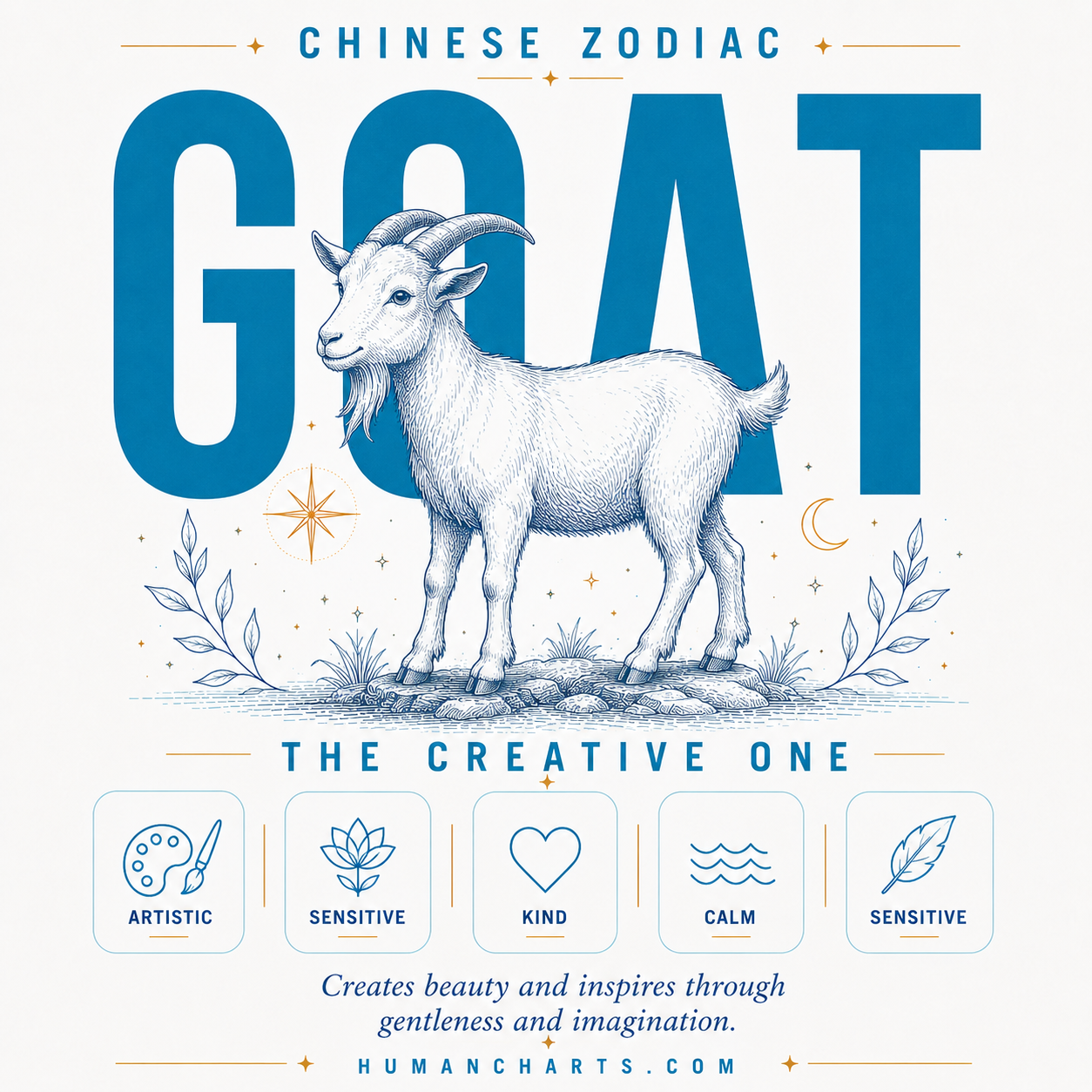
The Goat Chinese Zodiac at a Glance
- The Animal: The Goat (also Sheep, Ram) — The Artistic One
- Years: 1931, 1943, 1955, 1967, 1979, 1991, 2003, 2015, 2027
- How It Works: Earth (fixed) · Yin · The Goat/Sheep · Sit, feel, resonate
- Optimal Decision-Making: Sit with the options · feel which one resonates · let it become real
- “Make Up Your Mind” Is Wrong For You: Why the cultural advice misnames your instrument
- Five Elements: Wood · Fire · Earth · Metal · Water variations
- Strengths: Artistic, sensitive, kind, empathetic, creative
- Challenges: Indecisive, dependent, dreamy to the point of avoidance, prone to retreat
- Career & Business: Artist, designer, musician, therapist, craftsperson, curator
- Relationships: Need partners who can hold sensitivity — environments that punish softness are structurally costly
- Famous Goats: Mick Jagger, Steve Jobs, Julia Roberts, Michelangelo
The Goat Chinese Zodiac in Plain English
The Goat is the Artistic One. Some people are wired to perceive the world through beauty, feeling, and emotional resonance. They notice the texture of a fabric, the tone in a voice, the mood of a room, the quality of light. They make decisions not by argument but by what feels right at the level of taste and care. When the Goat says yes to something, the body said yes first; when the Goat hesitates, the body is registering something the analytical mind has not yet named.
Goat is the Chinese Astrology label for that wiring. It is the eighth animal in the twelve-year zodiac cycle and one of the most aesthetically attuned, gentle, and emotionally perceptive of the twelve. The Goat (羊, yáng) is also commonly called Sheep or Ram in English translations — the Chinese character covers all three, and you will see the sign rendered as Goat, Sheep, or Ram depending on the source. They all describe the same animal.
If you were born in a Goat year (1931, 1943, 1955, 1967, 1979, 1991, 2003, 2015, 2027), here is what that usually looks like in practice:
- You perceive aesthetic and emotional information at a higher resolution than most people. You can tell when something is off in a room before anyone has said anything.
- You make decisions slowly because you are waiting for the inner resonance — the felt sense that a thing is right. Forcing the decision before it arrives produces moves you later regret.
- You have a strong creative or artistic pull, even if your job is not officially artistic. Beauty matters to you structurally.
- You struggle in environments that punish sensitivity, demand fast directive decisions, or treat your slowness as a problem to fix.
- You become most yourself when you have a creative outlet, a kind environment, and partners or collaborators who respect that your instrument needs time to settle.
Listen to MATTEEN on the Goat Chinese Zodiac — a mechanical breakdown of the eighth animal in the Chinese zodiac, how resonance operates as the engine of the path, why aesthetic perception is structural intelligence and not soft preference, and how Goat carriers learn to trust the felt sense without disappearing into indecision.
Definition: The Goat (羊, yáng), also called the Sheep or Ram, is the eighth animal in the twelve-year Chinese zodiac cycle. Its fixed element is Earth, its polarity is Yin, and it is associated with artistry, sensitivity, kindness, creativity, and emotional perception. Goat carriers operate through aesthetic and emotional resonance — sitting with the available options until the body registers which one feels right at the level of taste, care, and inner harmony. The Goat’s decision-making instrument is the felt sense of resonance, and the discipline is honoring that instrument rather than forcing a directive choice the inner apparatus has not confirmed.
The Goat is the eighth animal in the twelve-year Chinese zodiac cycle, following the Horse and preceding the Monkey. In Chinese tradition, the Goat (羊, yáng) is associated with artistry, gentleness, kindness, sensitivity, and harmony with beauty. The character 羊 in classical Chinese covers goat, sheep, and ram — which is why in English-language sources the sign is rendered three different ways. They are the same animal. On this page, Goat is used as the primary label, but Sheep and Ram refer to the same sign.
Before reading further — a synthesis note. Chinese Astrology is one of several systems that describe a full design. Your Western Astrology (Sun, Moon, Rising, and the rest of the placements), Human Design, and Numerology Life Path each add their own structural inputs. The patterns on this page describe what the Goat brings — the core orientation around artistic sensitivity, emotional resonance, and gentle harmony. How that orientation actually shows up in your career, your relationships, and your decisions is shaped by the synthesis of all the systems together, not by the Chinese Zodiac alone.
In Chinese cosmology, the twelve animals each represent a distinct developmental pattern. Where the Horse moves with speed and the Monkey moves with clever improvisation, the Goat operates through aesthetic perception, emotional resonance, and the patient cultivation of beauty, kindness, and inner harmony. The Goat is what brings softness into the structure — what notices the texture, the mood, the quality of care — and what produces work that other people experience as nourishing.
The mechanism of the Goat is resonance combined with creativity. The engine runs on feeling, perceiving, and waiting for the option that aligns with the inner instrument. Where the Tiger acts on instinct and the Ox acts on duty, the Goat acts on what feels right. The shadow of the path is the cost of running an unusually sensitive and aesthetically attuned instrument inside a world that often rewards speed, decisiveness, and emotional armor — the Goat can be misread as indecisive, dependent, or weak when in fact the carrier is operating on a decision-making mechanism most cultures do not recognize as a mechanism at all.
Goat Years. The Goat years in the Chinese zodiac fall every 12 years: 1931, 1943, 1955, 1967, 1979, 1991, 2003, 2015, and 2027 are the most recent and upcoming. The Chinese New Year shifts each year — typically late January or early February — so people born in January or early-to-mid February of a “Goat year” may actually belong to the previous animal. If your birth date falls in January or early February of a Goat year, check it against the specific Chinese New Year cutoff for that year.
Every Chinese zodiac animal is built from four structural components: its fixed element, its yin/yang polarity, its symbol, and its position in the twelve-year cycle. Here is how the Goat is built.
- Symbol. The goat or sheep — gentle, sensitive, drawn to nourishing terrain, attuned to the quality of the field it grazes.
- Fixed element. Earth. The Goat’s underlying nature is grounded receptivity — the soft soil that holds, absorbs, and shapes what grows.
- Yin/Yang. Yin. Receptive, internal, feeling. The Goat takes in before it produces.
- Position in zodiac. Eighth of twelve — past the midpoint, into the integration phase of the cycle, where harmony and refinement become primary.
- Lucky colors. Brown, red, purple.
- Lucky numbers. 3, 9.
The Goat’s combination of Earth (grounded receptivity, holding capacity) and Yin (interiority, feeling, integration) is the structural key. Earth by itself is steady and practical; Earth held under Yin produces a steadiness that is also porous — a capacity to absorb the emotional and aesthetic texture of the environment and to integrate it into work that is gentle, beautiful, and deeply felt. This is the Goat’s signature: sensitivity grounded by earth, expressed as art and care.
Mechanically, the Goat operates in three phases: sit, feel, resonate. The sitting phase lays out the available options — relationships, projects, choices — without forcing a verdict. The feeling phase lets the body register each option’s emotional and aesthetic resonance, comparing the felt sense rather than the argued case. The resonance phase recognizes which option the inner instrument confirms, and the carrier moves into it. The choice is the option that resonates. The discipline is letting the resonance arrive rather than overriding the instrument with a directive verdict.
Everything in life is a function of decision-making. Every life unfolds through the decisions made within it. For the Goat Chinese Zodiac, the decision-making instrument is aesthetic and emotional resonance — what feels right at the level of taste, care, and inner harmony. The body responds to beauty, kindness, and rightness; the decision is the option that the body registers as resonant. The discipline is to honor the resonance when it arrives and to refuse the cultural pressure to manufacture a decision before the inner instrument has produced one.
Most cultures treat decision-making as a directive act — the moment the will chooses. The Goat is built differently. For the Goat, the will is not the decision-maker. The will executes after the resonance has done its work. The body perceives, the felt sense compares, the inner instrument lands on the option that aligns — and the will moves the carrier into the choice. By the time the choice is made, the decision has already been made by the resonance — the act of choosing is just the recognition.
How to make decisions well with this instrument:
- Sit with all options without forcing a verdict. When facing a choice, lay the options out in your environment — not in your head. Let them exist side by side. For your design, the sitting is structurally productive. The body needs time to register each option’s resonance. Rushing this phase produces choices the inner instrument never confirmed.
- Compare the felt sense, not the argument. Two options can look equally good on paper and feel completely different. Trust the felt difference. The argument is downstream of the resonance — the resonance is the primary data. When a choice “makes sense” but feels off, the off-ness is the signal.
- Recognize the signal that resonance has arrived. Clarity announces itself as a settling — the body relaxes around one option, the others quietly fall away, and the carrier moves toward the choice without internal friction. When that settling has happened, decide. Do not wait further for a louder signal; the signal is already there.
- Refuse to decide before the resonance has arrived. The cultural pressure to “make up your mind” or “just pick something” is structurally wrong for you. Deciding before the resonance produces choices the body never confirmed — and the body then spends months or years quietly registering that the choice was off. The cost compounds.
Everyday decisions and major decisions operate on the same instrument; only the timescale differs. Small decisions train the instrument across days — what to eat, what to wear, which room to work in, which conversation to enter. Major decisions — career, partnership, structural commitments — can require weeks or months of sitting before the resonance lands. The Goat who tries to make major decisions on the timescale other animals operate at will override the instrument and produce moves the inner apparatus would not have endorsed. The Goat who respects the natural timescale produces a life of unusual aesthetic and emotional coherence — a life where the work, the relationships, and the environment all carry the signature of an instrument that was honored.
The discipline is not indecision for indecision’s sake. The discipline is honoring the actual rhythm of how the instrument works.
The phrase “make up your mind” gets used universally — as if everyone’s decision-making instrument runs the same way and as if the failure to produce a fast directive verdict is always a problem. For you, it is wrong advice. Your instrument is resonance, and resonance cannot be willed into existence. What looks like indecision from the outside is the actual work your design is built to do: sitting with the options, letting the body register each one, waiting for the felt sense of rightness to land.
The cultural advice to “make up your mind” or “stop being so indecisive” or “just decide already” generally describes a different decision-making instrument — the directive in-the-moment verdict that some other animals (and some Human Design authorities) are built to operate on. For those carriers, the advice is correct. For you, the instrument is different. The decision does not arrive by directive choice. It arrives by resonance, across the time the inner instrument requires. Pressuring the Goat to “decide already” produces decisions the inner instrument never confirmed — and the body then registers, quietly, for years, that the choice was off.
When other people say “make up your mind,” they may be operating from a faster instrument, or they may simply be uncomfortable with the rhythm your design requires. Either way, the advice misnames your work. The sitting is not indecision. The feeling is not weakness. The wait for resonance is not avoidance. They are the structural mechanism your decision-making runs on.
For you, trust the resonance. Choose when the felt sense settles. Refuse the cultural pressure to manufacture a decision before the inner instrument has produced one.
Chinese Astrology pairs each animal’s fixed element with a year-specific element from the Five Elements system (Wood, Fire, Earth, Metal, Water) on a 60-year master cycle. This means every Goat is not just a Goat — they are a Wood Goat, Fire Goat, Earth Goat, Metal Goat, or Water Goat depending on which year inside the 60-year cycle they were born. The fixed Earth element gives the Goat its core nature; the year-specific element shades how that core is expressed.
- Wood Goat (1955, 2015) — more creative, expansive, and outwardly engaged. Wood lifts the Goat’s sensitivity into visible artistic production and produces the most generative of the variations.
- Fire Goat (1907, 1967) — more dramatic, passionate, and emotionally expressive. Fire warms the Goat’s interior and produces a carrier whose feeling shows on the surface rather than staying contained.
- Earth Goat (1919, 1979) — the double-earth combination. More grounded, practical, and steady. Earth on Earth produces the most stable of the Goat variations — a carrier who roots the sensitivity into durable form.
- Metal Goat (1931, 1991) — more disciplined, refined, and structured. Metal sharpens the Goat’s aesthetic into precision and produces the most formally elegant of the variations.
- Water Goat (1943, 2003) — more intuitive, philosophical, and deeply feeling. Water deepens the Goat’s interior and produces the most emotionally resonant of the variations.
When you read about a Goat’s traits, the fixed Earth-Yin nature is the foundation. The year-specific element is the modifier. A 1955 Wood Goat will read differently than a 1979 Earth Goat even though both share the underlying mechanism.
The Goat carries a consistent set of themes that show up across a carrier’s lifetime, regardless of upbringing, culture, or career. These are the structural traits the sign is built from.
- Artistic perception. A built-in capacity to perceive aesthetic information — color, texture, form, sound, composition — at a resolution other paths do not match. The Goat sees beauty as data.
- Sensitivity. A high-resolution emotional register. The carrier feels the room, the partner, the project at a depth that can be overwhelming if the environment does not respect it.
- Kindness. A native orientation toward gentleness, care, and harm-reduction. The Goat does not just behave kindly — kindness is structural to the path.
- Creativity. A persistent urge to make — art, music, design, food, environment, atmosphere. The Goat is one of the most creatively wired signs in the Chinese zodiac.
- Empathy. A capacity to feel into another person’s experience and meet them there. The Goat is often the one others come to when they need to be received.
- Dreaminess. A natural interiority — a tendency to drift into imagination, possibility, and inner worlds. The dreaming is generative, but it can also become escape.
- Calm presence. A quality of being that other people find soothing. The Goat’s gentleness is a structural resource for the environments it inhabits.
- Indecision. A characteristic slowness around directive choices. From the inside, it is resonance-waiting; from the outside, it can look like an inability to land.
- Dependence. A tendency to lean on trusted others for the directive verdict the Goat is reluctant to produce alone. The leaning can be wisdom (using collaborators well) or pattern (outsourcing decisions that the Goat needs to make).
Goat carriers are designed to:
- Perceive aesthetic and emotional information that other paths miss entirely
- Produce work — artistic, creative, caring — that other people experience as nourishing and beautiful
- Create environments, atmospheres, and relational fields where other people can soften and recover
- Hold the emotional reality of a partner, a team, or a family with a precision other signs do not match
- Build a life of unusual aesthetic coherence — where the home, the work, the wardrobe, and the relationships all carry the same signature
Strong work shows up where beauty, feeling, and care are the value. Artists, designers, musicians, writers, and craftspeople use the path’s aesthetic perception to make work that other people return to across years. Therapists, counselors, and caregivers use the empathy to receive what other paths cannot hold. Curators, stylists, and environment-builders use the path’s taste to shape spaces that other people experience as alive. The Goat is not built for high-volume tactical work where the path’s sensitivity has to be suppressed and the aesthetic intelligence cannot show — it is built for situations where the carrier’s specific perceptual depth and care are the asset.
When this path is operating cleanly, Goat carriers do not need to perform their sensitivity. The work itself transmits it — the room that feels right, the song that lands, the meal that nourishes, the response that meets the partner exactly where the partner is. People around the carrier often describe being in the Goat’s presence as a kind of softening — and that softening is structural, not stylistic. The trap of the path is that this gentleness is real and easy for the world to take advantage of, so Goat carriers who never learn to protect the instrument can spend decades giving care that no one returns, producing beauty no one credits, and absorbing emotional weight no one helps them release.
The shadow of the Goat is the predictable distortion that appears when the path’s mechanics are overdriven or unprotected. Common patterns:
- Indecision hardens into paralysis. The resonance-waiting that produces aligned choices becomes an inability to choose anything at all. The body never confirms; the life never moves.
- Sensitivity becomes overwhelm. The high-resolution feeling that nourishes becomes the wide-open register that absorbs every mood in the room until the carrier collapses.
- Dependence becomes pattern. The wise use of trusted collaborators becomes a habit of outsourcing decisions the Goat needs to make alone. The will atrophies.
- Dreaming becomes escape. The generative interior becomes a refuge the carrier never returns from. The work that the dreaming was supposed to seed never gets made.
- Kindness becomes self-erasure. The native gentleness becomes a structural inability to say no, set boundaries, or hold a position that disappoints another person.
- Aesthetic refinement becomes precious. What was care for the quality of the environment becomes a fragility that cannot tolerate anything rough or unfinished.
- Empathy becomes absorption. What was the capacity to receive another person’s experience becomes the inability to distinguish their feelings from the carrier’s own.
- Retreat becomes withdrawal. What was healthy interiority becomes a long-term move away from the world that the Goat’s work was built to nourish.
The repair pattern is not to suppress the path’s mechanics. The sensitivity is correct. The resonance-based decision-making is correct. The repair is in noticing when sensitivity has become overwhelm, when dependence has become avoidance, and when dreaming has become escape. The earlier in life this discernment develops, the more the path compounds into bodies of work, partnerships, and environments that the Goat’s gentleness was structurally built to produce. The later it develops, the more the carrier spends decades giving care that the world consumes without crediting, while the carrier’s own decisions never quite land.
Goat carriers are designed to:
- Distinguish between honoring the resonance and avoiding the choice altogether
- Protect the instrument from environments that drain the sensitivity faster than the carrier can replenish it
- Use trusted collaborators for input without outsourcing the final yes
- Recognize when kindness has become self-erasure and when retreat has become withdrawal
The Goat is built for work that has an aesthetic, creative, or caring layer. The path tends to perform at its peak when the carrier is operating in fields that reward perception, taste, sensitivity, and the patient cultivation of beauty or care. It tends to perform poorly in high-volume, high-pressure tactical work where the path’s depth has to be suppressed and the carrier is asked to produce directive decisions at a rhythm faster than the inner instrument can support. The actual career format depends on the synthesis with the rest of the chart — the careers below are where the Goat’s mechanism is most directly engaged, not the only places it shows up. Many Goat carriers do their aesthetic and emotional work quietly inside roles that are not officially artistic: as the colleague whose taste shapes every shared environment, the manager whose team feels safe because of how they hold the room, the parent whose home is the place everyone wants to be. The mechanism is the same; the format varies.
Careers where the Goat’s mechanism is most directly engaged include:
- Artist, painter, sculptor, illustrator, fine artist
- Designer — interior, fashion, graphic, product, environmental
- Musician, composer, songwriter, vocalist
- Writer, especially of work where atmosphere and feeling carry the meaning
- Craftsperson, ceramicist, textile artist, woodworker
- Therapist, counselor, social worker, caregiver
- Curator, gallerist, stylist, art director
- Chef, food stylist, hospitality designer
- Florist, garden designer, landscape architect
- Brand stewards, creative directors, atmosphere-builders inside larger ventures
Misaligned environments include high-volume tactical sales, cultures that punish sensitivity and reward emotional armor, roles that require constant fast directive decisions with no time for the resonance to settle, and any environment that treats the Goat’s slowness or softness as a problem to be solved.
In careers, Goat carriers are designed to:
- Build a body of work or a body of care that the carrier’s aesthetic and emotional intelligence is the asset of, not a problem inside
- Negotiate for the time the instrument actually requires — the Goat produces best output on its own clock
- Distinguish between resonance-based pacing that produces aligned work and avoidance dressed up as sensitivity
- Protect the instrument from environments that drain it faster than the carrier can replenish
In close relationships, the Goat tends to show up as a partner who brings unusual emotional perception, aesthetic care for the shared environment, and a structural need for the partner to respect both the sensitivity and the slowness of the decision-making instrument. The carrier reads the partner at a high resolution and often knows what the partner is feeling before the partner has named it. How this plays out in any specific relationship depends on the rest of the chart — but the core Goat pattern of empathic attunement combined with resonance-based pacing shows up consistently across carriers.
Common challenges include difficulty saying no to a partner who wants something the Goat is reluctant to refuse (the kindness can outrun the will), absorbing the partner’s emotional state to the point where the carrier loses track of their own, outsourcing directive decisions to the partner and then quietly resenting the choices, withdrawing into the interior when the partnership requires real-time presence the Goat cannot summon, and a tendency to drift into fantasy versions of the partner that the actual partner cannot live up to. The dreaming, when it does not return to the actual relationship, becomes its own form of absence.
The release in relationships is the discipline of honoring the instrument while still showing up as a full participant. The carrier learns to say no when no is the resonance, to hold the partner’s emotional weight without absorbing it as their own identity, to wait for the inner yes on major decisions without making the wait the partner’s responsibility, and to bring the dreamed-of beauty back into the actual shared life rather than leaving it in the interior. Healthy Goat partnerships involve a carrier who has practiced trusting the resonance without disappearing into it, and a partner who can hold the gentleness without exploiting it.
Goat carriers are designed to:
- Choose partners who respect the resonance-based pacing without trying to override it
- Practice protecting the instrument — the empathy is a gift, not an obligation to absorb everything
- Distinguish between kindness that serves the relationship and self-erasure dressed up as kindness
- Bring the dreamed-of beauty into the actual shared environment, not just the interior
The pattern is consistent across fields: a body of work or a public life built on aesthetic perception, emotional attunement, and a creative or caring intelligence other paths did not have. Below are 13 well-documented Goat figures across art, music, film, technology, and culture — each verified against the Chinese New Year cutoffs for their birth years.
A Direct Transmission from MATTEEN
“Everything in your life is a function of decision-making. Every life unfolds through the decisions made within it. The Goat’s decision-making instrument is resonance — the body’s felt sense of which option is right at the level of taste, care, and inner harmony. The mistake is thinking the slowness is a problem. The slowness is the instrument. Most Goat carriers spend a decade apologizing for the time it takes them to know. The harder discipline is refusing to apologize and refusing to manufacture a decision the inner apparatus has not produced. Sit with the options. Feel which one resonates. Let it become real. The resonance cannot be rushed, and a life built on rushed choices is a life the body never confirmed.”
— Matteen Terrany
Frequently Asked Questions About the Goat Chinese Zodiac
Unlock Your Full Chinese Zodiac
Your Chinese zodiac animal is one structural layer of your design. Your Western Astrology, Human Design, and Numerology Life Path add the rest. Calculate your full reading and start working with it.
Want to learn about the other Chinese zodiac animals? See the complete guide to all 12 animals →
The resonance cannot be rushed. Honor the instrument.