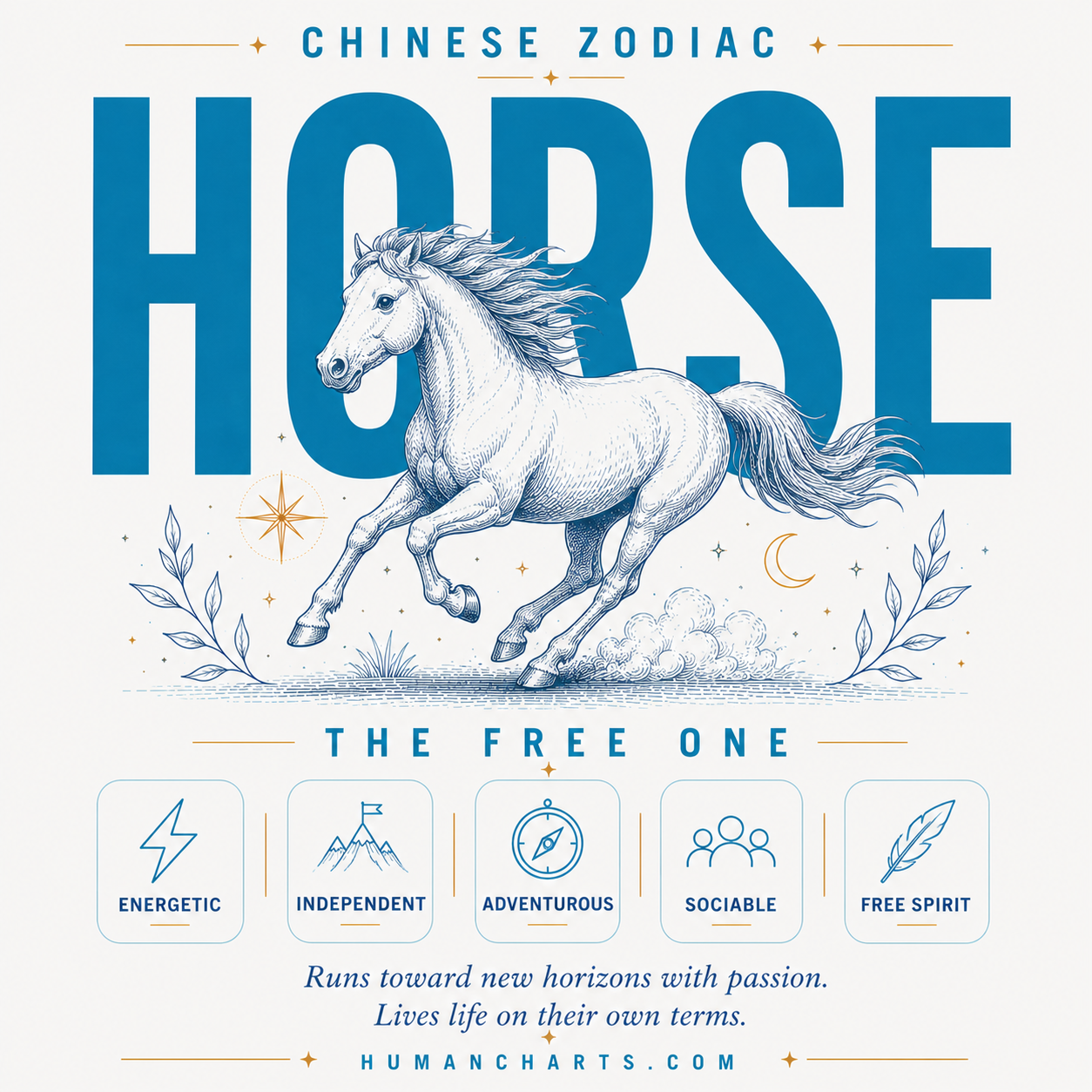
The Horse Chinese Zodiac at a Glance
- The Animal: The Horse — The Free One
- Years: 1930, 1942, 1954, 1966, 1978, 1990, 2002, 2014, 2026
- How It Works: Fire (fixed) · Yang · The Galloping Horse · Move, feel the direction, adjust
- Optimal Decision-Making: Begin moving · feel the direction emerge · adjust course in real time
- “Sit Still and Think It Through” Is Wrong For You: Why the cultural advice misnames your instrument
- Five Elements: Wood · Fire · Earth · Metal · Water variations
- Strengths: Energetic, independent, adventurous, social, optimistic
- Challenges: Restless, impulsive, scattered, allergic to long stillness
- Career & Business: Entrepreneur, performer, athlete, traveler, sales, anything kinetic
- Relationships: Need partners who can move with the path — confinement is structurally lethal
- Famous Horses: Jimi Hendrix, Paul McCartney, Nelson Mandela, Harrison Ford
The Horse Chinese Zodiac in Plain English
The Horse is the Free One. Some people are wired to move before they think. They take in the world by going into it — the new place, the new project, the new conversation, the new road — and the clarity arrives while they are already in motion. When they finally stop to look around, they discover the answer was the road itself. The Horse’s discipline is motion. The Horse’s gift is forward.
Horse is the Chinese Astrology label for that wiring. It is the seventh animal in the twelve-year zodiac cycle and one of the most energetic, independent, and forward-driving of the twelve. The Horse (马, mǎ) is associated in Chinese tradition with vitality, freedom, the open road, and the kind of optimism that keeps moving even when the path is unclear.
If you were born in a Horse year (1930, 1942, 1954, 1966, 1978, 1990, 2002, 2014, 2026), here is what that usually looks like in practice:
- You think best while moving. Long stillness produces fog; walking, traveling, exercising, or starting something new produces clarity.
- You have a high tolerance for change and a low tolerance for being penned in. Routines that feel safe to other people feel structurally suffocating to you.
- You are social by default. You read rooms quickly, make friends across very different worlds, and tend to know people in every corner of your life.
- You struggle in environments that punish kinetic energy or that ask you to sit still and process before acting.
- You become most yourself when you have room to move — the freedom to leave, to start, to travel, to change direction without permission.
Listen to MATTEEN on the Horse Chinese Zodiac — a mechanical breakdown of the seventh animal in the Chinese zodiac, how motion operates as the engine of the path, why clarity arrives in transit rather than in stillness, and how Horse carriers learn to use their forward drive without burning the structures around them down.
Definition: The Horse (马, mǎ) is the seventh animal in the twelve-year Chinese zodiac cycle. Its fixed element is Fire, its polarity is Yang, and it is associated with energy, independence, freedom, adventurousness, optimism, and forward motion. Horse carriers operate through movement — clarity arrives while moving, not while still. The Horse’s decision-making instrument is kinetic: begin moving, feel the direction emerge inside the motion, and adjust course in real time. Stillness produces fog; motion produces the read.
The Horse is the seventh animal in the twelve-year Chinese zodiac cycle, following the Snake and preceding the Goat. In Chinese tradition, the Horse (马, mǎ) is associated with vitality, freedom, the open road, and the forward-driving energy that keeps a life moving even when the destination is unclear. The Horse is one of the most universally admired animals in Chinese culture — a symbol of strength, perseverance, and the kind of optimism that does not need to be argued for.
Before reading further — a synthesis note. Chinese Astrology is one of several systems that describe a full design. Your Western Astrology (Sun, Moon, Rising, and the rest of the placements), Human Design, and Numerology Life Path each add their own structural inputs. The patterns on this page describe what the Horse brings — the core orientation around motion, independence, and kinetic clarity. How that orientation actually shows up in your career, your relationships, and your decisions is shaped by the synthesis of all the systems together, not by the Chinese Zodiac alone.
In Chinese cosmology, the twelve animals each represent a distinct developmental pattern. Where the Snake operates through patient observation and the Goat operates through gentle attunement, the Horse operates through motion. The Horse moves first and finds clarity inside the moving. The forward drive is not impulsiveness — it is the structural mechanism by which this design reads reality. The Horse is what keeps a life, a project, or a culture moving forward when other paths would have stalled in deliberation.
The mechanism of the Horse is motion combined with directional sensitivity. The engine runs on going, trying, leaving, starting — and on the body’s capacity to feel which direction is correct while already in transit. Where the Ox builds through steady labor and the Snake builds through patient timing, the Horse builds through forward motion and real-time course correction. The shadow of the path is the cost of running a high-kinetic instrument inside a world that often confuses motion with avoidance — the Horse can be misread as restless, scattered, or unwilling to commit when in fact the carrier is operating exactly as designed.
Horse Years. The Horse years in the Chinese zodiac fall every 12 years: 1930, 1942, 1954, 1966, 1978, 1990, 2002, 2014, and 2026 are the most recent. The Chinese New Year shifts each year — typically late January or early February — so people born in January or early-to-mid February of a “Horse year” may actually belong to the previous animal. If your birth date falls in January or early February of a Horse year, check it against the specific Chinese New Year cutoff for that year.
Every Chinese zodiac animal is built from four structural components: its fixed element, its yin/yang polarity, its symbol, and its position in the twelve-year cycle. Here is how the Horse is built.
- Symbol. The galloping horse — fast, free, untethered, capable of covering ground other animals cannot reach.
- Fixed element. Fire. The Horse’s underlying nature is heat in motion — passion, vitality, and the kind of warmth that draws other people in.
- Yin/Yang. Yang. Expressive, outward, kinetic. The Horse acts and the world responds.
- Position in zodiac. Seventh of twelve — the first animal of the second half of the cycle, often associated with momentum and the push into new territory.
- Lucky colors. Yellow, brown, purple.
- Lucky numbers. 2, 3, 7.
The Horse’s combination of Fire (intensity, vitality) and Yang (expression, outward motion) is the structural key. Fire by itself burns hot and visible; Fire combined with Yang burns hot and moving. This is the Horse’s signature: high vitality expressed through forward motion. The Horse cannot hold the fire in place — the fire wants to go somewhere. The motion is not the Horse running away from stillness. The motion is the structural form the Horse’s energy takes.
Mechanically, the Horse operates in three phases: begin moving, feel the direction emerge, adjust course in real time. The motion phase initiates the read — the body cannot tell which way is correct until it is already going. The directional phase is the body’s real-time feedback while in transit — a felt sense of “this way is alive, that way is dead” that arrives only through the moving. The adjustment phase is continuous: the Horse does not lock in a direction at the start and ride it to the end. The Horse rides, reads, adjusts, and rides again. The course is set by motion, not by planning.
Everything in life is a function of decision-making. Every life unfolds through the decisions made within it. For the Horse Chinese Zodiac, the decision-making instrument is motion. Clarity arrives while moving, not while still. The Horse decides by going, by trying, by being in transit. Stillness produces fog; motion produces the read. The discipline is to start moving even before the direction is clear, to trust that the direction will emerge inside the moving, and to refuse the cultural pressure to sit still and think it through first.
Most cultures treat decision-making as something that happens in stillness — sit down, consider, weigh the options, then act. The Horse is built differently. For the Horse, the considering happens inside the going. The body cannot generate the read while at rest. The mind spins without a clear signal. But once the carrier is in motion — walking, traveling, starting the project, leaving the room, taking the first step — the felt sense of which direction is alive arrives almost immediately. The motion is not the consequence of the decision. The motion is the mechanism that produces the decision.
How to make decisions well with this instrument:
- Honor motion as the instrument. When you find yourself stuck and unable to decide, do not interpret it as a failure of analysis. For your design, prolonged stillness is structurally a problem. Start moving in any direction — go for the walk, take the trip, start the draft, accept the meeting. The directional signal will arrive once you are in transit.
- Recognize the signal that the direction has emerged. Clarity announces itself while moving: the next step becomes obvious, the body’s resistance to continuing drops, and there is a felt sense of being on the right road. When that arrives, continue. When the road feels dead, change direction without apology.
- Refuse to commit before the motion has begun. The cultural pressure to “have a plan first” or “know your destination before you start” is structurally wrong for you. Locking in a direction from stillness produces commitments your body cannot sustain. The cost is that you either break the commitment partway through or finish it carrying resentment.
- Adjust course in real time. The Horse’s decisions are not single-shot. They are continuous. The carrier who decides at the start and refuses to adjust along the way is not honoring the design — they are imitating a different instrument. Course correction is structural, not failure.
Everyday decisions and major decisions operate on the same instrument; only the scale of motion differs. Small decisions are made through small motion — walking the room, leaving the chair, opening the conversation. Major decisions — career changes, geographical moves, partnership shifts — are made through larger motion: travel, trial periods, starting before being certain, leaving before being sure where to land. The Horse who tries to make major decisions from a chair will produce decisions the body cannot follow through on. The Horse who lets the body move and trusts the directional read produces decisions of unusual rightness across a lifetime.
The discipline is not motion for motion’s sake. The discipline is honoring the actual rhythm of how the instrument works.
The phrase “sit still and think it through” — and its variants, “settle down,” “stop running,” “stay in one place for once” — gets used universally, as if everyone’s decision-making instrument runs the same way and as if stillness is always the route to clarity. For you, it is wrong advice. Your instrument is motion, and the body’s directional read is the apparatus that turns the moving into clarity. What looks like restlessness from the outside is the actual work your design is built to do.
The cultural advice to “sit still” or “settle down” or “stop running from yourself” generally describes a different decision-making instrument — the slow, internal, stillness-based read that some other animals (and some Human Design authorities) are built to operate on. For those carriers, the advice is correct. For you, the instrument is different. The body’s read does not arrive in a chair. It arrives in transit. Forcing the carrier to be still in order to think produces fog, not clarity. The mind spins because the structural mechanism — motion — has been removed.
When other people say “sit still and figure it out,” they may be operating from a stillness-based instrument, or they may simply be uncomfortable with the rhythm your design requires. Either way, the advice misnames your work. The moving is not avoidance. The kinetic energy is not running away. They are the structural mechanism your decision-making runs on.
For you, trust the motion. Begin moving even before the direction is clear. Let the road tell you which way is alive. Refuse the cultural pressure to sit down first.
Chinese Astrology pairs each animal’s fixed element with a year-specific element from the Five Elements system (Wood, Fire, Earth, Metal, Water) on a 60-year master cycle. This means every Horse is not just a Horse — they are a Wood Horse, Fire Horse, Earth Horse, Metal Horse, or Water Horse depending on which year inside the 60-year cycle they were born. The fixed Fire element gives the Horse its core nature; the year-specific element shades how that core is expressed.
- Wood Horse (1954, 2014) — more flexible, creative, and collaborative. Wood softens the Horse’s solo edge and produces a more relational, growth-oriented version of the path that builds bridges as it moves.
- Fire Horse (1906, 1966) — the double-fire combination. The most intense, magnetic, and high-risk of the Horse variations. Fire on Fire produces a carrier whose energy is impossible to ignore and whose life often runs at a faster clock than the people around them.
- Earth Horse (1918, 1978) — more grounded, practical, and steady. Earth stabilizes the Horse’s motion and produces a carrier who moves with purpose — fewer impulsive departures, more sustainable forward drive.
- Metal Horse (1930, 1990) — more disciplined, focused, and ambitious. Metal sharpens the Horse’s drive and produces the most goal-oriented of the variations — the Horse who builds visible structures inside the motion.
- Water Horse (1942, 2002) — more intuitive, adaptable, and persuasive. Water deepens the Horse’s social capacity and produces a carrier who moves with people, who reads currents, and who often leads movements that other paths could not start.
When you read about a Horse’s traits, the fixed Fire-Yang nature is the foundation. The year-specific element is the modifier. A 1966 Fire Horse will read differently than a 1978 Earth Horse even though both share the underlying mechanism.
The Horse carries a consistent set of themes that show up across a carrier’s lifetime, regardless of upbringing, culture, or career. These are the structural traits the sign is built from.
- Energy. A built-in vitality that the carrier has to spend somewhere. Suppressed Horse energy turns into restlessness, irritation, or physical illness. Expressed Horse energy moves projects, people, and rooms.
- Independence. A deep need for autonomy. The Horse does not do well being told what to do, where to be, or how to do it. The carrier needs room to choose the route.
- Adventurousness. A native pull toward the new — new places, new people, new ideas, new projects. The familiar wears thin quickly; the unfamiliar refreshes the system.
- Optimism. A structural belief that the road ahead is worth riding. Even after setbacks, the Horse tends to find the next direction faster than other paths.
- Sociability. A natural ease with people. The Horse reads rooms fast, connects across very different worlds, and tends to have wide social networks rather than narrow deep ones.
- Free spirit. A constitutional refusal to be confined — physically, emotionally, intellectually, or relationally. Confinement is structurally toxic to this design.
- Restlessness. The shadow side of the kinetic energy. When the Horse cannot find a direction to move in, the energy turns inward and the carrier becomes scattered, irritable, or impulsive.
- Passion. Fire-Yang produces a carrier who feels things intensely and expresses them outwardly. The Horse rarely runs cool.
Horse carriers are designed to:
- Initiate motion that other paths would have stalled on — start the project, take the trip, leave the dying situation, begin the next chapter
- Read direction in real time while already moving — find the live road through transit rather than through planning
- Energize teams, partners, and rooms simply by being present and in motion
- Cover wide ground — geographical, social, intellectual — and bring back insights from places other paths never go
- Sustain optimism across long arcs, recovering from setbacks faster than the people around them
Strong work shows up where motion, courage, and forward drive matter. Entrepreneurs use the path’s initiating capacity to start ventures others would have planned forever. Performers, athletes, and public figures use the kinetic vitality to do work that has to come through the body in real time. Travelers, journalists, and field operators use the Horse’s tolerance for change to do work that more rooted paths cannot sustain. Sales operators, organizers, and connectors use the social ease to move people and resources across networks. The Horse is not built for static, low-stimulus environments where the carrier’s energy has to be suppressed and the kinetic capacity cannot show through — it is built for situations where the carrier’s specific drive, mobility, and forward read are the value.
When this path is operating cleanly, Horse carriers do not need to perform their energy. The work itself transmits it — the project that started, the trip that opened the next chapter, the conversation that moved the room, the team that found its momentum because the Horse showed up. People around the carrier often feel lifted, energized, or invited into motion themselves. The trap of the path is that this kinetic capacity is real and easy to scatter across too many directions at once, so carriers who never learn to channel the drive into a sustained arc can spend decades in motion without ever producing the body of work the drive was structurally built to make.
The shadow of the Horse is the predictable distortion that appears when the path’s mechanics are overdriven or suppressed. Common patterns:
- Restlessness becomes scatter. The kinetic energy that should be channeled into a direction gets spread across too many directions and produces nothing finished.
- Independence becomes isolation. The need for autonomy that protects the path becomes a refusal to lean on anyone, and the carrier ends up doing alone what could have been done with company.
- Adventurousness becomes avoidance. The pull toward the new becomes a structural way of leaving every situation the moment it requires depth, stillness, or hard conversation.
- Optimism becomes denial. The forward orientation that serves the path becomes a refusal to look at what is broken behind the carrier — debts, relationships, structures that the Horse rode away from rather than repaired.
- Sociability becomes shallowness. The wide network that the path naturally builds becomes a substitute for the few deep relationships the carrier actually needs.
- Impulsiveness. The Horse can act on a directional read that has not yet stabilized — leaving, starting, committing before the body has actually confirmed the direction. The cost is broken commitments and missed compound.
- Allergy to long stillness. What was protective motion becomes an inability to be still even when stillness is what the situation requires — a meditation, a grieving, a partnership going through a quiet phase.
- Burnout under the kinetic mask. The path can run an unusually depleting inner energy expenditure that the public vitality never reveals.
The repair pattern is not to suppress the path’s mechanics. The motion is correct. The repair is in noticing when motion has become scatter, when independence has become isolation, and when adventure has become avoidance. The earlier in life this discernment develops, the more the path compounds into bodies of work, partnerships, and lives that the Horse’s drive was structurally built to produce. The later it develops, the more the carrier spends decades in motion without anything to show for the ground covered.
Horse carriers are designed to:
- Distinguish between motion that is producing the directional read and motion that is just avoiding what stillness would surface
- Channel the kinetic energy into a sustained arc rather than scattering it across too many simultaneous directions
- Stay present in relationships, projects, and inner lives that require the Horse to be still for a season
- Recognize when adventurousness has become structural avoidance and when independence has become structural isolation
The Horse is built for work that has a kinetic, initiating, or forward-driving layer. The path tends to perform at its peak when the carrier is operating in fields that reward motion, courage, real-time read, and the capacity to start what others would only plan. It tends to perform poorly in static, low-autonomy work where the carrier has to sit still for long periods, follow detailed instructions, and suppress the kinetic capacity. The actual career format depends on the synthesis with the rest of the chart — the careers below are where the Horse’s mechanism is most directly engaged, not the only places it shows up. Many Horse carriers do their kinetic work quietly inside roles that are not officially kinetic: as the team member who keeps the project moving when momentum stalls, the parent whose energy organizes the family’s life, the friend whose phone call gets everyone out of the house. The mechanism is the same; the format varies.
Careers where the Horse’s mechanism is most directly engaged include:
- Entrepreneur, founder, early-stage operator
- Sales, business development, deal-making roles where momentum is the asset
- Performer, musician, actor, athlete — kinetic work that has to come through the body in real time
- Journalist, foreign correspondent, field researcher, documentary maker
- Travel writer, tour leader, international operator, expat-track careers
- Coach, trainer, group leader — anyone whose job is to energize and move others
- Politician, organizer, movement leader — work that requires moving large groups forward
- Pilot, captain, transport operator — literal motion as the work
- Emergency responder, ER doctor, first responder — real-time read inside high-motion situations
Misaligned environments include long-tenure desk work with low autonomy, cultures that punish initiative and reward staying in place, roles that require sitting still for extended periods without kinetic outlet, and any environment that treats the Horse’s restlessness and need for change as problems to be managed rather than structural features of the design.
In careers, Horse carriers are designed to:
- Build a body of work or a body of relationships that the carrier’s drive and mobility are the asset of, not a problem inside
- Negotiate for the autonomy the work actually requires — the Horse produces best output when free to set the route
- Distinguish between forward motion that compounds into a coherent arc and motion that just scatters energy across too many starts
- Stay with the project long enough for the compound to arrive — the world cannot use the work that gets abandoned three steps in
In close relationships, the Horse tends to show up as a partner who brings unusual vitality, optimism, social energy, and a structural need for the partner to respect the kinetic nature of the path. The carrier moves through the world quickly, reads partners at high speed, and often invites the partner into a faster, more adventurous version of life than the partner would have chosen alone. How this plays out in any specific relationship depends on the rest of the chart — but the core Horse pattern of motion-based intimacy combined with deep need for freedom shows up consistently across carriers.
Common challenges include difficulty with prolonged stillness inside the relationship (the path finds it structurally difficult to sit with quiet phases), starting new directions without fully closing previous ones (the partner experiences this as being left behind), restlessness inside long-term partnership that the partner can mistake for unhappiness, an allergy to confinement that gets read by the partner as commitment-phobia, and a tendency to ride away from hard emotional conversations rather than stay seated through them — the motion that protects the path can become the avoidance that erodes the partnership.
The release in relationships is the discipline of letting the partner ride with the Horse rather than asking the Horse to dismount. The carrier learns to bring the partner into the motion — shared travel, shared projects, shared starts — rather than asking the partner to wait at home while the Horse goes. The carrier also learns to stay seated for the conversations that require it, even when every cell wants to move. Healthy Horse partnerships involve a carrier who has practiced staying still for the moments that require stillness, and a partner who can move with the Horse without trying to slow the carrier into a different design.
Horse carriers are designed to:
- Choose partners who can move with the path and who do not interpret the kinetic energy as a flaw to be fixed
- Practice staying present in the relationship’s quiet phases — not every season requires forward motion
- Distinguish between protective motion that the design requires and avoidance dressed up as motion
- Recognize when the urge to leave is a structural read on the relationship versus a habitual response to discomfort
The pattern is consistent across fields: a body of work or a public life built on motion, kinetic vitality, and forward drive other paths did not have. Below are 14 well-documented Horse figures across politics, music, film, sports, and culture — each verified against the Chinese New Year cutoffs for their birth years.
A Direct Transmission from MATTEEN
“Everything in your life is a function of decision-making. Every life unfolds through the decisions made within it. The Horse’s decision-making instrument is motion — clarity arrives while moving, not while still. The mistake is thinking the motion is restlessness, or avoidance, or evidence of an unsettled mind. The motion IS the work. Most Horse carriers spend a decade being told to sit down and think it through, and they spend that decade producing fog instead of clarity. The harder discipline is starting to move before the direction is clear — most Horses wait too long for permission because the culture has trained them to distrust their own kinetic read. Begin moving. Feel the direction emerge. Adjust as the road tells you what is alive.”
— Matteen Terrany
Frequently Asked Questions About the Horse Chinese Zodiac
Unlock Your Full Chinese Zodiac
Your Chinese zodiac animal is one structural layer of your design. Your Western Astrology, Human Design, and Numerology Life Path add the rest. Calculate your full reading and start working with it.
Want to learn about the other Chinese zodiac animals? See the complete guide to all 12 animals →
The road is the answer. The motion is the read.