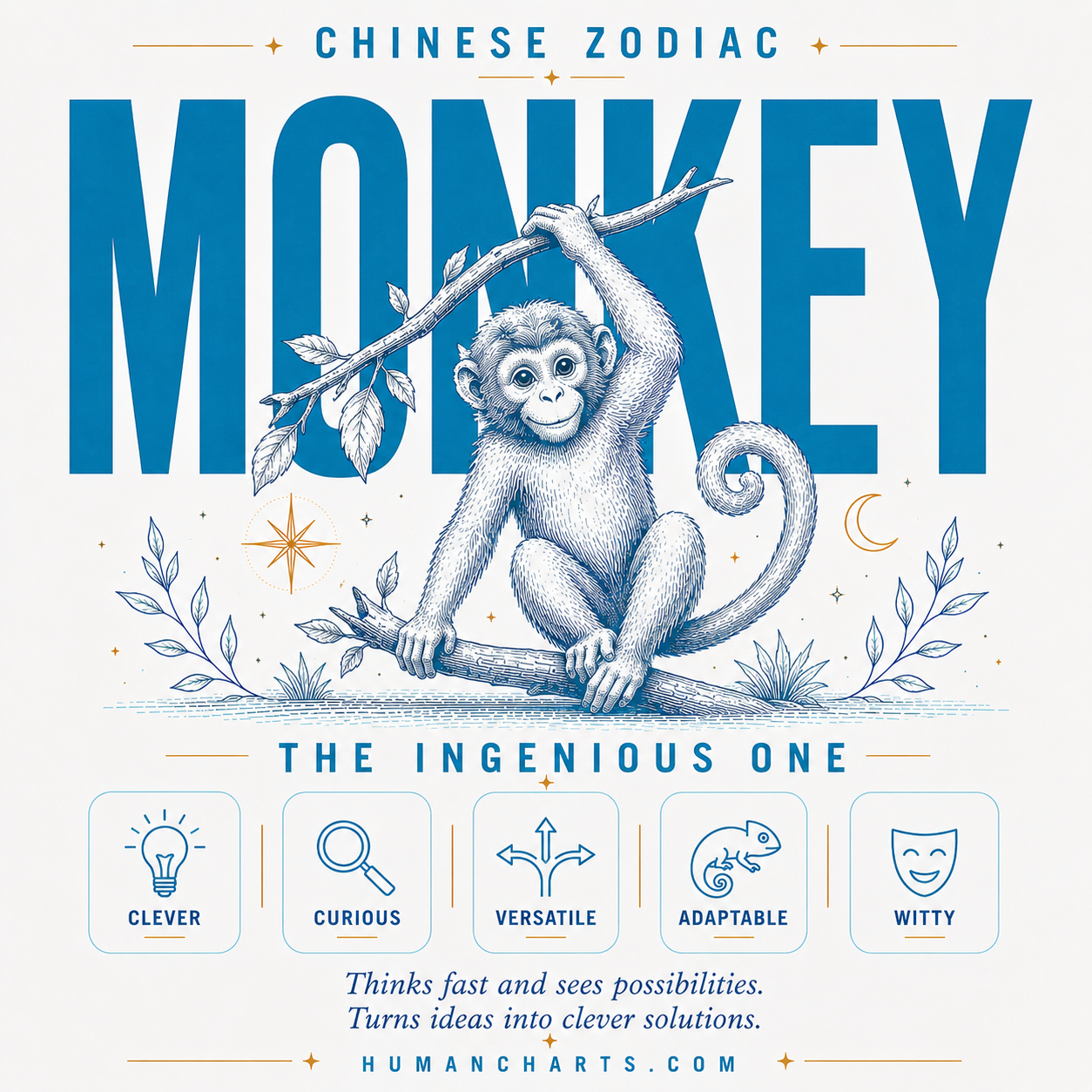
The Monkey Chinese Zodiac at a Glance
- The Animal: The Monkey — The Clever One
- Years: 1932, 1944, 1956, 1968, 1980, 1992, 2004, 2016, 2028
- How It Works: Metal (fixed) · Yang · The Monkey · Try, observe, adapt
- Optimal Decision-Making: Try a small version · observe the result · adapt or commit
- “Pick a Lane” Is Wrong For You: Why the cultural advice misnames your instrument
- Five Elements: Wood · Fire · Earth · Metal · Water variations
- Strengths: Clever, inventive, adaptable, sociable, quick to learn
- Challenges: Restless, opportunistic, scattered, mischievous edge
- Career & Business: Inventor, entrepreneur, performer, technologist, multi-disciplinary operator
- Relationships: Need partners who can hold variability — rigid intimacy is structurally suffocating
- Famous Monkeys: Leonardo da Vinci, Elizabeth Taylor, George Lucas, Will Smith
The Monkey Chinese Zodiac in Plain English
The Monkey is the Clever One. Some people are wired to learn by trying. They see a problem, they reach for it, they fiddle with it, they discover what it actually is by interacting with it directly. When they finally understand something, the understanding is structural — not borrowed from a book, not absorbed from an authority, but generated from contact with the actual thing. The Monkey’s discipline is experimentation. The Monkey’s gift is versatility.
Monkey is the Chinese Astrology label for that wiring. It is the ninth animal in the twelve-year zodiac cycle and one of the most inventive, curious, and adaptable of the twelve. The Monkey (猴, hóu) is regarded in Chinese tradition as the trickster and the inventor — the animal whose intelligence shows up as agility, problem-solving, and the willingness to try a thing nobody has tried yet.
If you were born in a Monkey year (1932, 1944, 1956, 1968, 1980, 1992, 2004, 2016, 2028), here is what that usually looks like in practice:
- You learn faster by doing than by reading. The actual interaction with a thing teaches you what theory never could.
- You pivot easily. When something is not working, you do not push harder — you try a different angle, a different tool, a different framing.
- You make connections across fields that other people keep separate. The pattern in one domain becomes the solution in another.
- You struggle in environments that demand you stay still, stay narrow, or commit to one path before you have tested several.
- You become most yourself when you have permission to experiment — a career, a relationship, or a structure that respects your need to try things and to keep trying things.
Listen to MATTEEN on the Monkey Chinese Zodiac — a mechanical breakdown of the ninth animal in the Chinese zodiac, how experimentation operates as the engine of the path, why pivoting is structurally correct, and how Monkey carriers learn to use their cleverness without scattering inside it.
Definition: The Monkey (猴, hóu) is the ninth animal in the twelve-year Chinese zodiac cycle. Its fixed element is Metal, its polarity is Yang, and it is associated with cleverness, curiosity, wit, versatility, invention, and sociability. Monkey carriers operate through experimentation — trying a small version of the thing, observing what happens, and adapting until the right form appears. The Monkey’s decision-making instrument is the experiment itself — the carrier learns what works by interacting with the actual thing rather than by theorizing in advance.
The Monkey is the ninth animal in the twelve-year Chinese zodiac cycle, following the Goat and preceding the Rooster. In Chinese tradition, the Monkey (猴, hóu) is associated with cleverness, invention, mischief, and the kind of intelligence that shows up as agility — the capacity to solve a problem by reaching for it from an angle no one else considered. The classical Chinese figure of the Monkey King (Sun Wukong) captures the archetype: brilliant, restless, transformative, occasionally chaotic, but capable of moves that no other character in the story could have made.
Before reading further — a synthesis note. Chinese Astrology is one of several systems that describe a full design. Your Western Astrology (Sun, Moon, Rising, and the rest of the placements), Human Design, and Numerology Life Path each add their own structural inputs. The patterns on this page describe what the Monkey brings — the core orientation around experimentation, versatility, and inventive intelligence. How that orientation actually shows up in your career, your relationships, and your decisions is shaped by the synthesis of all the systems together, not by the Chinese Zodiac alone.
In Chinese cosmology, the twelve animals each represent a distinct developmental pattern. Where the Snake operates through patient observation and the Rooster operates through principled order, the Monkey operates through trial, contact, and rapid iteration. The Monkey is what tries the thing nobody has tried, finds the angle nobody has seen, and discovers — by doing — what the situation actually contains.
The mechanism of the Monkey is experimentation combined with adaptability. The engine runs on contact: try a small version, observe the result, adjust the next try, and either commit to the form that works or pivot to the next experiment. Where the Ox commits and stays and the Tiger acts on instinct, the Monkey commits provisionally — willing to invest fully in the current experiment while remaining willing to pivot when the experiment reveals its limit. The shadow of the path is the cost of running an unusually exploratory instrument inside a world that often rewards consistency — the Monkey can be misread as flighty, scattered, or unserious when in fact the carrier is doing the structural work the design requires.
Monkey Years. The Monkey years in the Chinese zodiac fall every 12 years: 1932, 1944, 1956, 1968, 1980, 1992, 2004, 2016, and 2028 are the most recent and the next. The Chinese New Year shifts each year — typically late January or early February — so people born in January or early-to-mid February of a “Monkey year” may actually belong to the previous animal (the Goat). If your birth date falls in January or early February of a Monkey year, check it against the specific Chinese New Year cutoff for that year. (For reference: the 1932 Monkey year began February 6; the 1968 Monkey year began January 30.)
Every Chinese zodiac animal is built from four structural components: its fixed element, its yin/yang polarity, its symbol, and its position in the twelve-year cycle. Here is how the Monkey is built.
- Symbol. The monkey — agile, curious, restless, capable of moves no other animal in the lineup can perform.
- Fixed element. Metal. The Monkey’s underlying nature is sharpness — clarity of perception, precision of thought, the cutting edge that turns curiosity into useful invention.
- Yin/Yang. Yang. Outward, expressive, generative. The Monkey acts on the world rather than receiving from it.
- Position in zodiac. Ninth of twelve — past the midpoint, into the integrative stretch of the cycle where versatility and synthesis become the developmental work.
- Lucky colors. White, gold, blue.
- Lucky numbers. 4, 9.
The Monkey’s combination of Metal (sharpness, precision) and Yang (outward action) is the structural key. Metal by itself is exact but static; Metal carried by Yang is exact and in motion — the precise blade that keeps cutting new shapes. This is the Monkey’s signature: a sharp intelligence that does not sit still, a clarity that comes from contact rather than contemplation, a willingness to test the edge of the thing rather than describe it from a distance.
Mechanically, the Monkey operates in three phases: try, observe, adapt. The try phase starts a small version of the move — not the full commitment, not the theoretical version, but a real small attempt at the actual thing. The observe phase reads what happened: what worked, what failed, what surprised, what shifted. The adapt phase either commits to the form that worked or pivots to the next experiment. The Monkey decides by doing. Theory is for other animals; the Monkey learns by interacting with the actual thing.
Everything in life is a function of decision-making. Every life unfolds through the decisions made within it. For the Monkey Chinese Zodiac, the decision-making instrument is experimentation — try a small version, observe the result, adapt or commit. The decision does not get made in advance, inside the carrier’s head. The decision gets made by interacting with the actual thing and reading what comes back. The discipline is to run the experiment honestly and to let the result of the experiment be the answer.
Most cultures treat decision-making as a problem of advance analysis — gather the information, weigh the options, choose the path, commit. The Monkey is built differently. For the Monkey, advance analysis runs out of resolution quickly. The room has too many variables; the path has too many unknowns; the situation will not yield to thinking. The way through is to try it. A small version, a partial version, a test version — something real enough that the world can talk back. What the world says is the data. The decision is downstream of the data, not upstream of it.
How to make decisions well with this instrument:
- Honor the experiment as the work. When you find yourself trying things, pivoting, testing different angles, do not interpret it as scattering. For your design, experimentation is structurally productive. The contact with the actual thing is the data the decision needs.
- Make the experiments small enough to be cheap and real enough to be honest. The trap is the experiment that is too small to teach anything or too large to abandon. The right experiment is the smallest version of the move that still produces real feedback from the world.
- Read what the experiment actually returns. The Monkey’s clarity comes from observing what happened, not from defending what you hoped would happen. When the result surprises you, the surprise is the data. Adjust the next try around the surprise.
- Commit when the form has revealed itself. The cultural read of the Monkey is that you cannot commit. The structural truth is that you commit downstream of the experiment, not upstream of it. When the experiment has shown you the form that works, commit fully. The pivoting was the path to the commitment, not the avoidance of it.
Everyday decisions and major decisions operate on the same instrument; only the scale of the experiment differs. Small decisions run on tiny experiments across days — try this restaurant, try this route, try this approach to the email. Major decisions — career, partnership, structural commitments — run on larger experiments across months or years: the side project that becomes the company, the second skill that becomes the actual career, the relationship that started as friendship and revealed itself across time. The Monkey who tries to skip the experiment phase and commit on theory alone produces decisions that the carrier’s actual intelligence would have refused. The Monkey who runs the experiment cleanly produces a life of unusual range and unusual adaptability across decades.
The discipline is not pivoting for pivoting’s sake. The discipline is letting the experiment teach you what the next move is.
The phrase “pick a lane” gets used universally — as if everyone’s decision-making instrument runs the same way and as if commitment to one path from the start is always the right move. For you, it is wrong advice. Your instrument is experimentation, and the variability that other people read as indecision is the actual work your design is built to do. “Pick a lane” and “stop pivoting” assume one path is correct from the start. For the Monkey, the path reveals itself through trying many paths and reading what each one returns. Pruning that down to one too early kills the instrument.
The cultural advice to “pick a lane” or “stop pivoting” or “just commit already” generally describes a different decision-making instrument — the design that knows in advance which path is correct and only needs the discipline to walk it. For those carriers, the advice is correct. For you, the instrument is different. The right path is not knowable in advance. It is knowable only through the experiments that test what is actually viable, what is actually alive, what actually returns useful work when the carrier engages it. Cutting the experimentation phase short to “commit” produces commitments the carrier’s actual judgment would not have endorsed.
When other people say “pick a lane,” they may be operating from a more linear instrument, or they may simply be uncomfortable with the variability your design requires. Either way, the advice misnames your work. The experimentation is not avoidance. The pivoting is not flakiness. They are the structural mechanism your decision-making runs on. The carrier who tries to suppress the variability to be “consistent” usually ends up running a smaller, narrower, less alive version of the path — the consistency was bought by killing the instrument.
For you, trust the experiment. Try the small version. Read what the world returns. Commit when the form has shown itself.
Chinese Astrology pairs each animal’s fixed element with a year-specific element from the Five Elements system (Wood, Fire, Earth, Metal, Water) on a 60-year master cycle. This means every Monkey is not just a Monkey — they are a Wood Monkey, Fire Monkey, Earth Monkey, Metal Monkey, or Water Monkey depending on which year inside the 60-year cycle they were born. The fixed Metal element gives the Monkey its core nature; the year-specific element shades how that core is expressed.
- Wood Monkey (1944, 2004) — more expansive, creative, and humanitarian. Wood softens the Monkey’s edge and produces a more outwardly collaborative version of the path, often drawn to long-arc creative work and social structures.
- Fire Monkey (1956, 2016) — more dramatic, ambitious, and charismatic. Fire amplifies the Monkey’s outward energy and produces the most magnetic and performative of the Monkey variations.
- Earth Monkey (1908, 1968) — more grounded, practical, and reliable. Earth stabilizes the Monkey’s curiosity and produces operators who turn experimentation into durable structures and businesses.
- Metal Monkey (1920, 1980) — the double-metal combination. The sharpest and most precise of the variations — ambitious, disciplined, and capable of cutting through complexity to the form that actually works.
- Water Monkey (1932, 1992) — more intuitive, fluid, and socially perceptive. Water deepens the Monkey’s adaptability and produces the most diplomatically agile of the variations, often skilled at reading rooms and finding angles other people miss.
When you read about a Monkey’s traits, the fixed Metal-Yang nature is the foundation. The year-specific element is the modifier. A 1980 Metal Monkey will read differently than a 1968 Earth Monkey even though both share the underlying mechanism.
The Monkey carries a consistent set of themes that show up across a carrier’s lifetime, regardless of upbringing, culture, or career. These are the structural traits the sign is built from.
- Cleverness. A built-in intelligence that shows up as problem-solving, lateral thinking, and the capacity to see the angle the room is missing.
- Curiosity. A native pull toward new things, new fields, new tools, new people. The Monkey runs on stimulus and starves in environments that do not provide it.
- Versatility. A capacity to operate competently across many domains. The Monkey is structurally multi-disciplinary.
- Wit. A quick verbal intelligence — humor, timing, the read on what to say and when to say it. The Monkey is often the funniest carrier in the room.
- Adaptability. A capacity to change shape with the situation. When the environment shifts, the Monkey shifts faster than the rest of the room.
- Inventiveness. A native pull toward making the thing that does not yet exist. The Monkey is the prototype-builder, the early adopter, the angle-finder.
- Sociability. A real interest in other people — what they are doing, how they think, what they could become. The Monkey is naturally networked.
- Restlessness. A structural inability to sit still for long. The Monkey requires movement, novelty, and contact to stay alive in the design.
- Opportunism. A sharp read on which doors are open and a willingness to walk through them quickly. The Monkey moves on openings other people are still considering.
- Mischief. A playful edge that shows up as humor, occasional rule-bending, and a refusal to take the inherited rules entirely seriously.
Monkey carriers are designed to:
- See the angle, the workaround, the alternate route that other paths miss because they were committed to the obvious one
- Move quickly between fields, projects, and approaches without losing competence in any of them
- Invent — build new tools, new methods, new frames, new businesses — by trying versions until one clicks
- Read rooms and situations quickly and adapt their approach in real time
- Build social and professional networks across surprising combinations of people, fields, and worlds
Strong work shows up where invention, adaptability, and lateral intelligence matter. Inventors and entrepreneurs use the path’s experimentation to build companies and tools that linear paths would have prematurely dismissed. Performers and communicators use the path’s wit and timing to connect with audiences other paths cannot reach. Technologists and creative directors use the path’s pattern-matching across fields to make moves nobody else in the meeting can see. The Monkey is not built for narrow specialist work where the design is locked in advance and the carrier’s job is only to execute — it is built for situations where the carrier’s specific cleverness, range, and willingness to try the unproven move are the value.
When this path is operating cleanly, Monkey carriers do not need to explain their range. The work itself transmits it — the invention that worked, the pivot that turned out to be the right one, the cross-domain move that opened the next decade. People around the carrier often sense that something resourceful is being worked out even when the carrier has not yet articulated it. The trap of the path is that this range is real and easy to spread too thin, so carriers who never learn to consolidate the wins can spend decades brilliant, busy, and never quite finishing the thing the experiments were pointing toward.
The shadow of the Monkey is the predictable distortion that appears when the path’s mechanics are overdriven. Common patterns:
- Curiosity scatters into distraction. The pull toward the next interesting thing becomes the inability to finish the current one. The carrier accumulates starts without completions.
- Cleverness hardens into showing off. What was real intelligence becomes performance — winning the room rather than solving the problem.
- Adaptability becomes shapelessness. The willingness to shift becomes the inability to hold a position. The carrier becomes whoever the situation requires and loses the thread of who they actually are.
- Opportunism crosses into manipulation. The sharp read on open doors becomes a willingness to exploit openings at the cost of other people.
- Wit becomes deflection. Humor stops being a connection point and starts being a wall — used to avoid the conversations that would require the carrier to stand still.
- Restlessness becomes inability to commit. The pivoting that serves the experiment becomes the pivoting that prevents the experiment from ever resolving.
- Mischief becomes irresponsibility. The playful edge that kept the path alive starts costing other people — the team, the partner, the kids.
- Inventiveness without completion. A lifetime of prototypes that never shipped because the next prototype was more interesting than finishing the current one.
The repair pattern is not to suppress the path’s mechanics. The experimentation is correct. The repair is in noticing when curiosity has become avoidance of completion, when adaptability has become loss of self, and when restlessness has become refusal to commit downstream of the experiments. The earlier in life this discernment develops, the more the path compounds into bodies of work, businesses, and partnerships that the Monkey’s range was structurally built to produce. The later it develops, the more the carrier spends decades clever, busy, and quietly aware that nothing fully landed.
Monkey carriers are designed to:
- Distinguish between productive experimentation and pivoting that avoids the commitment the experiment has earned
- Finish the experiments that have already revealed their answer rather than abandoning them for the next interesting start
- Use the wit and the cleverness as connection points rather than as walls or performances
- Recognize when adaptability has crossed into shapelessness and re-anchor in the carrier’s own position
The Monkey is built for work that has an inventive, exploratory, or multi-disciplinary layer. The path tends to perform at its peak when the carrier is operating in fields that reward experimentation, lateral thinking, rapid iteration, or the capacity to operate competently across several domains at once. It tends to perform poorly in narrow specialist work where the design is locked in advance and variability is treated as a problem. The actual career format depends on the synthesis with the rest of the chart — the careers below are where the Monkey’s mechanism is most directly engaged, not the only places it shows up. Many Monkey carriers do their inventive work inside roles that are not officially called inventive: as the employee who quietly rebuilds the process everyone was complaining about, the consultant whose contribution is the reframe nobody else generated, the parent whose willingness to try a new approach changes the family’s trajectory. The mechanism is the same; the format varies.
Careers where the Monkey’s mechanism is most directly engaged include:
- Inventor, product designer, prototype-builder, R&D operator
- Entrepreneur, founder, builder of multi-product or multi-vertical companies
- Performer, actor, comedian, host, public-facing communicator
- Technologist, software engineer, hardware tinkerer, applied AI builder
- Creative director, art director, multi-medium artist
- Strategist or consultant whose value is cross-domain pattern-matching
- Teacher or trainer whose specialty is making complex material accessible through real-time experimentation
- Journalist, documentarian, multi-beat reporter
- Diplomat, negotiator, or operator whose value is reading rooms and finding angles
- Salesperson or business developer whose strength is range and adaptability
Misaligned environments include rigid bureaucracies that punish experimentation, narrow specialist roles with no room for cross-domain work, cultures that treat pivoting as failure rather than as data, and any environment that treats the Monkey’s curiosity and range as problems to be solved.
In careers, Monkey carriers are designed to:
- Build a career format that respects the range — not one job that contains everything, but a portfolio or a role with structural room for multiple experiments
- Negotiate for the latitude the experimentation actually requires — the Monkey produces best output when the carrier is allowed to try things
- Distinguish between productive pivoting and pivoting that avoids the commitment the previous experiment had already earned
- Consolidate wins — finish the prototypes that worked, ship the projects that revealed their form, and turn the experiments into structures the world can use
In close relationships, the Monkey tends to show up as a partner who brings unusual liveliness, range, humor, and a structural need for the partner to respect the carrier’s curiosity. The carrier engages the partner like a continuing experiment — interested in what the partner is becoming, willing to try new approaches when the current one is stale, allergic to the kind of rigid intimacy that asks the relationship to stop evolving. How this plays out in any specific relationship depends on the rest of the chart — but the core Monkey pattern of variable, inventive, sociable intimacy shows up consistently across carriers.
Common challenges include difficulty with intimacy that demands the carrier sit still emotionally (the path finds it structurally suffocating), a tendency to deflect serious conversation with humor, restlessness that the partner reads as one foot out the door even when the carrier is fully committed, opportunistic patterns that the partner experiences as the carrier prioritizing the next interesting thing over the relationship, and a difficulty letting the partner see the carrier without the cleverness on — the wit that connects can also become a costume the carrier struggles to take off.
The release in relationships is the discipline of letting the experimentation operate inside the relationship rather than as escape from it. The carrier learns to bring the curiosity to the partner — interested in who the partner is becoming, willing to try new versions of the partnership together, willing to commit downstream of the experiments the carrier has already run. Healthy Monkey partnerships involve a carrier who has practiced staying when the situation asks for stillness without losing the design’s liveliness, and a partner who can hold the range without trying to flatten it.
Monkey carriers are designed to:
- Choose partners who can hold the variability and respect the range without trying to lock either down
- Practice bringing the experimentation inside the relationship — small new versions across years, not constant pivoting away from the relationship
- Distinguish between productive curiosity and opportunism that costs the partner
- Recognize when the wit has become a costume and let the partner see the carrier underneath
The pattern is consistent across fields: a body of work or a public life built on invention, range, and the willingness to try moves other paths would have refused. Below are well-documented Monkey figures across art, science, music, film, sports, and business — each verified against the Chinese New Year cutoffs for their birth years.
A Direct Transmission from MATTEEN
“Everything in your life is a function of decision-making. Every life unfolds through the decisions made within it. The Monkey’s decision-making instrument is the experiment — a small version of the move, real contact with the actual thing, honest reading of what came back. The mistake is thinking the experiments are the prelude to the decision. The experiments ARE the decision. Most Monkey carriers spend a decade learning to trust the variability — to stop apologizing for the pivoting and recognize that the pivoting is the path. The harder discipline is the second half: committing downstream of the experiment when the experiment has revealed the form. Most Monkeys pivot one beat too long because the next experiment is more interesting than finishing the one that already worked. Try the small version. Read what the world returns. Commit when the form has shown itself.”
— Matteen Terrany
Frequently Asked Questions About the Monkey Chinese Zodiac
Unlock Your Full Chinese Zodiac
Your Chinese zodiac animal is one structural layer of your design. Your Western Astrology, Human Design, and Numerology Life Path add the rest. Calculate your full reading and start working with it.
Want to learn about the other Chinese zodiac animals? See the complete guide to all 12 animals →
The experiment is the path. Commit when the form has shown itself.