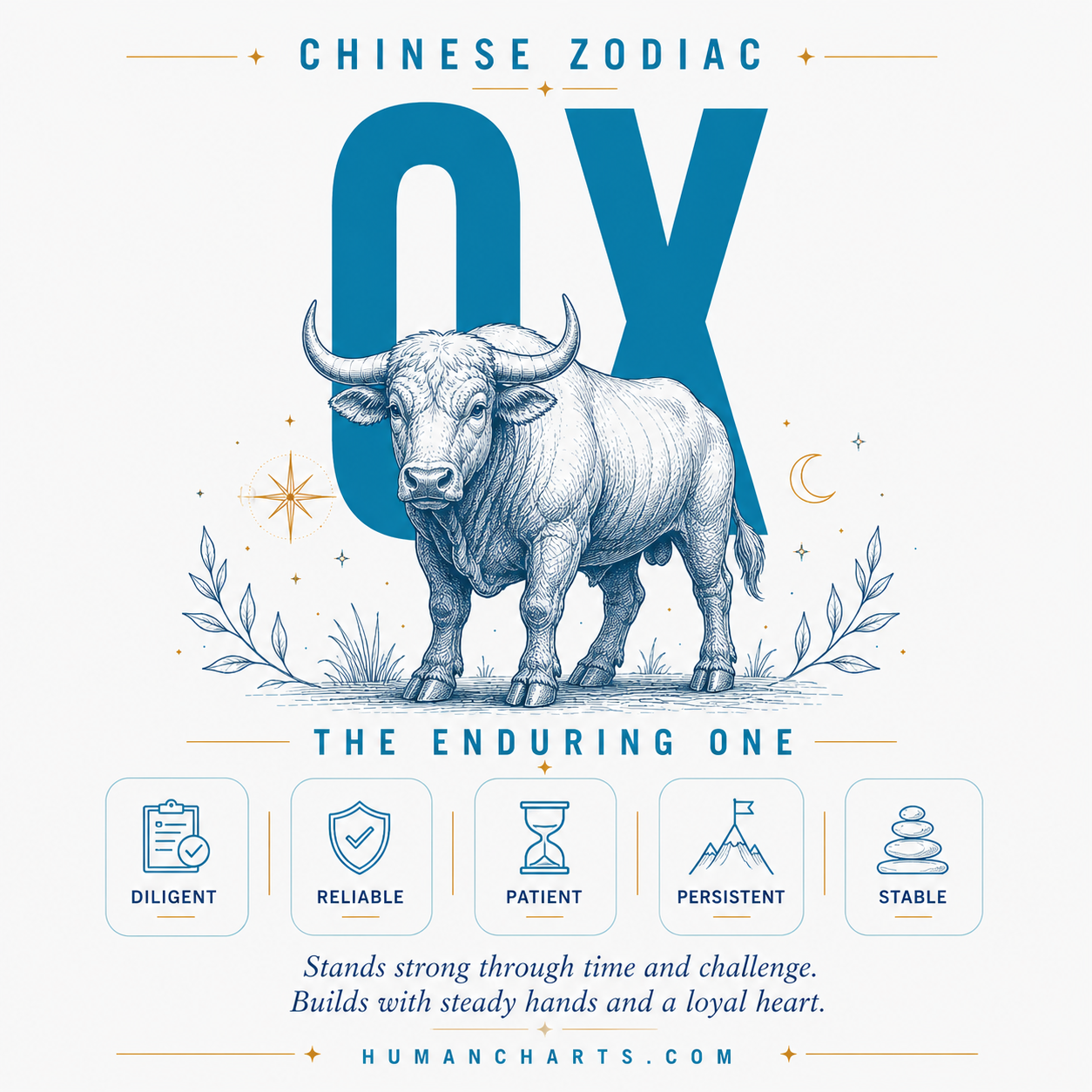
The Ox Chinese Zodiac at a Glance
- The Animal: The Ox — The Steady One
- Years: 1925, 1937, 1949, 1961, 1973, 1985, 1997, 2009, 2021
- How It Works: Earth (fixed) · Yin · The Ox · Weigh, test, commit
- Optimal Decision-Making: Weigh thoroughly · test cautiously · commit fully and hold
- “Move Fast and Iterate” Is Wrong For You: Why the cultural advice misnames your instrument
- Five Elements: Wood · Fire · Earth · Metal · Water variations
- Strengths: Hardworking, reliable, patient, methodical, honest
- Challenges: Stubborn, conservative, slow to adapt, resistant to change
- Career & Business: Builder, operator, engineer, farmer, institutional leader
- Relationships: Need partners who can hold the long arc — the Ox does not pivot lightly
- Famous Oxen: Barack Obama, Princess Diana, Margaret Thatcher, Walt Disney
The Ox Chinese Zodiac in Plain English
The Ox is the Steady One. Some people are wired to weigh before they move. They examine the structure, test the ground, walk the perimeter once and then twice, and only commit when the picture is complete. When they finally commit, the commitment is total. The Ox’s discipline is thoroughness. The Ox’s gift is durability.
Ox is the Chinese Astrology label for that wiring. It is the second animal in the twelve-year zodiac cycle and one of the most hardworking, reliable, and structurally sound of the twelve. The Ox (牛, niú) sits at the foundation of the Chinese agrarian imagination — the animal that turned the soil, carried the load, and held the work that fed the village.
If you were born in an Ox year (1925, 1937, 1949, 1961, 1973, 1985, 1997, 2009, 2021), here is what that usually looks like in practice:
- You weigh decisions slowly and other people sometimes interpret the slowness as resistance when actually you are testing the ground.
- You finish what you start. Once the commitment is made, abandonment is not in your repertoire — even when other people would have moved on.
- You distrust hype, shortcuts, and fast-pivot rhetoric. The Ox knows that structures that go up overnight come down the same way.
- You struggle in environments that demand constant reinvention or that punish methodical pace.
- You become most yourself when you have a body of work, a structure, or a position you can hold over years and that compounds with the holding.
Listen to MATTEEN on the Ox Chinese Zodiac — a mechanical breakdown of the second animal in the Chinese zodiac, how methodical weighing operates as the engine of the path, why durability beats speed, and how Ox carriers learn to use their thoroughness without confusing it with rigidity.
Definition: The Ox (牛, niú) is the second animal in the twelve-year Chinese zodiac cycle. Its fixed element is Earth, its polarity is Yin, and it is associated with diligence, reliability, patience, honesty, and methodical strength. Ox carriers operate through thorough evaluation and steady commitment, weighing every angle before they move and then holding the chosen position across decades. The Ox’s decision-making instrument is slow methodical evaluation followed by full commitment — the weighing is structurally the work, and once the Ox has chosen, the Ox does not waver.
The Ox is the second animal in the twelve-year Chinese zodiac cycle, following the Rat and preceding the Tiger. In Chinese tradition, the Ox (牛, niú) is associated with diligence, honesty, reliability, and the quiet strength that carries civilization forward. The Ox is the animal that pulled the plow, hauled the load, and held the work that fed everyone else — the structural backbone of the agrarian world.
Before reading further — a synthesis note. Chinese Astrology is one of several systems that describe a full design. Your Western Astrology (Sun, Moon, Rising, and the rest of the placements), Human Design, and Numerology Life Path each add their own structural inputs. The patterns on this page describe what the Ox brings — the core orientation around methodical strength, durability, and the long arc of patient construction. How that orientation actually shows up in your career, your relationships, and your decisions is shaped by the synthesis of all the systems together, not by the Chinese Zodiac alone.
In Chinese cosmology, the twelve animals each represent a distinct developmental pattern. Where the Rat moves with cleverness and the Tiger acts on instinct, the Ox operates through evaluation, persistence, and the patient building of structures meant to last. The Ox is what holds the ground while everyone else is moving — and what compounds quietly across decades while flashier signs burn through their cycles.
The mechanism of the Ox is thorough weighing combined with full commitment. The engine runs on testing, building, and holding. Where the Monkey adapts and the Horse runs, the Ox endures. The shadow of the path is the cost of running an unusually deliberate instrument inside a world that often rewards speed and novelty — the Ox can be misread as slow, stubborn, or behind the curve when in fact the carrier is doing the structural work that the faster paths skip.
Ox Years. The Ox years in the Chinese zodiac fall every 12 years: 1925, 1937, 1949, 1961, 1973, 1985, 1997, 2009, and 2021 are the most recent. The Chinese New Year shifts each year — typically late January or early February — so people born in January or early-to-mid February of an “Ox year” may actually belong to the previous animal. If your birth date falls in January or early February of an Ox year, check it against the specific Chinese New Year cutoff for that year.
Every Chinese zodiac animal is built from four structural components: its fixed element, its yin/yang polarity, its symbol, and its position in the twelve-year cycle. Here is how the Ox is built.
- Symbol. The ox or buffalo — patient, immensely strong, capable of carrying the load across the long distance without breaking stride.
- Fixed element. Earth. The Ox’s underlying nature is grounded and structural — the ballast that holds the system stable while everything else moves around it.
- Yin/Yang. Yin. Receptive, internal, accumulating. The Ox builds capacity quietly before it expresses it.
- Position in zodiac. Second of twelve — the foundation laid immediately after the Rat begins the cycle. Where the Rat initiates, the Ox builds the structure that holds.
- Lucky colors. White, yellow, green.
- Lucky numbers. 1, 9.
The Ox’s combination of Earth (stability, structure) and Yin (receptivity, accumulation) is the structural key. Earth by itself is solid and durable; Earth under Yin is the patient accumulation of mass — the slow build that produces structures other paths cannot match. This is the Ox’s signature: steady weight gathering over time, then expressed as a commitment that does not break. The methodical pace is not slowness — it is the work.
Mechanically, the Ox operates in three phases: weigh thoroughly, test cautiously, and commit fully and hold. The weighing phase examines every angle — the costs, the structural soundness, the durability of the choice across years. The testing phase puts careful weight on the ground before the full commitment is made, watching for cracks. The commitment phase is total: once the Ox has chosen, the Ox does not waver. The weighing and testing are most of the work; the commitment, once made, runs on its own for years.
Everything in life is a function of decision-making. Every life unfolds through the decisions made within it. For the Ox Chinese Zodiac, the decision-making instrument is slow methodical evaluation followed by full commitment. The weighing is not the prelude to the work — the weighing IS the work. The discipline is to test every angle, to weigh the costs and the structural soundness, and then to commit without reservation once the picture is complete.
Most cultures treat decision-making as the commitment phase alone — the moment of saying yes. The Ox is built differently. For the Ox, the weighing phase is structurally primary. The carrier tests the ground from multiple angles, examines what could fail across years, and runs the structural integrity of the choice through the patient evaluation that other paths skip. By the time the commitment happens, the choice has already been made by the weighing — the commitment is just the formal sealing of it.
How to make decisions well with this instrument:
- Honor the weighing as the work. When you find yourself evaluating without committing, do not interpret it as procrastination. For your design, evaluation is structurally productive. The thoroughness is the apparatus that produces the durability of the commitment that follows. Trust the process.
- Recognize the signal that the picture has resolved. Clarity announces itself as completeness: every major angle has been tested, the cost of the commitment is fully known, and the body’s resistance to commitment drops. When all three line up, commit. Do not test further.
- Refuse to commit before the weighing is complete. The cultural pressure to “decide now” or “move fast” is structurally wrong for you. Committing before the picture has resolved produces commitments that crack later under load. The Ox is built to carry weight — but only on ground the Ox has tested.
- Honor the duration of the commitment once made. Your design is built to hold the chosen position across years. The pivot reflex other paths use is not your instrument. Once the picture has resolved and the commitment is made, the work is to hold, not to re-decide. Reopening the decision after it is made costs the Ox more than it costs other paths.
Everyday decisions and major decisions operate on the same instrument; only the timescale differs. Small decisions train the instrument across days. Major decisions — career, partnership, structural commitments — can require months or years of weighing before the moment for commitment resolves. The Ox who tries to make major decisions on the same timescale other animals operate at will rush the weighing and produce commitments the structural mind would not have endorsed. The Ox who respects the natural timescale produces decisions of unusual durability across decades.
The discipline is not slowness for slowness’s sake. The discipline is honoring the actual rhythm of how the instrument works.
The phrase “move fast and iterate” gets repeated everywhere — Silicon Valley, startup culture, productivity literature — as if every decision-making instrument runs on the same operating system and as if speed is always the answer. For you, it is wrong advice. Your instrument is methodical weighing, and your structural mind is the apparatus that turns the evaluation into a commitment that holds. What looks like “moving too slow” from the outside is the actual work your design is built to do.
The cultural advice to “move fast and iterate” or “ship the MVP” or “fail forward” generally describes a different decision-making instrument — the rapid-prototype-and-pivot loop that some other animals (and some startup operators) are built to run on. For those carriers, the advice is correct. For you, the instrument is different. Your design does not iterate well. Your design weighs once, commits fully, and holds across years. Moving fast before the weighing is complete produces structures that collapse when the load arrives — and the load always arrives.
When other people say “move fast and iterate,” they may be operating from a faster instrument, or they may simply be impatient with the rhythm your design requires. Either way, the advice misnames your work. The weighing is not stalling. The thoroughness is not resistance to change. They are the structural mechanism your decision-making runs on. The Ox who tries to iterate like a Monkey produces nothing durable. The Ox who weighs like an Ox produces structures that compound for decades.
For you, trust the weight. Commit when the picture resolves. Refuse the cultural pressure to move before the ground has been tested.
Chinese Astrology pairs each animal’s fixed element with a year-specific element from the Five Elements system (Wood, Fire, Earth, Metal, Water) on a 60-year master cycle. This means every Ox is not just an Ox — they are a Wood Ox, Fire Ox, Earth Ox, Metal Ox, or Water Ox depending on which year inside the 60-year cycle they were born. The fixed Earth element gives the Ox its core nature; the year-specific element shades how that core is expressed.
- Wood Ox (1925, 1985) — more flexible, growing, and expressively engaged. Wood softens the Ox’s rigidity and produces an outwardly creative version of the path, more willing to adapt within the long commitment.
- Fire Ox (1937, 1997) — more passionate, driven, and ambitious. Fire heats the Earth and produces the most charismatically forceful of the Ox variations — the Ox who leads from the front.
- Earth Ox (1949, 2009) — the double-earth combination. The most grounded, conservative, and structurally durable of the Oxen. Earth on Earth produces the most institutional of the variations — the carrier whose work outlasts them.
- Metal Ox (1961, 2021) — more disciplined, ambitious, and sharply principled. Metal hardens the Earth and produces the most determined of the Ox variations — the Ox who will not be moved.
- Water Ox (1913, 1973) — more intuitive, adaptable, and emotionally fluid. Water softens the Earth and produces the most relationally attuned of the Ox variations — the Ox who carries the load while reading the room.
When you read about an Ox’s traits, the fixed Earth-Yin nature is the foundation. The year-specific element is the modifier. A 1961 Metal Ox will read differently than a 1973 Water Ox even though both share the underlying mechanism.
The Ox carries a consistent set of themes that show up across a carrier’s lifetime, regardless of upbringing, culture, or career. These are the structural traits the sign is built from.
- Diligence. A built-in capacity for sustained effort across long timescales. The Ox does not require external motivation to keep going — the work itself is the engine.
- Reliability. A structural commitment to follow-through. When the Ox says yes, the yes holds. Other people learn to organize their lives around the Ox’s dependability.
- Patience. A capacity to wait for the structural moment without rushing the process. The Ox understands that things worth building take the time they take.
- Methodical pace. A preference for thoroughness over speed. The Ox completes each step before moving to the next — and the completeness is what makes the next step possible.
- Honesty. A native distaste for spin, exaggeration, and surface charm. The Ox speaks plainly and trusts plain speech in return.
- Persistence. A long-arc commitment to goals, projects, and relationships. The Ox does not abandon what the Ox has chosen.
- Stability. A grounded presence that other people lean on. The Ox is the ballast in any room — the one whose weight holds the system steady.
- Conservatism. A structural caution about change. The Ox protects what has been built and is slow to dismantle structures that work.
Ox carriers are designed to:
- Carry sustained workloads across years that would burn out less durable paths
- Hold institutional and structural positions where reliability is the asset
- Build bodies of work, businesses, and relationships that compound through patient construction
- Make commitments that hold through pressure, setback, and the slow grind of the long timescale
- Provide the structural ground that less stable paths organize themselves around
Strong work shows up where durability and reliability matter. Builders, engineers, farmers, and operators use the path’s methodical pace to construct structures that other people then live and work inside. Institutional leaders, senior executives, and chief operating officers use the path’s commitment capacity to hold organizations stable across the turbulence that arrives at every level. Craftspeople, artisans, and master technicians use the path’s patience to develop levels of skill that less patient paths never reach. The Ox is not built for fast-pivot creative work where the action has to constantly reinvent itself — it is built for situations where what was built yesterday has to still be standing in twenty years.
When this path is operating cleanly, Ox carriers do not need to perform their reliability. The work itself transmits it — the project that finished, the structure that held, the commitment that did not break. People around the carrier often sense that the Ox is the one who will still be standing when the others have moved on. The trap of the path is that this reliability is real and easy to take for granted, so carriers who do not learn to name the value they provide can spend decades carrying institutional weight that the institution never adequately recognized.
The shadow of the Ox is the predictable distortion that appears when the path’s mechanics are overdriven. Common patterns:
- Patience hardens into rigidity. The methodical pace that produces durability becomes a refusal to adapt even when the structural picture has changed.
- Persistence becomes stubbornness. The commitment that holds becomes the commitment that will not release even when the holding has become a cost.
- Conservatism becomes resistance to all change. The protective caution that preserves what works becomes a blanket no to new information, new methods, and new possibilities.
- Diligence becomes overwork. The capacity for sustained effort becomes the inability to stop — the Ox who works through what the body is asking the Ox to put down.
- Reliability becomes resentment. The carrier who quietly carries the load develops a slow-burning resentment of the people who did not carry their share — and rarely names it directly.
- Honesty becomes bluntness. The plain speech that the Ox values becomes a refusal to read the room or to soften the delivery when the situation requires care.
- Stability becomes isolation. The grounded presence that holds the system becomes the position of not letting others get close enough to share the load.
- Methodical pace becomes paralysis. The thorough weighing that produces durable commitment becomes the indefinite weighing that never commits at all.
The repair pattern is not to suppress the path’s mechanics. The thoroughness is correct. The commitment is correct. The repair is in noticing when patience has become rigidity, when persistence has become stubbornness, and when reliability has become quiet resentment. The earlier in life this discernment develops, the more the path compounds into structures, bodies of work, and partnerships that the Ox’s durability was built to produce. The later it develops, the more the carrier spends decades dependable, exhausted, and quietly resentful that nobody noticed what they were holding.
Ox carriers are designed to:
- Distinguish between durable commitment and stubbornness dressed up as commitment
- Update the picture when new structural information arrives, without abandoning the long arc
- Let trusted partners help carry the load — the Ox does not have to carry it alone
- Recognize when the working has become an escape from rest, intimacy, or repair
The Ox is built for work that has a structural, institutional, or long-arc layer. The path tends to perform at its peak when the carrier is operating in fields that reward durability, methodical execution, reliability, or the patient construction of bodies of work that compound over decades. It tends to perform poorly in high-volume reinvention work where the path’s commitment capacity has to be suppressed and the structural mind cannot show through. The actual career format depends on the synthesis with the rest of the chart — the careers below are where the Ox’s mechanism is most directly engaged, not the only places it shows up. Many Ox carriers do their structural work quietly inside roles that are not officially structural: as the senior employee whose reliability is the institutional spine, the parent whose steady presence shapes a household across decades, the operator whose name is not on the door but whose work is the reason the door is still open. The mechanism is the same; the format varies.
Careers where the Ox’s mechanism is most directly engaged include:
- Builder, engineer, architect, construction operator
- Farmer, rancher, agricultural operator, land steward
- Chief operating officer, operations executive, senior institutional administrator
- Manufacturer, plant manager, industrial operator
- Master craftsperson, artisan, technician, skilled tradesperson
- Banker, accountant, financial steward, fiduciary
- Teacher, professor, mentor — particularly across the long-arc developmental work
- Judge, magistrate, senior civil servant
- Founder of a business meant to last generations rather than to scale-and-exit
Misaligned environments include high-volume creative-reinvention work where structures are torn down every quarter, cultures that punish methodical pace and reward speed, roles that require constant pivoting, and any environment that treats the Ox’s thoroughness and commitment as problems to be solved.
In careers, Ox carriers are designed to:
- Build a body of work or a structure that the carrier’s durability is the asset of, not a problem inside
- Negotiate for the time the work actually requires — the Ox produces best output on its own clock
- Distinguish between durable commitment and stubborn refusal to update the picture
- Let the value of the carrying be named and counted — the world cannot reciprocate what the Ox does not allow to be seen
In close relationships, the Ox tends to show up as a partner who brings unusual reliability, structural commitment, honesty, and a structural need for the partner to respect the slowness of the path’s pace. The carrier holds the partnership steady across the seasons other paths would have left during — and expects the partner to recognize and reciprocate that steadiness. How this plays out in any specific relationship depends on the rest of the chart — but the core Ox pattern of durable commitment combined with quiet expectation shows up consistently across carriers.
Common challenges include difficulty with partners who pivot frequently (the Ox reads pivoting as instability), a tendency to carry the practical load of the relationship without naming the expectation that the partner will reciprocate, stubbornness once a position has been taken (re-opening the question after the Ox has committed is structurally difficult), bluntness in communication that lands harder than the Ox intended, and a reluctance to express need — the Ox who quietly carries the load and then resents not being met.
The release in relationships is the discipline of naming the load and asking directly for partnership in carrying it. The carrier learns to bring the inner expectations into the relationship explicitly, to ask for what is needed before the resentment builds, and to let the partner participate in the structure rather than admiring it from a distance. Healthy Ox partnerships involve a carrier who has practiced naming the load and a partner who can match the long-arc commitment with their own steadiness.
Ox carriers are designed to:
- Choose partners who can hold the long arc and who value durability as a structural good
- Practice naming the load before the load becomes resentment
- Distinguish between durable commitment and refusal to update when the relationship’s structural picture has changed
- Recognize when the steady presence has become a wall the partner cannot get behind
The pattern is consistent across fields: a body of work or a public life built on durability, methodical construction, and the kind of commitment that holds across decades. Below are 10 well-documented Ox figures across politics, science, music, film, business, and the arts — each verified against the Chinese New Year cutoffs for their birth years.
A Direct Transmission from MATTEEN
“Everything in your life is a function of decision-making. Every life unfolds through the decisions made within it. The Ox’s decision-making instrument is the weighing — thorough evaluation combined with structural testing combined with full commitment. The mistake is thinking the weighing is just the prelude to the action. The weighing IS the work. Most Ox carriers spend a decade learning to trust the slowness of their own pace inside a culture that worships speed. The harder discipline is committing fully when the picture resolves — and then holding the commitment across the years it takes for the structure to compound. Weigh thoroughly. Commit fully. Then hold.”
— Matteen Terrany
Frequently Asked Questions About the Ox Chinese Zodiac
Unlock Your Full Chinese Zodiac
Your Chinese zodiac animal is one structural layer of your design. Your Western Astrology, Human Design, and Numerology Life Path add the rest. Calculate your full reading and start working with it.
Want to learn about the other Chinese zodiac animals? See the complete guide to all 12 animals →
The weighing is everything. The commitment is forever.