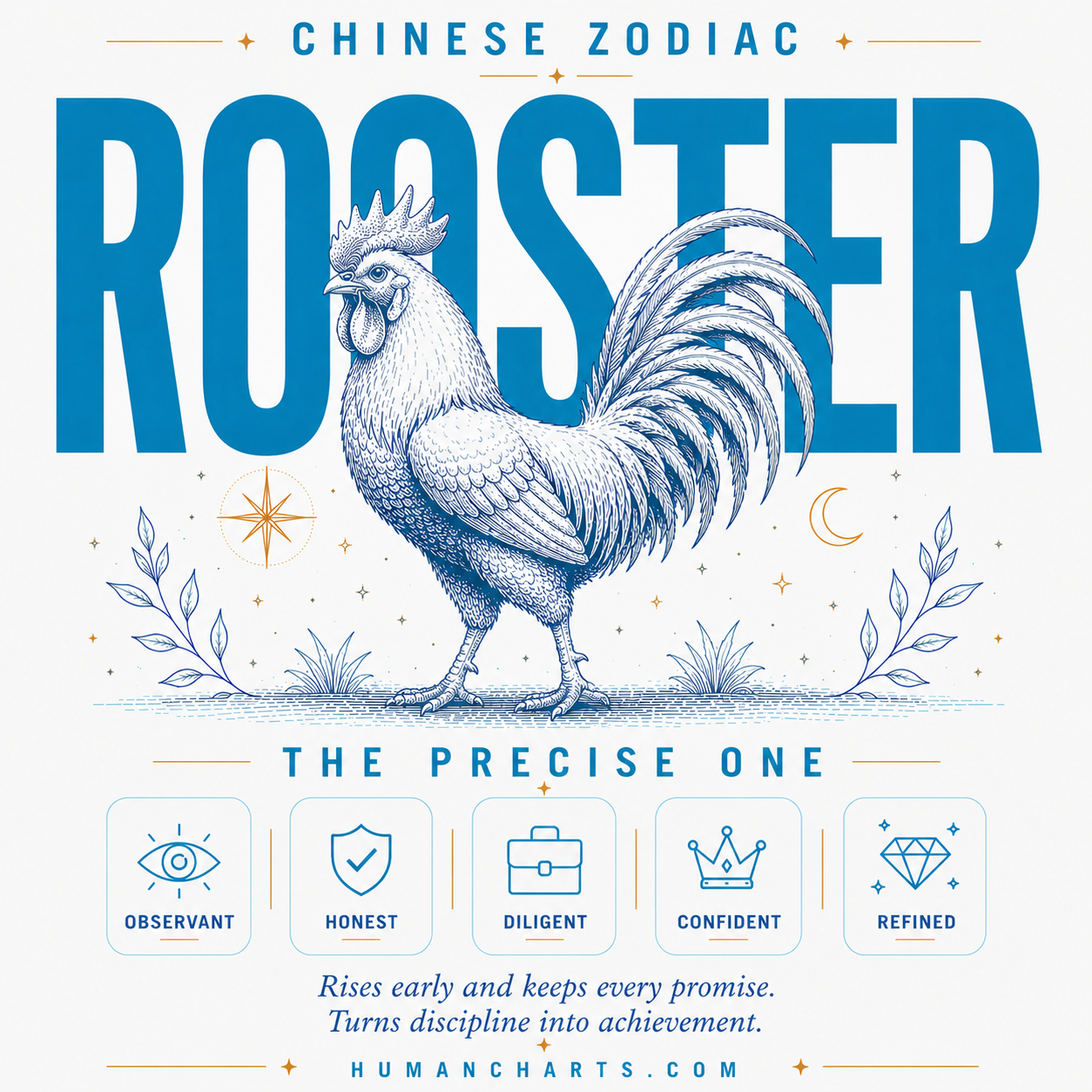
The Rooster Chinese Zodiac at a Glance
- The Animal: The Rooster — The Honest One
- Years: 1933, 1945, 1957, 1969, 1981, 1993, 2005, 2017, 2029
- How It Works: Metal (fixed) · Yin · The Rooster · Identify, apply, hold
- Optimal Decision-Making: Identify the standard · apply it precisely · hold the line
- “Be More Flexible” Is Wrong For You: Why the cultural advice misnames your instrument
- Five Elements: Wood · Fire · Earth · Metal · Water variations
- Strengths: Observant, hardworking, courageous, talented, principled
- Challenges: Perfectionist, blunt, critical, rigid under pressure
- Career & Business: Editor, auditor, surgeon, analyst, performer, quality lead
- Relationships: Need partners who can hold honesty — soft-pedaled truth is structurally exhausting
- Famous Roosters: Beyoncé, Cate Blanchett, Roger Federer, Quincy Jones
The Rooster Chinese Zodiac in Plain English
The Rooster is the Honest One. Some people are wired to see the standard a situation calls for and to apply it without softening. They notice the misaligned detail across the room, the unspoken sloppiness in the work, the gap between what was promised and what was delivered. When they speak, they say the true thing. When they work, they work to a standard most people are not even tracking. The Rooster’s discipline is precision. The Rooster’s gift is honesty.
Rooster is the Chinese Astrology label for that wiring. It is the tenth animal in the twelve-year zodiac cycle and one of the most observant, principled, and structurally honest of the twelve. The Rooster (鸡, jī) is the animal whose crow announces the day — the carrier whose voice cuts through ambiguity and names what is actually there.
If you were born in a Rooster year (1933, 1945, 1957, 1969, 1981, 1993, 2005, 2017, 2029), here is what that usually looks like in practice:
- You notice the off detail before anyone else does. The misaligned frame, the inconsistent claim, the typo nobody else has caught.
- You work harder than people around you and you do not understand why this is unusual. The standard is the standard. You meet it.
- You have a hard time pretending you do not see what you see. When you try to be polite about something that is wrong, the politeness costs you energy.
- You struggle in environments that punish precision or that ask you to lower your standards to make other people comfortable.
- You become most yourself when you have a role, a craft, or a relationship that respects the standard you are holding — and that does not ask you to disable the eye that sees it.
Listen to MATTEEN on the Rooster Chinese Zodiac — a mechanical breakdown of the tenth animal in the Chinese zodiac, how the standard operates as the engine of the path, why precision is not rigidity, and how Rooster carriers learn to use their eye without flattening the people around them.
Definition: The Rooster (鸡, jī) is the tenth animal in the twelve-year Chinese zodiac cycle. Its fixed element is Metal, its polarity is Yin, and it is associated with honesty, precision, hard work, observation, courage, and principled action. Rooster carriers operate through identifying the standard a situation calls for and applying that standard precisely, holding the line even when other people would prefer the standard to be lowered. The Rooster’s decision-making instrument is alignment with principle — the eye that sees what is correct IS the decision-making mechanism.
The Rooster is the tenth animal in the twelve-year Chinese zodiac cycle, following the Monkey and preceding the Dog. In Chinese tradition, the Rooster (鸡, jī) is associated with honesty, precision, hard work, courage, and the announcement of order — the carrier whose crow marks the boundary between night and day, ambiguity and clarity.
Before reading further — a synthesis note. Chinese Astrology is one of several systems that describe a full design. Your Western Astrology (Sun, Moon, Rising, and the rest of the placements), Human Design, and Numerology Life Path each add their own structural inputs. The patterns on this page describe what the Rooster brings — the core orientation around precision, principled action, and honest perception. How that orientation actually shows up in your career, your relationships, and your decisions is shaped by the synthesis of all the systems together, not by the Chinese Zodiac alone.
In Chinese cosmology, the twelve animals each represent a distinct developmental pattern. Where the Monkey adapts and improvises and the Dog protects and serves, the Rooster identifies the standard the situation requires and applies it — without softening, without political negotiation, without the social cushioning that other paths use to make precision palatable. The Rooster is what holds the quality of the work, the integrity of the claim, and the truth of the moment when everyone else is willing to let it slip.
The mechanism of the Rooster is precision combined with principle. The engine runs on observation, comparison against a standard, and the courage to name the gap when the gap is there. Where the Snake acts on strategy and the Horse acts on momentum, the Rooster acts on what is correct. The shadow of the path is the cost of running an unusually exacting instrument inside a world that often rewards smoothness over truth — the Rooster can be misread as critical, blunt, or rigid when in fact the carrier is doing the structural work of holding a line that protects the integrity of whatever the work is.
Rooster Years. The Rooster years in the Chinese zodiac fall every 12 years: 1933, 1945, 1957, 1969, 1981, 1993, 2005, 2017, and 2029 are the most recent and upcoming. The Chinese New Year shifts each year — typically late January or early February — so people born in January or early-to-mid February of a “Rooster year” may actually belong to the previous animal. If your birth date falls in January or early February of a Rooster year, check it against the specific Chinese New Year cutoff for that year.
Every Chinese zodiac animal is built from four structural components: its fixed element, its yin/yang polarity, its symbol, and its position in the twelve-year cycle. Here is how the Rooster is built.
- Symbol. The rooster — alert, watchful, vocal, the announcer of the day. The bird whose crow ends the ambiguity of night and names the moment morning has arrived.
- Fixed element. Metal. The Rooster’s underlying nature is structure, precision, and the capacity to cut cleanly through what is not aligned. Metal is the element of refinement and discernment.
- Yin/Yang. Yin. Receptive, observing, internal. The Rooster gathers data on the standard before applying it.
- Position in zodiac. Tenth of twelve — late in the cycle, often associated with refinement, quality control, and the integration of what the earlier animals have produced.
- Lucky colors. Gold, brown, yellow.
- Lucky numbers. 5, 7, 8.
The Rooster’s combination of Metal (precision, structure, discernment) and Yin (receptivity, observation, internalization) is the structural key. Metal by itself can cut without context; Metal under Yin observes first and then cuts — the precision is informed by careful observation of what the situation actually contains. This is the Rooster’s signature: the eye that watches closely, the standard that holds steady, and the voice that names what it sees when the moment requires it.
Mechanically, the Rooster operates in three phases: identify the standard, apply the standard precisely, hold the line even under pressure. The identification phase reads the situation and surfaces the standard it calls for — truth, quality, integrity, precision, alignment with stated values. The application phase implements that standard in the actual work, the actual decision, the actual statement. The holding phase is where the structural courage lives — it is the refusal to lower the standard when other people would prefer it lowered, and the discipline to keep applying it even when the social cost arrives.
Everything in life is a function of decision-making. Every life unfolds through the decisions made within it. For the Rooster Chinese Zodiac, the decision-making instrument is alignment with principle — the eye that identifies the standard the situation calls for and applies it. The Rooster does not decide by mood, by social consensus, or by the path of least resistance. The Rooster decides by reading the situation, naming the standard it requires, and asking whether the available options meet that standard.
Most cultures treat decision-making as a negotiation between preferences. The Rooster is built differently. For the Rooster, the question is not “what do I want” or “what will other people prefer” — the question is “what does this situation actually call for, and which option meets that standard.” The eye that sees what is correct is not a personality trait. It is the instrument. Asking the Rooster to decide without consulting the standard is asking the Rooster to decide with the instrument switched off.
How to make decisions well with this instrument:
- Name the standard out loud before evaluating the options. The Rooster’s mind moves so quickly to “this one is right” that the standard underneath the choice can stay implicit. Naming it first — to yourself, on paper, in conversation — makes the decision legible to other people and protects it from being dismissed as preference.
- Recognize the signal that the standard is being met. Clarity arrives precisely: the option aligns, the work meets the bar, the claim is true. When the alignment is there, decide and move. The Rooster’s instrument resolves cleanly when the standard is met.
- Refuse to lower the standard to make a decision faster. The cultural pressure to “just pick one” or “stop being so picky” is structurally wrong for you. Lowering the standard to close the decision produces decisions your principled mind would have refused, and the cost shows up later as compromised work, broken trust, or quiet resentment.
- Distinguish between standards that protect the work and standards that protect a preference. Not every Rooster precision is structural. Some of the standards you hold are protecting the integrity of the work and some are protecting a personal preference that you have dressed up as a standard. The discipline is learning to tell the difference — the structural standards stay, the dressed-up preferences can flex.
Everyday decisions and major decisions operate on the same instrument; only the timescale and the stakes differ. Small decisions train the eye across days — what is good coffee, what is a well-written sentence, what is a clean handoff. Major decisions — career, partnership, structural commitments — engage the same instrument at higher resolution. The Rooster who tries to make major decisions by suppressing the eye that sees the standard will produce decisions the principled mind cannot endorse, and the body will register the misalignment for years. The Rooster who respects the instrument — naming the standard, applying it, and holding the line — produces decisions of unusual integrity across decades.
The discipline is not rigidity for rigidity’s sake. The discipline is honoring the actual rhythm of how the instrument works.
The phrase “be more flexible” gets used universally — as if everyone’s decision-making instrument runs the same way and as if more flexibility is always the answer. For you, it is wrong advice. Your instrument is the standard, and your eye for what is correct is the apparatus that turns the situation into clarity. What looks like rigidity from the outside is the actual work your design is built to do.
The cultural advice to “be more flexible” or “don’t be so rigid” or “stop being so picky” generally describes a different decision-making instrument — the consensus-tracking, preference-blending mechanism that some other paths operate on. For those carriers, the advice is correct. For you, the instrument is different. The standard is not a personality preference you can flex around to keep the peace. It is the way your design makes decisions at all. Asking the Rooster to flex on the standard is asking the Rooster to disable the instrument the decision-making is running on.
When other people say “be more flexible,” they may be operating from a different instrument, or they may simply be uncomfortable with the rhythm your design requires. Either way, the advice misnames your work. The precision is not rigidity. The standard is not stubbornness. They are the structural mechanism your decision-making runs on.
For you, trust the standard. Apply it precisely. Hold the line when the moment requires it. Flex on the dressed-up preferences. Refuse the cultural pressure to disable the eye that sees what is correct.
Chinese Astrology pairs each animal’s fixed element with a year-specific element from the Five Elements system (Wood, Fire, Earth, Metal, Water) on a 60-year master cycle. This means every Rooster is not just a Rooster — they are a Wood Rooster, Fire Rooster, Earth Rooster, Metal Rooster, or Water Rooster depending on which year inside the 60-year cycle they were born. The fixed Metal element gives the Rooster its core nature; the year-specific element shades how that core is expressed.
- Wood Rooster (1945, 2005) — more expressive, generous, and socially engaged. Wood softens the Metal’s edge and produces a more outwardly warm version of the path — still principled, but with more bandwidth for the people around the standard.
- Fire Rooster (1957, 2017) — more dramatic, charismatic, and emotionally intense. Fire heats the Metal and produces the most magnetic and performative of the Rooster variations — the standard delivered with public presence.
- Earth Rooster (1909, 1969) — more grounded, practical, and patient. Earth stabilizes the Metal’s precision and produces operators who build durable systems and hold the standard across the long arc without burning out.
- Metal Rooster (1921, 1981) — the double-metal combination. The most exacting, structured, and uncompromising of the Rooster variations. Metal on Metal produces a carrier whose precision is the structural signature of everything they touch.
- Water Rooster (1933, 1993) — more reflective, philosophical, and adaptable. Water softens the Metal and produces the most thoughtful of the variations — the standard held with depth and the capacity to consider context before applying it.
When you read about a Rooster’s traits, the fixed Metal-Yin nature is the foundation. The year-specific element is the modifier. A 1981 Metal Rooster will read differently than a 1969 Earth Rooster even though both share the underlying mechanism.
The Rooster carries a consistent set of themes that show up across a carrier’s lifetime, regardless of upbringing, culture, or career. These are the structural traits the sign is built from.
- Observation. A built-in tendency to notice the detail other people miss. The carrier’s eye is the instrument — it does not switch off.
- Honesty. A structural inability to comfortably lie. The Rooster can be diplomatic, but the carrier registers the cost of the unsaid truth and the cost compounds.
- Hard work. A native willingness to do the work to the standard, including the parts other people would skip. The Rooster does not understand why other people stop early.
- Principle. A clear internal sense of right and wrong, fair and unfair, true and false. The carrier acts from principle even when it costs them.
- Courage. A capacity to say the unpopular thing, hold the unpopular position, and refuse the comfortable lie. The Rooster’s voice cuts.
- Talent. A pattern of being unusually capable across the carrier’s domains — the precision and the work ethic compound into skill that other people notice.
- Confidence. A grounded self-trust that does not require external validation. The Rooster knows the standard was met. That knowing is its own ground.
- Aesthetic discernment. A strong eye for quality — in dress, presentation, environment, craft. The Rooster cares how things look because how things look is a signal of how they were made.
Rooster carriers are designed to:
- See what other people miss — the off detail, the inconsistency, the gap between claim and reality
- Hold a standard across the long arc, including through pressure that would cause less principled paths to compromise
- Do the unglamorous structural work that protects the integrity of the larger thing — auditing, editing, quality, verification
- Speak truth in rooms that need it, even when the social cost is real
- Build bodies of work whose precision is part of the value — the work meets the bar in ways that less exacting paths would not have produced
Strong work shows up where precision and honesty matter. Editors, auditors, and quality leads use the path’s eye to keep the work honest. Surgeons, specialist physicians, and master technicians use the precision to do work where the margin for error is structural. Performers and athletes use the discipline to train to a standard most people cannot sustain. Analysts and investigators use the honesty to surface what was actually there. The Rooster is not built for environments where the work is supposed to look fine even when it is not — it is built for situations where the carrier’s specific exacting eye and principled action are the value.
When this path is operating cleanly, Rooster carriers do not need to perform their precision. The work itself transmits it — the catch nobody else made, the standard nobody else held, the truth nobody else said. People around the carrier often experience the Rooster as the person they trust to actually look. The trap of the path is that the eye is so reliable that the carrier can spend years applying it to other people’s work and never turn it on their own life — the standard the Rooster holds for everyone else can be quietly absent from the Rooster’s own choices.
The shadow of the Rooster is the predictable distortion that appears when the path’s mechanics are overdriven. Common patterns:
- Precision becomes perfectionism. The standard that produces quality becomes the standard that prevents the work from ever shipping. Good enough never arrives.
- Honesty becomes bluntness without care. The structural inability to comfortably lie becomes a willingness to say the true thing without considering whether the receiver can hold it.
- Observation becomes criticism. The eye that notices the off detail becomes the voice that names every off detail, and the people around the carrier feel monitored rather than seen.
- Principle becomes rigidity. The clear sense of right and wrong becomes an unwillingness to consider that other contexts have other standards.
- Hard work becomes burnout. The willingness to do the structural work becomes a refusal to stop, and the body pays the cost.
- Confidence becomes self-righteousness. The grounded self-trust hardens into a posture that does not register its own potential blind spots.
- Standard-holding becomes control. The instinct to keep the work clean becomes a need to control how other people do their work, and collaboration suffers.
- Self-doubt under the confident exterior. The path can run an unusually critical inner monologue that the public confidence never reveals — the Rooster judges itself by the same standard it applies to everything else, and the standard is exacting.
The repair pattern is not to suppress the path’s mechanics. The standard is correct. The repair is in noticing when precision has become perfectionism, when honesty has been delivered without care for the receiver, and when the eye that watches the work has started monitoring the people. The earlier in life this discernment develops, the more the path compounds into bodies of work, partnerships, and positions that the Rooster’s exacting eye was structurally built to produce. The later it develops, the more the carrier spends decades excellent, correct, and quietly cut off from the people whose work the Rooster was actually trying to protect.
Rooster carriers are designed to:
- Distinguish between the structural standard and the dressed-up preference
- Deliver honesty with care for whether the receiver can hold it, without softening the content itself
- Recognize when the eye has started monitoring the people rather than the work
- Turn the standard on the carrier’s own life with the same precision it turns on everything else
The Rooster is built for work that has a precision, integrity, or quality-control layer. The path tends to perform at its peak when the carrier is operating in fields that reward exact work, principled judgment, and the willingness to name what is actually there. It tends to perform poorly in roles that require constant softening of the truth, environments that punish precision as a personality problem, or cultures where “good enough” is the structural ceiling. The actual career format depends on the synthesis with the rest of the chart — the careers below are where the Rooster’s mechanism is most directly engaged, not the only places it shows up. Many Rooster carriers do their precision work quietly inside roles that are not officially about precision: as the team member whose check is the institutional safeguard, the colleague whose draft is the one that turns out to be right, the parent whose standards quietly raise the standard the child holds for themselves.
Careers where the Rooster’s mechanism is most directly engaged include:
- Editor, copy editor, fact-checker, proofreader
- Auditor, accountant, controller, compliance officer
- Surgeon, dentist, specialist physician, master technician
- Analyst, researcher, investigator, journalist
- Quality lead, head of standards, operations precision role
- Lawyer, especially regulatory, contract, or litigation work
- Performer, athlete, dancer, musician — disciplines that train to an exacting standard
- Designer, architect, craftsperson — fields where the eye for quality is the asset
- Founder of a venture where the structural standard of the work is the differentiator
Misaligned environments include roles that require constant softening of unwelcome truths, cultures that treat the carrier’s standard as a personality problem, work where the carrier is asked to ship things they know are not yet good, and any environment that asks the Rooster to disable the eye that sees what is correct.
In careers, Rooster carriers are designed to:
- Build a body of work or a body of relationships where the carrier’s exacting eye is the asset, not a problem inside
- Negotiate for the conditions that let the standard actually be met — time, resources, authority over the work the carrier is accountable for
- Distinguish between structural standards that protect the work and dressed-up preferences that protect the carrier’s comfort
- Deliver the truth the role requires the carrier to deliver, with care for the receiver but without sacrificing the content
In close relationships, the Rooster tends to show up as a partner who brings honesty, observation, structural reliability, and a need for the partner to respect the standard the Rooster is holding. The carrier reads the partner at a high resolution and notices things the partner does not know are visible — the small inconsistency, the unsaid concern, the gap between what the partner is saying and what the partner is actually doing. How this plays out in any specific relationship depends on the rest of the chart — but the core Rooster pattern of principled honesty combined with exacting observation shows up consistently across carriers.
Common challenges include difficulty softening unwelcome truths (the path finds soft-pedaling structurally exhausting), naming the off detail in a way the partner experiences as criticism even when the Rooster meant it as observation, holding the partner to a standard the partner did not consent to, turning the eye for quality on the partner’s choices in ways that erode the partner’s autonomy, difficulty receiving criticism from the partner (the Rooster’s confidence is grounded but it does not always have room for being seen as wrong), and a tendency to default to the structural truth without checking whether the partner is in a state to hold it.
The release in relationships is the discipline of delivering the honesty the partnership actually requires while caring for whether the partner can hold it in the form the carrier is delivering it in. The carrier learns to keep the content true and adjust the form — the same truth, delivered when the partner can receive it, with care for the receiver. Healthy Rooster partnerships involve a carrier who has practiced delivering honesty with care for the receiver and a partner who can value the precision without feeling monitored by it.
Rooster carriers are designed to:
- Choose partners who can hold honest observation and who value precision without experiencing it as control
- Practice delivering truth with care for the receiver — adjust the form, keep the content
- Distinguish between structural feedback the partnership needs and preference-criticism the partner did not ask for
- Recognize when the eye has started monitoring the partner rather than seeing them, and turn it off in domains where the partner did not consent to be evaluated
The pattern is consistent across fields: a body of work or a public life built on observation, principled action, and a standard most people are not even tracking. Below are 13 well-documented Rooster figures across music, film, sports, business, and culture — each verified against the Chinese New Year cutoffs for their birth years.
A Direct Transmission from MATTEEN
“Everything in your life is a function of decision-making. Every life unfolds through the decisions made within it. The Rooster’s decision-making instrument is the standard — the eye that identifies what the situation calls for and the principled action that applies it. The mistake is thinking the precision is a personality trait you should soften to make other people comfortable. The precision is the instrument. The standard is not optional. Most Rooster carriers spend a decade trying to be less exact to fit in. The harder discipline is holding the standard while learning to deliver it with care for the receiver — same content, better form. Identify the standard. Apply it precisely. Hold the line.”
— Matteen Terrany
Frequently Asked Questions About the Rooster Chinese Zodiac
Unlock Your Full Chinese Zodiac
Your Chinese zodiac animal is one structural layer of your design. Your Western Astrology, Human Design, and Numerology Life Path add the rest. Calculate your full reading and start working with it.
Want to learn about the other Chinese zodiac animals? See the complete guide to all 12 animals →
The standard is the standard. The eye is the instrument.