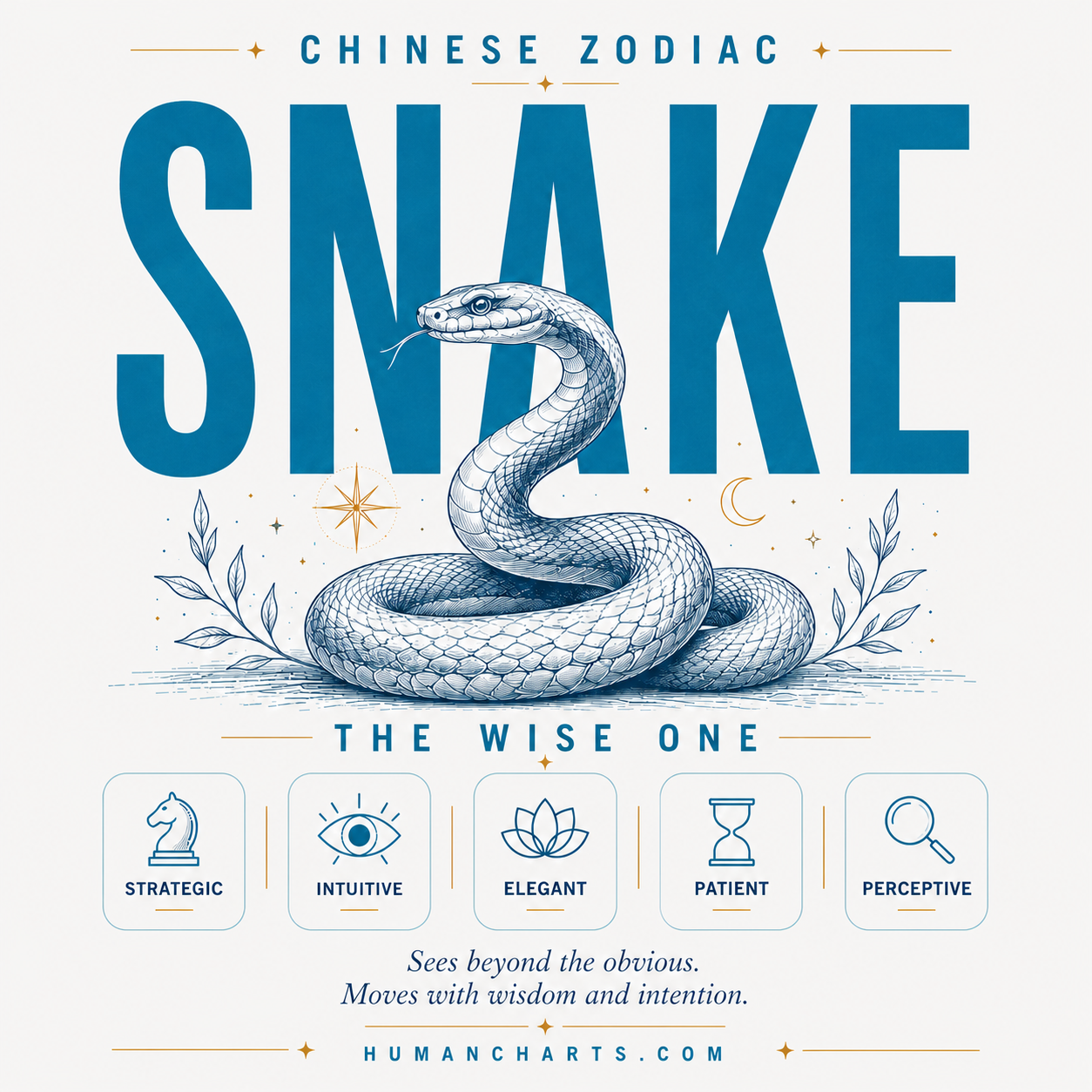
The Snake Chinese Zodiac at a Glance
- The Animal: The Snake — The Wise One
- Years: 1929, 1941, 1953, 1965, 1977, 1989, 2001, 2013, 2025
- How It Works: Fire (fixed) · Yin · The Serpent · Watch, integrate, strike
- Optimal Decision-Making: Watch deeply · strike precisely · then watch again
- “Don’t Overthink It” Is Wrong For You: Why the cultural advice misnames your instrument
- Five Elements: Wood · Fire · Earth · Metal · Water variations
- Strengths: Strategic, intuitive, elegant, patient, perceptive
- Challenges: Mistrustful, secretive, possessive, paralyzed by analysis
- Career & Business: Strategist, researcher, philosopher, financier, master craftsperson
- Relationships: Need partners who can hold depth — surface intimacy is structurally exhausting
- Famous Snakes: Mahatma Gandhi, John F. Kennedy, Stephen Hawking, Oprah Winfrey
The Snake Chinese Zodiac in Plain English
The Snake is the Wise One. Some people are wired to watch before they move. They take in everything — the room, the conversation, the timing, the unspoken politics — and they hold their position until the moment is right. When they finally act, the action is precise. The Snake’s discipline is patience. The Snake’s gift is timing.
Snake is the Chinese Astrology label for that wiring. It is the sixth animal in the twelve-year zodiac cycle and one of the most strategic, intelligent, and mysterious of the twelve. The Snake (蛇, shé) is sometimes called the Little Dragon in Chinese tradition — a nod to the wisdom and quiet power the sign carries.
If you were born in a Snake year (1929, 1941, 1953, 1965, 1977, 1989, 2001, 2013, 2025), here is what that usually looks like in practice:
- You watch more than you speak. People sometimes misread your silence as agreement when actually you are observing.
- You think strategically by default. The next three moves are visible to you when other people are still planning the next one.
- You have a strong aesthetic — taste in environment, food, art, clothing, conversation. The Snake values beauty.
- You struggle in environments that punish patience or that ask you to act before you are ready.
- You become most yourself when you have a body of work, a position, or a relationship that respects the slowness of the path.
Listen to MATTEEN on the Snake Chinese Zodiac — a mechanical breakdown of the sixth animal in the Chinese zodiac, how patience operates as the engine of the path, why strategy beats speed, and how Snake carriers learn to use their watchfulness without disappearing inside it.
Definition: The Snake (蛇, shé) is the sixth animal in the twelve-year Chinese zodiac cycle. Its fixed element is Fire, its polarity is Yin, and it is associated with wisdom, intuition, strategic intelligence, mystery, and patient timing. Snake carriers operate through observation and precision, holding their position until the moment for decisive action arrives. The Snake’s decision-making instrument is patient observation combined with precise timing — the watching is structurally the work, and the strike is small, fast, and exact.
The Snake is the sixth animal in the twelve-year Chinese zodiac cycle, following the Dragon and preceding the Horse. In Chinese tradition, the Snake (蛇, shé) is associated with wisdom, intuition, mystery, and quiet power. The classical Chinese phrase pairs the Snake with the Dragon as the Little Dragon — same fundamental energy, expressed through stillness rather than display.
Before reading further — a synthesis note. Chinese Astrology is one of several systems that describe a full design. Your Western Astrology (Sun, Moon, Rising, and the rest of the placements), Human Design, and Numerology Life Path each add their own structural inputs. The patterns on this page describe what the Snake brings — the core orientation around strategic patience, intuition, and refined timing. How that orientation actually shows up in your career, your relationships, and your decisions is shaped by the synthesis of all the systems together, not by the Chinese Zodiac alone.
In Chinese cosmology, the twelve animals each represent a distinct developmental pattern. Where the Dragon initiates with power and the Horse moves with speed, the Snake operates through observation, integration, and the patient build-up of strategic understanding before any move is made. The Snake is what holds the structure together while everyone else is moving — and what acts decisively when the moment is precisely right.
The mechanism of the Snake is patience combined with intelligence. The engine runs on watching, integrating, and waiting until the strike is worth the effort. Where the Tiger acts on instinct and the Rooster acts on principle, the Snake acts on strategy. The shadow of the path is the cost of running an unusually patient and observant instrument inside a world that often rewards speed — the Snake can be misread, undervalued, or dismissed as cold when in fact the carrier is processing at depth.
Snake Years. The Snake years in the Chinese zodiac fall every 12 years: 1929, 1941, 1953, 1965, 1977, 1989, 2001, 2013, and 2025 are the most recent. The Chinese New Year shifts each year — typically late January or early February — so people born in January or early-to-mid February of a “Snake year” may actually belong to the previous animal. If your birth date falls in January or early February of a Snake year, check it against the specific Chinese New Year cutoff for that year.
Every Chinese zodiac animal is built from four structural components: its fixed element, its yin/yang polarity, its symbol, and its position in the twelve-year cycle. Here is how the Snake is built.
- Symbol. The serpent — coiled, watchful, capable of sudden precision after long stillness.
- Fixed element. Fire. The Snake’s underlying nature is heat held inside — passion and intensity contained behind quiet exterior.
- Yin/Yang. Yin. Receptive, internal, observing. The Snake gathers before it acts.
- Position in zodiac. Sixth of twelve — exactly halfway through the cycle, often associated with maturation and integration.
- Lucky colors. Red, yellow, black.
- Lucky numbers. 2, 8, 9.
The Snake’s combination of Fire (intensity, passion) and Yin (receptivity, internalization) is the structural key. Fire by itself burns hot and visible; Fire held under Yin burns hot and invisible. This is the Snake’s signature: deep intensity processed through stillness, then expressed with surgical precision when the moment requires it. The watching is not absence — it is the work.
Mechanically, the Snake operates in three phases: observation, integration, and strike. The observation phase collects high-resolution data about the room, the timing, and the patterns underneath the surface. The integration phase assembles what the watching has gathered into a coherent strategic picture — usually below the threshold of conscious analysis. The strike phase is precise and fast, but it is structurally the smallest part of the process. The watching is most of the work.
Everything in life is a function of decision-making. Every life unfolds through the decisions made within it. For the Snake Chinese Zodiac, the decision-making instrument is patient observation combined with precise timing. The watching is not the prelude to the work — the watching IS the work. The discipline is to act decisively when the observation reveals the moment, and to refuse to act before the moment has revealed itself.
Most cultures treat decision-making as the strike phase alone — the moment of action. The Snake is built differently. For the Snake, the observation phase is structurally primary. The body collects data at a higher resolution than other paths can perceive. The strategic mind integrates that data into a coherent picture, often below conscious thought. By the time the strike happens, the decision has already been made by the integration — the strike is just the execution.
How to make decisions well with this instrument:
- Honor the watching as the work. When you find yourself observing without acting, do not interpret it as procrastination. For your design, observation is structurally productive. The strategic mind is integrating; the body is gathering. Trust the process.
- Recognize the signal that the moment has arrived. Clarity announces itself precisely: the strategic picture resolves, the next move becomes visible, and the body’s resistance to action drops. When all three line up, strike. Do not wait further.
- Refuse to strike before the picture has resolved. The cultural pressure to “be decisive” or “act now” is structurally wrong for you. Acting before the watching is complete produces tactical moves your strategic mind would have refused. The cost compounds.
- Work in patterns, not moments. The Snake’s mind operates on pattern, not isolated facts. When facing a major decision, observe the pattern across weeks or months — not the data point in front of you. Truth lives in the pattern.
Everyday decisions and major decisions operate on the same instrument; only the timescale differs. Small decisions train the instrument across days. Major decisions — career, partnership, structural commitments — can require months or years of observation before the moment for action resolves. The Snake who tries to make major decisions on the same timescale other animals operate at will rush the instrument and produce moves the strategic mind would not have endorsed. The Snake who respects the natural timescale produces decisions of unusual quality across decades.
The discipline is not patience for patience’s sake. The discipline is honoring the actual rhythm of how the instrument works.
The phrase “don’t overthink it” gets used universally — as if everyone’s decision-making instrument runs the same way and as if more thinking is always the problem. For you, it is wrong advice. Your instrument is observation, and your strategic mind is the apparatus that turns the watching into clarity. What looks like “overthinking” from the outside is the actual work your design is built to do.
The cultural advice to “don’t overthink it” or “trust your gut” or “just decide already” generally describes a different decision-making instrument — the fast in-the-body signal that some other animals (and some Human Design authorities) are built to operate on. For those carriers, the advice is correct. For you, the instrument is different. The body’s read does not arrive in a moment. It arrives across the integration of pattern, across the observation period the strategic mind requires. Cutting the observation short to “decide already” produces tactical decisions the strategic mind would have refused.
When other people say “don’t overthink it,” they may be operating from a faster instrument, or they may simply be uncomfortable with the rhythm your design requires. Either way, the advice misnames your work. The watching is not overthinking. The strategic integration is not paralysis. They are the structural mechanism your decision-making runs on.
For you, trust the watching. Strike when the picture resolves. Refuse the cultural pressure to act before the moment has arrived.
Chinese Astrology pairs each animal’s fixed element with a year-specific element from the Five Elements system (Wood, Fire, Earth, Metal, Water) on a 60-year master cycle. This means every Snake is not just a Snake — they are a Wood Snake, Fire Snake, Earth Snake, Metal Snake, or Water Snake depending on which year inside the 60-year cycle they were born. The fixed Fire element gives the Snake its core nature; the year-specific element shades how that core is expressed.
- Wood Snake (1905, 1965, 2025) — more creative, expressive, and adaptable. Wood softens the Snake’s reserve and produces a more outwardly engaged version of the path.
- Fire Snake (1917, 1977) — the double-fire combination. More dramatic, passionate, and emotionally intense. Fire on Fire produces the most magnetic of the Snake variations.
- Earth Snake (1869, 1929, 1989) — more grounded, practical, and steady. Earth stabilizes the Snake’s strategic mind and produces operators who build durable structures.
- Metal Snake (1881, 1941, 2001) — more disciplined, structured, and ambitious. Metal sharpens the Snake’s precision and produces the most strategically focused of the variations.
- Water Snake (1893, 1953, 2013) — more intuitive, philosophical, and deep. Water deepens the Snake’s mystery and produces the most contemplative of the variations.
When you read about a Snake’s traits, the fixed Fire-Yin nature is the foundation. The year-specific element is the modifier. A 1977 Fire Snake will read differently than a 1989 Earth Snake even though both share the underlying mechanism.
The Snake carries a consistent set of themes that show up across a carrier’s lifetime, regardless of upbringing, culture, or career. These are the structural traits the sign is built from.
- Watchfulness. A built-in tendency to observe before acting. The carrier collects information at a higher resolution than other paths.
- Strategic mind. A capacity to see several moves ahead, to anticipate consequences, to position quietly for the move that arrives later.
- Intuition. A high-resolution inner knowing that arrives without explanation — and is often correct.
- Elegance. A strong aesthetic sense. Taste in environment, art, clothing, food, conversation, presentation. The Snake values beauty as a structural good.
- Sensuality. A native appreciation for the body, touch, taste, and the slow pleasures. The Snake is one of the most sensual signs in the Chinese zodiac.
- Mystery. A natural privacy about the inner life. The carrier does not broadcast — they keep the depth contained.
- Persistence. A long-arc commitment to goals, projects, and relationships. The Snake’s slowness is a form of devotion.
- Wisdom. A capacity to integrate experience into understanding that other people then come to the carrier to receive.
Snake carriers are designed to:
- See what is coming long before other people can see it
- Make precise, well-timed decisions that other paths miss because they moved too soon
- Hold a strategic position across the years it takes for the strategy to mature
- Cultivate refined taste, aesthetic environments, and bodies of work other people want to spend time inside
- Build long-arc relationships, careers, and structures that compound through patient construction
Strong work shows up where strategy and timing matter. Researchers and theorists use the path’s watchfulness to develop bodies of work that other people then operate inside. Strategists, investors, and senior advisors use the precision to make calls that less patient paths would have rushed. Artists and craftspeople use the path’s aesthetic depth to make work that other people return to across decades. The Snake is not built for high-volume tactical work where the action has to be constant and the depth has to be suppressed — it is built for situations where the carrier’s specific strategic intelligence and refined judgment are the value.
When this path is operating cleanly, Snake carriers do not need to perform their intelligence. The work itself transmits it — the strategy that succeeded, the framework that holds, the choice that turned out to have been the right one. People around the carrier often sense that something deeper is being processed even when the carrier is not yet speaking. The trap of the path is that this depth is real and easy to keep private indefinitely, so carriers who never learn to bring the work out can spend decades developing remarkable judgment that the world never gets to use.
The shadow of the Snake is the predictable distortion that appears when the path’s mechanics are overdriven. Common patterns:
- Mistrust hardens into paranoia. The watchfulness that protects becomes a default suspicion that erodes relationships and isolates the carrier.
- Patience becomes paralysis. The waiting that serves strategy becomes the waiting that avoids action altogether. The strike never comes.
- Mystery becomes isolation. The privacy that protects the inner life becomes a barrier other people cannot cross. Intimacy becomes structurally hard.
- Strategy becomes manipulation. The capacity to see several moves ahead gets used against the people around the carrier rather than with them.
- Sensuality becomes obsession. The native appreciation for beauty hardens into attachments that cost the carrier their alignment.
- Possessiveness. Once the Snake has chosen — a partner, a project, a position — letting go is structurally difficult. The grip can become its own problem.
- Secrecy. What was protective privacy becomes an inability to let the partner, the team, or the friends actually know the carrier.
- Self-doubt under the strategic mask. The path can run an unusually critical inner monologue that the public confidence never reveals.
The repair pattern is not to suppress the path’s mechanics. The patience is correct. The repair is in noticing when watchfulness has become mistrust, when waiting has become avoidance, and when privacy has become isolation. The earlier in life this discernment develops, the more the path compounds into bodies of work, partnerships, and positions that the Snake’s slowness was structurally built to produce. The later it develops, the more the carrier spends decades brilliant, private, and quietly resentful that nobody saw what they were holding.
Snake carriers are designed to:
- Distinguish between strategic patience and avoidance dressed up as strategy
- Move when the moment is right, even though the body’s preference is to wait further
- Let trusted partners into the inner life on a timeline the carrier can actually sustain
- Recognize when secrecy has become a structural cost rather than a structural protection
The Snake is built for work that has a strategic, contemplative, or aesthetic layer. The path tends to perform at its peak when the carrier is operating in fields that reward observation, long-arc thinking, refined judgment, or deep specialized expertise. It tends to perform poorly in high-volume, low-stakes tactical work where the path’s depth has to be suppressed and the strategic capacity cannot show through. The actual career format depends on the synthesis with the rest of the chart — the careers below are where the Snake’s mechanism is most directly engaged, not the only places it shows up. Many Snake carriers do their strategic work quietly inside roles that are not officially strategic: as the senior employee whose judgment is the institutional memory, the consultant whose contribution is the one sentence that reframes everything, the parent whose patient guidance shapes a child’s decisions years later. The mechanism is the same; the format varies.
Careers where the Snake’s mechanism is most directly engaged include:
- Researcher, scientist, academic, philosopher
- Strategist, senior consultant, executive advisor
- Investor, capital allocator, financial analyst, deep-value or long-arc investing
- Lawyer, especially appellate, contract, or strategic work
- Therapist, psychoanalyst, depth-psychology practitioner
- Writer of long-form work that rewards sustained attention
- Master craftsperson, artisan, fine artist, art curator
- Surgeon, specialist physician, master technical specialist
- Founder of a long-arc venture where patient capital and refined judgment are the assets
Misaligned environments include high-volume customer-facing work with no time for depth, cultures that punish patience and reward speed, roles that require constant social performance, and any environment that treats the Snake’s privacy and slowness as problems to be solved.
In careers, Snake carriers are designed to:
- Build a body of work or a body of relationships that the carrier’s strategic intelligence is the asset of, not a problem inside
- Negotiate for the time the work actually requires — the Snake produces best output on its own clock
- Distinguish between strategic patience that produces compounded returns and avoidance dressed up as strategy
- Bring the inner work out at intervals the carrier can sustain — the world cannot use what stays private forever
In close relationships, the Snake tends to show up as a partner who brings unusual depth, intuition, sensuality, and a structural need for the partner to respect the slowness of the path. The carrier reads the partner at a high resolution and often knows what the partner is feeling before the partner has named it. How this plays out in any specific relationship depends on the rest of the chart — but the core Snake pattern of strategic intimacy combined with deep privacy shows up consistently across carriers.
Common challenges include difficulty with surface chit-chat (the path finds it structurally exhausting), reading the partner so accurately that the carrier responds to what the partner has not yet said (and the partner experiences this as being managed), withdrawal into solitude when the partnership requires real-time emotional presence, possessiveness once the relationship is established (the Snake’s grip is firm), and a difficulty letting the partner fully see the carrier’s inner world — the privacy that protects the path can become a wall the partner cannot cross.
The release in relationships is the discipline of letting the partner in on the carrier’s actual timeline. The carrier learns to bring the inner work into the partnership without performing it, without managing the partner’s reception of it, and without requiring the partner to earn access through some implicit test. Healthy Snake partnerships involve a carrier who has practiced bringing the depth out at a rhythm the partnership can hold, and a partner who can value the privacy without feeling locked out by it.
Snake carriers are designed to:
- Choose partners who can hold the slowness and respect the depth without trying to rush either
- Practice bringing the inner work into the partnership — small disclosures across years, not big disclosures all at once
- Distinguish between protective privacy and isolation dressed up as privacy
- Recognize possessiveness as it arises and ask whether the grip is serving the relationship or replacing it
The pattern is consistent across fields: a body of work or a public life built on observation, patient timing, and strategic intelligence other paths did not have. Below are 14 well-documented Snake figures across politics, science, music, film, sports, and literature — each verified against the Chinese New Year cutoffs for their birth years.
A Direct Transmission from MATTEEN
“Everything in your life is a function of decision-making. Every life unfolds through the decisions made within it. The Snake’s decision-making instrument is the watching — observation combined with strategic integration combined with precise timing. The mistake is thinking the watching is just the prelude to the action. The watching IS the work. Most Snake carriers spend a decade learning to trust what they are seeing. The harder discipline is acting when the watching reveals the moment — most Snakes wait one beat too long because the watching is more comfortable than the strike. Watch deeply. Strike precisely. Then watch again.”
— Matteen Terrany
Frequently Asked Questions About the Snake Chinese Zodiac
Unlock Your Full Chinese Zodiac
Your Chinese zodiac animal is one structural layer of your design. Your Western Astrology, Human Design, and Numerology Life Path add the rest. Calculate your full reading and start working with it.
Want to learn about the other Chinese zodiac animals? See the complete guide to all 12 animals →
The strike is fast. The watching is everything.