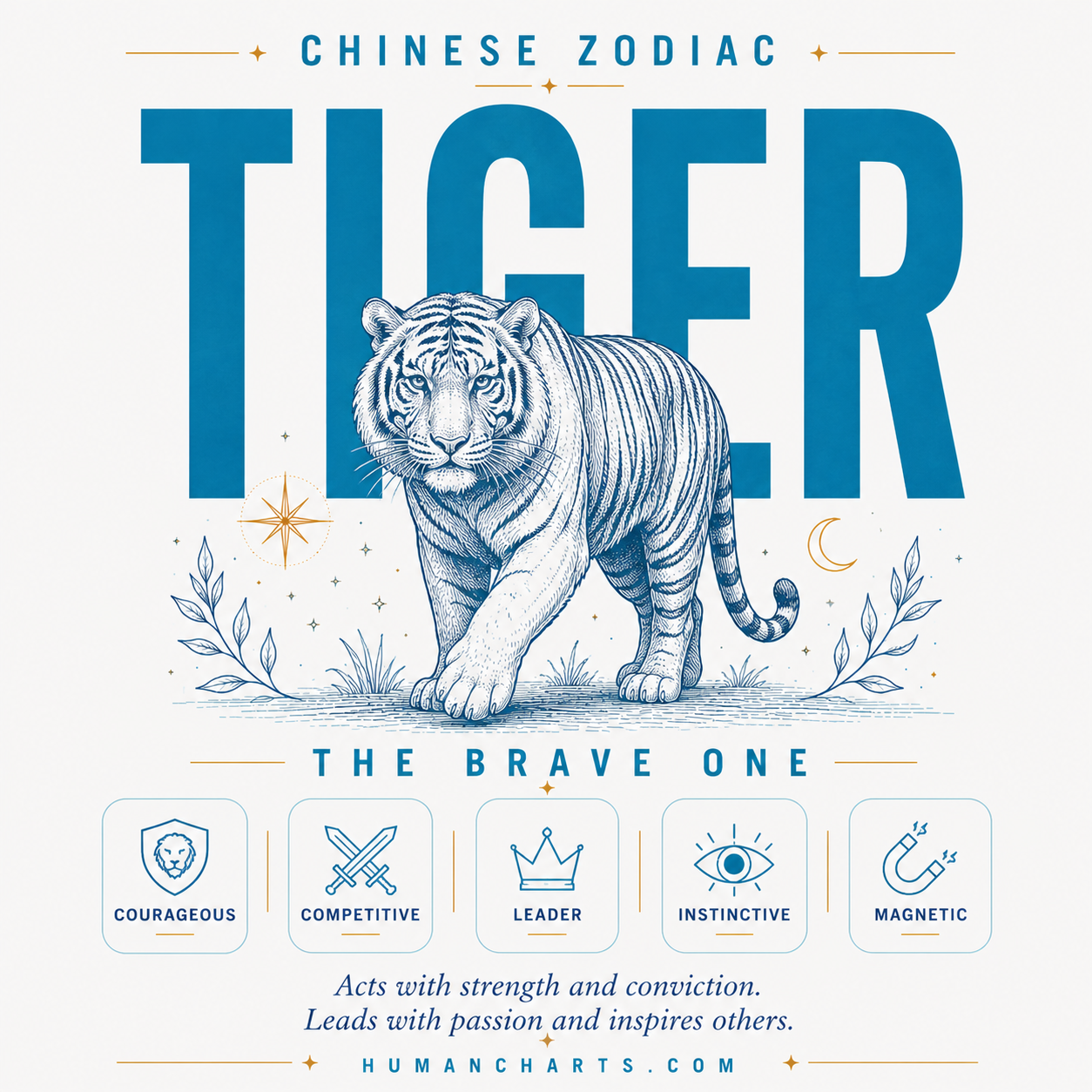
The Tiger Chinese Zodiac at a Glance
- The Animal: The Tiger — The Brave One
- Years: 1926, 1938, 1950, 1962, 1974, 1986, 1998, 2010, 2022
- How It Works: Wood (fixed) · Yang · The Tiger · Feel, engage, adjust
- Optimal Decision-Making: Feel the call · engage instinctively · adjust mid-motion
- “Think Before You Act” Is Wrong For You: Why the cultural advice misnames your instrument
- Five Elements: Wood · Fire · Earth · Metal · Water variations
- Strengths: Courageous, charismatic, magnetic, decisive, present
- Challenges: Impulsive, rebellious, restless, burned out by indecision
- Career & Business: Leader, founder, performer, athlete, frontline operator
- Relationships: Need partners who can hold intensity — low-voltage intimacy is structurally suffocating
- Famous Tigers: Queen Elizabeth II, Marilyn Monroe, Tom Cruise, Leonardo DiCaprio
The Tiger Chinese Zodiac in Plain English
The Tiger is the Brave One. Some people are wired to engage before they analyze. They feel the call of the situation and the body responds — the impulse arrives whole, already containing the read of the room, the timing, and the move. When they finally explain what they did, the explanation comes after the fact. The Tiger’s discipline is presence. The Tiger’s gift is courage.
Tiger is the Chinese Astrology label for that wiring. It is the third animal in the twelve-year zodiac cycle and one of the most magnetic, decisive, and powerful of the twelve. The Tiger (虎, hǔ) is sometimes called the king of beasts in Chinese tradition — a nod to the natural authority and instinctive leadership the sign carries.
If you were born in a Tiger year (1926, 1938, 1950, 1962, 1974, 1986, 1998, 2010, 2022), here is what that usually looks like in practice:
- You act before you have finished thinking. People sometimes call this impulsive when actually your body has already read the situation.
- You walk into rooms and the room reorganizes around you. The Tiger has a built-in magnetism that does not require performance.
- You have a strong sense of justice — you move when you see something wrong, often before the situation has clarified.
- You struggle in environments that punish initiative or that require you to wait for permission to act.
- You become most yourself when you have a stage, a frontier, or a fight that respects the largeness of the path.
Listen to MATTEEN on the Tiger Chinese Zodiac — a mechanical breakdown of the third animal in the Chinese zodiac, how instinct operates as the engine of the path, why action beats deliberation, and how Tiger carriers learn to use their courage without burning the structure down around them.
Definition: The Tiger (虎, hǔ) is the third animal in the twelve-year Chinese zodiac cycle. Its fixed element is Wood, its polarity is Yang, and it is associated with courage, charisma, leadership, instinctive action, and magnetic presence. Tiger carriers operate through instinctive engagement and mid-motion adjustment, with the body responding to the situation before the mind argues. The Tiger’s decision-making instrument is the impulse itself — the body has already processed the situation, and the leap is the structural mechanism through which the design works.
The Tiger is the third animal in the twelve-year Chinese zodiac cycle, following the Ox and preceding the Rabbit. In Chinese tradition, the Tiger (虎, hǔ) is associated with courage, authority, vital energy, and the power to drive away misfortune. The classical Chinese imagination places the Tiger as the king of beasts on land — a counterpart to the Dragon in the sky — and uses the symbol on amulets, doorways, and children’s clothing to repel evil.
Before reading further — a synthesis note. Chinese Astrology is one of several systems that describe a full design. Your Western Astrology (Sun, Moon, Rising, and the rest of the placements), Human Design, and Numerology Life Path each add their own structural inputs. The patterns on this page describe what the Tiger brings — the core orientation around courageous instinct, magnetic presence, and decisive action. How that orientation actually shows up in your career, your relationships, and your decisions is shaped by the synthesis of all the systems together, not by the Chinese Zodiac alone.
In Chinese cosmology, the twelve animals each represent a distinct developmental pattern. Where the Ox endures through patient labor and the Rabbit moves with gentleness and tact, the Tiger operates through instinct, presence, and the willingness to engage before the situation is fully knowable. The Tiger is what moves first when the rest of the room is hesitating — and what holds the line when everyone else has stepped back.
The mechanism of the Tiger is instinct combined with courage. The engine runs on feeling the call of the situation and engaging the body immediately, then adjusting mid-motion as the situation reveals itself. Where the Snake acts on strategy and the Rooster acts on principle, the Tiger acts on impulse — and the impulse is structurally correct. The shadow of the path is the cost of running an unusually bold and instinctive instrument inside a world that often rewards caution — the Tiger can be misread as reckless, exhausted by environments that demand hesitation, or burned out by long stretches of no real call to engage.
Tiger Years. The Tiger years in the Chinese zodiac fall every 12 years: 1926, 1938, 1950, 1962, 1974, 1986, 1998, 2010, and 2022 are the most recent. The Chinese New Year shifts each year — typically late January or early February — so people born in January or early-to-mid February of a “Tiger year” may actually belong to the previous animal. If your birth date falls in January or early February of a Tiger year, check it against the specific Chinese New Year cutoff for that year.
Every Chinese zodiac animal is built from four structural components: its fixed element, its yin/yang polarity, its symbol, and its position in the twelve-year cycle. Here is how the Tiger is built.
- Symbol. The tiger — alert, powerful, capable of explosive movement after long stillness.
- Fixed element. Wood. The Tiger’s underlying nature is growth-force, upward drive, and the natural energy that pushes through obstacles toward what it senses.
- Yin/Yang. Yang. Active, outward, expressive. The Tiger gives off energy rather than absorbing it.
- Position in zodiac. Third of twelve — early in the cycle, often associated with initiation, courage, and the breaking of new ground.
- Lucky colors. Blue, gray, white, orange.
- Lucky numbers. 1, 3, 4.
The Tiger’s combination of Wood (growth, vitality, drive) and Yang (active, outward, expressive) is the structural key. Wood by itself grows upward; Wood in the Yang mode grows visibly, fast, and against resistance. This is the Tiger’s signature: vital force expressed through immediate engagement, then channeled mid-motion into whatever the situation actually requires. The action is not haste — it is the engine running at the speed it was built to run.
Mechanically, the Tiger operates in three phases: feel the call, engage instinctively, and adjust mid-motion. The feeling phase is the body’s read of the situation — a fast, full-resolution signal that something requires presence. The engagement phase is the leap: the body commits before the mind has assembled an argument for it. The adjustment phase is where the Tiger’s intelligence actually lives — once moving, the carrier reads what is happening and modifies the trajectory in real time. The leap is small; the adjustment is most of the work.
Everything in life is a function of decision-making. Every life unfolds through the decisions made within it. For the Tiger Chinese Zodiac, the decision-making instrument is instinctive bold action. The body responds before the mind argues. The Tiger’s signal is the impulse itself — when the situation calls, the body engages with full presence. The discipline is to trust the impulse when it arrives, to engage the situation fully once committed, and to make the corrections inside the motion rather than from the sidelines.
Most cultures treat decision-making as the deliberation phase — the moment of weighing. The Tiger is built differently. For the Tiger, the deliberation has already happened, below conscious thought, in the moment the body felt the call. The impulse is not the absence of thinking. The impulse IS the thinking — already processed, already integrated, already containing the read of the situation. By the time the leap happens, the decision has been made by the body — the leap is the execution.
How to make decisions well with this instrument:
- Honor the impulse as the read. When the body engages before you have finished thinking, do not interpret it as recklessness. For your design, the impulse is structurally informed. The body has processed faster than the verbal mind can track. Trust the signal.
- Recognize the signal that the moment has arrived. Clarity announces itself in the body: the chest opens, the legs commit, the attention narrows on the situation. When all three line up, engage. Do not wait for the mind to write the permission slip.
- Refuse to wait the impulse out of existence. The cultural pressure to “think it through” is structurally wrong for you. Holding the impulse on the shelf while the verbal mind argues with itself produces hesitation that the Tiger’s design cannot absorb cleanly. The cost compounds — and the carrier loses access to the engine that was the whole point.
- Adjust inside the motion, not before it. The Tiger’s intelligence lives in the mid-motion correction, not in the pre-flight calculation. When facing a major decision, engage the first move and let the next move resolve from inside the situation. Truth lives in the contact.
Everyday decisions and major decisions operate on the same instrument; only the stakes differ. Small decisions train the instrument across days. Major decisions — career, partnership, structural commitments — still resolve through the same body signal, but the Tiger has to trust that the courage to engage will produce the correct mid-motion adjustments. The Tiger who tries to make major decisions through long deliberation will rush the verbal mind into territory it was never built to navigate and produce moves the body would not have endorsed. The Tiger who respects the natural rhythm produces decisions of unusual force across decades.
The discipline is not bravery for bravery’s sake. The discipline is honoring the actual rhythm of how the instrument works.
The phrase “think before you act” — and its cousin “look before you leap” — gets used universally, as if everyone’s decision-making instrument runs the same way and as if more deliberation is always the answer. For you, it is wrong advice. Your instrument is the impulse, and the body’s engagement is the apparatus that turns the read into action. What looks like “leaping without looking” from the outside is the actual work your design is built to do.
The cultural advice to “think before you act” or “look before you leap” or “slow down and consider” generally describes a different decision-making instrument — the deliberative, analyze-first signal that some other animals (and some Human Design authorities) are built to operate on. For those carriers, the advice is correct. For you, the instrument is different. The body’s read does not arrive after a period of analysis. It arrives as the impulse, fully formed, in the moment the situation calls. Holding the impulse on the shelf to “think it through” produces hesitation that the Tiger’s design cannot absorb cleanly — the engine stalls, the moment passes, and the carrier ends up with the same decision they were going to make anyway, only worse executed.
When other people say “think before you act,” they may be operating from a slower instrument, or they may simply be uncomfortable with the speed your design requires. Either way, the advice misnames your work. The impulse is not recklessness. The leap is not the absence of thought. They are the structural mechanism your decision-making runs on.
For you, trust the leap. Engage when the body responds. Refuse the cultural pressure to wait the impulse out of existence.
Chinese Astrology pairs each animal’s fixed element with a year-specific element from the Five Elements system (Wood, Fire, Earth, Metal, Water) on a 60-year master cycle. This means every Tiger is not just a Tiger — they are a Wood Tiger, Fire Tiger, Earth Tiger, Metal Tiger, or Water Tiger depending on which year inside the 60-year cycle they were born. The fixed Wood element gives the Tiger its core nature; the year-specific element shades how that core is expressed.
- Wood Tiger (1914, 1974) — the double-wood combination. More creative, expansive, and visionary. Wood on Wood produces the most growth-driven and idealistic of the Tiger variations.
- Fire Tiger (1926, 1986) — more dramatic, charismatic, and performative. Fire ignites the Tiger’s natural magnetism and produces the most stage-ready of the variations.
- Earth Tiger (1938, 1998) — more grounded, practical, and patient. Earth stabilizes the Tiger’s impulse and produces operators who build durable structures around the courage.
- Metal Tiger (1950, 2010) — more disciplined, focused, and uncompromising. Metal sharpens the Tiger’s force and produces the most strategically aimed of the variations.
- Water Tiger (1962, 2022) — more intuitive, fluid, and emotionally aware. Water deepens the Tiger’s sensitivity and produces the most psychologically nuanced of the variations.
When you read about a Tiger’s traits, the fixed Wood-Yang nature is the foundation. The year-specific element is the modifier. A 1986 Fire Tiger will read differently than a 1998 Earth Tiger even though both share the underlying mechanism.
The Tiger carries a consistent set of themes that show up across a carrier’s lifetime, regardless of upbringing, culture, or career. These are the structural traits the sign is built from.
- Courage. A built-in willingness to engage before the situation is fully knowable. The carrier moves while other people are still calculating.
- Charisma. A magnetic presence that reorganizes rooms without effort. The Tiger does not need to perform to be seen.
- Instinctive action. A capacity to read the situation through the body and respond immediately — the impulse is the read.
- Passion. A high-voltage internal current that drives the carrier toward whatever the situation has activated.
- Leadership. A natural authority that other people defer to before the carrier has asked for the role.
- Competitive drive. A native taste for the contest. The Tiger orients toward what is at stake and engages it.
- Rebellion. A structural resistance to authority that has not earned its position. The Tiger will not follow orders it does not respect.
- Intensity. A way of inhabiting whatever the carrier is doing at full volume. The Tiger does not do low-stakes well.
- Magnetism. A pull on attention that the carrier does not generate consciously — it arrives with the body.
Tiger carriers are designed to:
- Move first when the rest of the room is hesitating, and unstick situations that other paths cannot unstick
- Hold a line under pressure that less courageous paths would step back from
- Inspire and lead through presence rather than position — the authority arrives with the body
- Engage high-stakes situations with full force and adjust the trajectory inside the motion
- Build a career, a relationship, or a body of work that runs on the carrier’s specific combustion rather than on borrowed energy
Strong work shows up where courage, presence, and direct engagement matter. Founders use the path’s force to start ventures other paths would have analyzed into inaction. Performers and athletes use the magnetism to fill stages and arenas that less charismatic paths would have left half-empty. Frontline operators — military, emergency services, frontier roles — use the instinctive engagement to act inside situations the verbal mind would not have time to process. The Tiger is not built for slow, deliberative, low-stakes work where the courage has no call to engage and the presence has no room to show — it is built for situations where the carrier’s specific bold force is the value.
When this path is operating cleanly, Tiger carriers do not need to announce their authority. The body transmits it — the way they walk into the room, the way they engage the situation, the way the rest of the room reorganizes around them. People around the carrier often sense that something has shifted before the carrier has spoken. The trap of the path is that this force is real and easy to use destructively, so carriers who never learn to channel the courage into work the world can use can spend decades burning through situations, relationships, and positions without producing the body of work the path was built to produce.
The shadow of the Tiger is the predictable distortion that appears when the path’s mechanics are overdriven or starved. Common patterns:
- Impulse becomes recklessness. The instinctive engagement that serves the situation becomes the engagement that ignores the cost. The leap that was structural becomes the leap that destroys.
- Courage becomes domination. The natural authority that organizes the room becomes the authority that does not let other voices in.
- Passion becomes burnout. The high-voltage current that drives the work becomes the current the carrier cannot turn off — and the body breaks.
- Rebellion becomes opposition for its own sake. The structural resistance to unearned authority becomes a refusal to engage any authority, including the carrier’s own.
- Intensity becomes intolerance. The full-volume engagement becomes a structural inability to be around lower-volume people without contempt.
- Restlessness. Without a real call to engage, the engine runs the carrier into manufactured problems just to have something to engage.
- Indecision under the bold mask. Paradoxically, the Tiger can develop an unusually stuck inner state when the cultural advice to “think it through” has been internalized and the carrier no longer trusts the impulse.
- Self-doubt under the magnetism. The path can run an unusually critical inner monologue that the public force never reveals.
The repair pattern is not to suppress the path’s mechanics. The courage is correct. The repair is in noticing when impulse has become recklessness, when courage has become domination, and when intensity has become contempt. The earlier in life this discernment develops, the more the path compounds into bodies of work, partnerships, and positions that the Tiger’s force was structurally built to produce. The later it develops, the more the carrier spends decades burning brightly through situations that never become the structure the path was supposed to build.
Tiger carriers are designed to:
- Distinguish between the impulse that is the body’s read and the impulse that is restlessness looking for a target
- Channel the courage into work that requires it, rather than letting it discharge against the nearest available friction
- Let the people around the carrier in on the inner intensity at a rhythm they can hold
- Recognize when the engine is starved for real engagement and find a situation that actually calls for the path’s force
The Tiger is built for work that has a frontline, performative, or high-stakes layer. The path tends to perform at its peak when the carrier is operating in fields that reward decisive action, magnetic presence, instinctive engagement, or the willingness to lead under pressure. It tends to perform poorly in slow, deliberative, low-stakes tactical work where the path’s force has to be suppressed and the courage has no call to engage. The actual career format depends on the synthesis with the rest of the chart — the careers below are where the Tiger’s mechanism is most directly engaged, not the only places it shows up. Many Tiger carriers do their bold work quietly inside roles that are not officially heroic: as the team member who absorbs the friction other people cannot hold, the parent whose courage shapes a child’s sense of what is possible, the operator whose willingness to move first unblocks situations everyone else had given up on. The mechanism is the same; the format varies.
Careers where the Tiger’s mechanism is most directly engaged include:
- Founder, entrepreneur, startup operator
- Actor, performer, musician, public figure
- Athlete, especially competitive and high-stakes formats
- Military, emergency services, firefighter, first responder
- Activist, organizer, frontline advocate
- Trial lawyer, litigator, advocate in adversarial settings
- Executive in turnaround or crisis situations
- Sales leader, business development, deal-closer roles
- Director, conductor, leader of creative ensembles
Misaligned environments include slow bureaucracies where action requires permission from absent authorities, cultures that punish initiative and reward waiting, roles that require constant deference to processes the carrier does not respect, and any environment that treats the Tiger’s force and visibility as problems to be managed.
In careers, Tiger carriers are designed to:
- Build a position or body of work that the carrier’s specific courage and presence is the asset of, not a problem inside
- Negotiate for the autonomy the work actually requires — the Tiger produces best output when the leash is loose
- Distinguish between courage that serves the situation and force that discharges against the nearest available friction
- Bring the inner intensity out at intervals the team and the partnership can sustain
In close relationships, the Tiger tends to show up as a partner who brings unusual intensity, presence, magnetism, and a structural need for the partner to meet the voltage of the path. The carrier engages the partnership the way they engage everything else — fully, immediately, at volume. How this plays out in any specific relationship depends on the rest of the chart — but the core Tiger pattern of high-voltage intimacy combined with the need for autonomy shows up consistently across carriers.
Common challenges include difficulty with low-voltage intimacy (the path finds it structurally suffocating), engaging the partner so directly that the partner experiences it as being run over, restlessness in long stretches of stable connection where no real call to engage is present, possessiveness that arrives with the depth of the bond, and a difficulty letting the partner have authority over the carrier’s decisions — the Tiger will not be managed, and the partner who tries will be met with the rebellion the path was built to deploy against unearned authority.
The release in relationships is the discipline of channeling the intensity into the bond rather than against it. The carrier learns to bring the force into the partnership as engagement with the partner’s actual life — their work, their decisions, their inner world — rather than as pressure on the partner to match the carrier’s voltage. Healthy Tiger partnerships involve a carrier who has practiced engaging the bond with presence rather than force, and a partner who can hold the intensity without trying to dim it.
Tiger carriers are designed to:
- Choose partners who can meet the voltage without flinching and who can hold the intensity without trying to manage it
- Practice channeling the force into engagement with the partner’s real life — small acts of presence across years, not big gestures all at once
- Distinguish between protective autonomy and rebellion dressed up as autonomy
- Recognize possessiveness as it arises and ask whether the grip is serving the relationship or replacing it
The pattern is consistent across fields: a body of work or a public life built on courage, magnetic presence, and instinctive engagement other paths did not have. Below are 14 well-documented Tiger figures across politics, science, music, film, sports, and literature — each verified against the Chinese New Year cutoffs for their birth years.
A Direct Transmission from MATTEEN
“Everything in your life is a function of decision-making. Every life unfolds through the decisions made within it. The Tiger’s decision-making instrument is the impulse — instinctive engagement combined with mid-motion adjustment. The mistake is thinking the impulse is the absence of thought. The impulse IS the thinking — already processed, already integrated, already containing the read of the situation. Most Tiger carriers spend a decade being told to slow down and consider. The harder discipline is trusting the body when it commits — most Tigers wait one beat too long because the culture has taught them that the leap is reckless. Feel the call. Engage. Adjust inside the motion.”
— Matteen Terrany
Frequently Asked Questions About the Tiger Chinese Zodiac
Unlock Your Full Chinese Zodiac
Your Chinese zodiac animal is one structural layer of your design. Your Western Astrology, Human Design, and Numerology Life Path add the rest. Calculate your full reading and start working with it.
Want to learn about the other Chinese zodiac animals? See the complete guide to all 12 animals →
The leap is the read. The motion is everything.