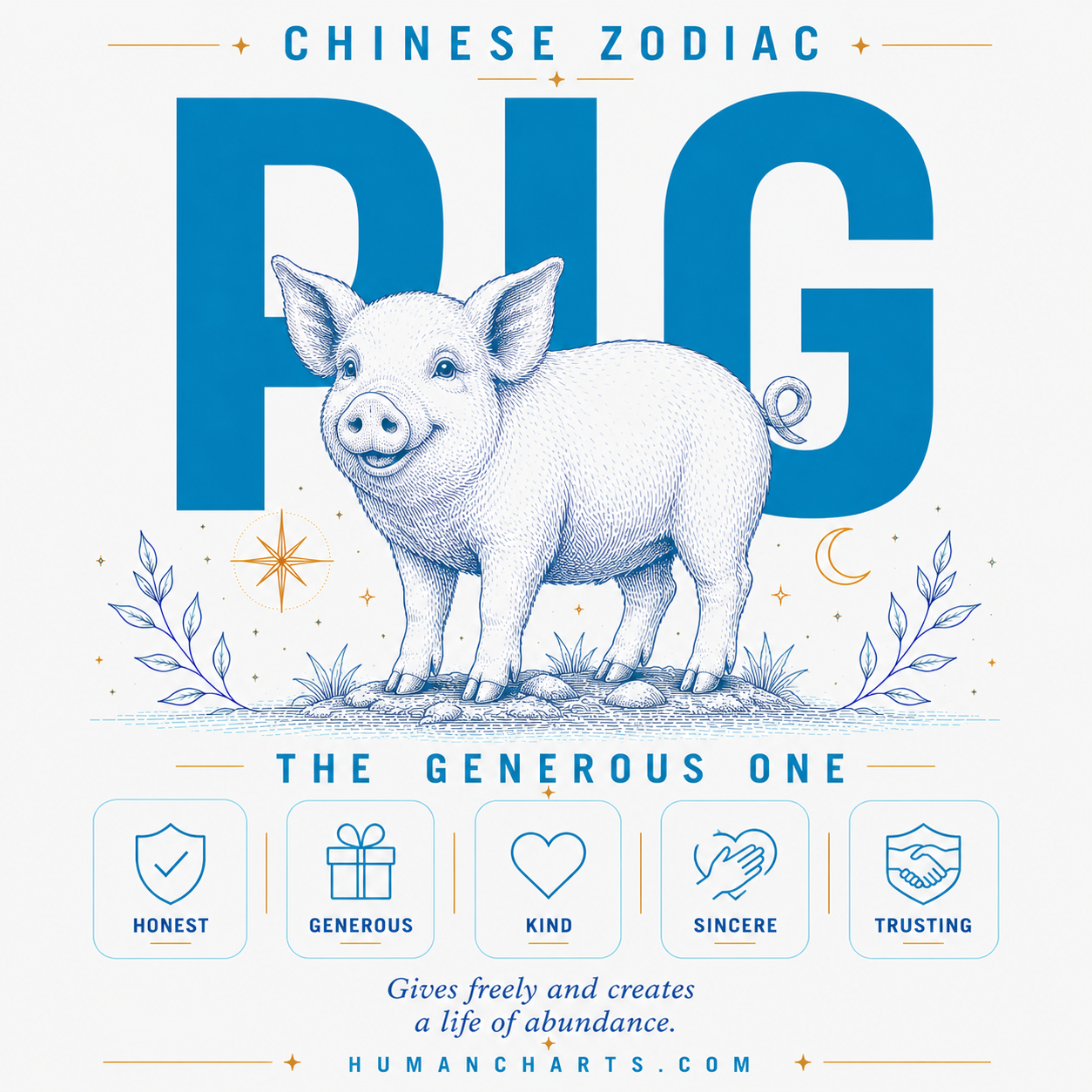
The Pig Chinese Zodiac at a Glance
- The Animal: The Pig — The Generous One
- Years: 1935, 1947, 1959, 1971, 1983, 1995, 2007, 2019, 2031
- How It Works: Water (fixed) · Yin · The Pig · Trust, give, receive
- Optimal Decision-Making: Trust openly · give generously · receive what comes back
- “Be More Skeptical” Is Wrong For You: Why the cultural advice misnames your instrument
- Five Elements: Wood · Fire · Earth · Metal · Water variations
- Strengths: Generous, honest, kind, optimistic, sincere, easygoing
- Challenges: Naive, indulgent, trusting to a fault, sometimes lazy
- Career & Business: Hospitality, philanthropy, caregiving roles, hosts, gatherers, abundance-builders
- Relationships: Need partners who can receive generosity without exploiting it
- Famous Pigs: Hillary Clinton, Arnold Schwarzenegger, Stephen King, Elton John, Snoop Dogg, Winona Ryder
The Pig Chinese Zodiac in Plain English
The Pig is the Generous One. Some people are wired to assume the best of the situation and to give into it openhandedly. They walk into the room expecting goodness, and most of the time they bring it with them. When other people are calculating who they can trust, the Pig has already trusted. When other people are measuring the cost of the gift, the Pig has already given it. The Pig’s discipline is openheartedness. The Pig’s gift is abundance.
Pig is the Chinese Astrology label for that wiring. It is the twelfth and final animal in the twelve-year zodiac cycle and one of the most honest, kind, and openhearted of the twelve. The Pig (猪, zhū) is the closing animal — the one that completes the round and carries the energy of fullness, harvest, and generosity into the year.
If you were born in a Pig year (1935, 1947, 1959, 1971, 1983, 1995, 2007, 2019, 2031), here is what that usually looks like in practice:
- You assume the best of people by default. The cynical read does not arrive naturally for you, and when it does, it costs you something to hold it.
- You give freely — time, money, attention, food, hospitality. The giving is structurally how you participate in life.
- You enjoy comfort, food, beauty, and the slow pleasures. The Pig is one of the most sensually present signs in the Chinese zodiac.
- You struggle in environments that punish openness or that require you to be transactional with people you care about.
- You become most yourself when you have a circle, a home, or a body of work that the generosity flows through — when the abundance has somewhere to go.
Listen to MATTEEN on the Pig Chinese Zodiac — a mechanical breakdown of the twelfth animal in the Chinese zodiac, how openhearted trust operates as the engine of the path, why generosity is structurally productive rather than naive, and how Pig carriers learn to use their abundance without being consumed by it.
Definition: The Pig (猪, zhū) is the twelfth and final animal in the twelve-year Chinese zodiac cycle. Its fixed element is Water, its polarity is Yin, and it is associated with generosity, honesty, kindness, optimism, sincerity, and openhearted abundance. Pig carriers operate through trust and giving — the openness IS the instrument, not the vulnerability. The Pig’s decision-making instrument is openhearted abundance combined with structural trust in the basic goodness of the situation, giving generously into it and receiving what comes back.
The Pig is the twelfth animal in the twelve-year Chinese zodiac cycle, following the Dog and completing the round. In Chinese tradition, the Pig (猪, zhū) is associated with generosity, honesty, kindness, abundance, and the warmth of a full table. The Pig closes the cycle — the energy of harvest, of gathering, of bringing everyone in.
Before reading further — a synthesis note. Chinese Astrology is one of several systems that describe a full design. Your Western Astrology (Sun, Moon, Rising, and the rest of the placements), Human Design, and Numerology Life Path each add their own structural inputs. The patterns on this page describe what the Pig brings — the core orientation around openhearted trust, generosity, and abundance. How that orientation actually shows up in your career, your relationships, and your decisions is shaped by the synthesis of all the systems together, not by the Chinese Zodiac alone.
In Chinese cosmology, the twelve animals each represent a distinct developmental pattern. Where the Rat opens the cycle with strategic resourcefulness and the Dog holds the line on loyalty, the Pig closes the cycle by trusting openly, giving generously, and receiving what comes back. The Pig is what reminds everyone else that the world will mostly meet you the way you meet it — and that the openhanded posture, far from being naive, is structurally productive across a lifetime.
The mechanism of the Pig is trust combined with generosity. The engine runs on assuming the best, giving freely, and letting the abundance circulate. Where the Snake acts on strategy and the Rooster acts on principle, the Pig acts on openheartedness. The shadow of the path is the cost of running an unusually trusting and generous instrument inside a world that sometimes rewards calculation over kindness — the Pig can be taken advantage of, overextended, or dismissed as naive when in fact the carrier is operating on a longer-arc logic of abundance that the calculator never sees.
Pig Years. The Pig years in the Chinese zodiac fall every 12 years: 1935, 1947, 1959, 1971, 1983, 1995, 2007, 2019, and 2031 are the most recent and upcoming. The Chinese New Year shifts each year — typically late January or early February — so people born in January or early-to-mid February of a “Pig year” may actually belong to the previous animal, the Dog. If your birth date falls in January or early February of a Pig year, check it against the specific Chinese New Year cutoff for that year.
Every Chinese zodiac animal is built from four structural components: its fixed element, its yin/yang polarity, its symbol, and its position in the twelve-year cycle. Here is how the Pig is built.
- Symbol. The pig — round, content, gathering, generous, the closing animal of the cycle.
- Fixed element. Water. The Pig’s underlying nature is fluid abundance — generosity that moves outward and circulates back.
- Yin/Yang. Yin. Receptive, internal, gathering. The Pig accepts what is offered and offers what it has.
- Position in zodiac. Twelfth of twelve — the closing animal, associated with completion, harvest, and the full table.
- Lucky colors. Yellow, gray, brown, gold.
- Lucky numbers. 2, 5, 8.
The Pig’s combination of Water (flow, depth, circulation) and Yin (receptivity, internalization) is the structural key. Water by itself moves and finds its level; Water under Yin gathers, deepens, and holds. This is the Pig’s signature: deep openness that flows outward as generosity and inward as receptivity, producing a carrier who is structurally hospitable — to people, to experiences, to the goodness in the situation. The openness is not naivety. It is the work.
Mechanically, the Pig operates in three phases: trust openly, give generously, and receive what comes back. The trust phase opens the room — the carrier walks in assuming the goodness of the situation and the people in it. The give phase pours into the room what the carrier has: time, attention, money, food, hospitality, sincerity. The receive phase is the long-arc payoff — the abundance that circulates back across years, often through unexpected channels. Most cultures only count the strike phase as decision-making. For the Pig, the trust IS the decision.
Everything in life is a function of decision-making. Every life unfolds through the decisions made within it. For the Pig Chinese Zodiac, the decision-making instrument is openhearted abundance — what serves the welfare of the whole, what feels honest and full. The Pig decides by trusting the basic goodness of the situation and giving generously into it. The trust IS the instrument. The discipline is not to pull the trust radius back to a skeptical default, and not to extend the giving past the point where the carrier’s own structure can sustain it.
Most cultures treat decision-making as a calculation problem — weigh the risks, model the downside, protect the position. The Pig is built differently. For the Pig, the calculation framing produces decisions the openhearted instrument would have refused. The body’s read does not arrive through risk modeling. It arrives through the felt sense of whether the situation is honest, whether the people are sincere, whether the goodness of the whole is being served. When that sense is clear, the Pig gives. When it is not, the Pig pauses — but not because the threat model has resolved, because the openheartedness has detected the dissonance.
How to make decisions well with this instrument:
- Trust the openheartedness as the work. When you find yourself assuming the best, do not interpret it as naivety. For your design, trust is structurally productive. The openness collects the goodness that calculation would have filtered out. Across a lifetime, the openhearted carrier accumulates a network, a body of work, and a circle of relationships that the calculator never accesses.
- Recognize the signal that the situation is honest. Clarity announces itself precisely: the people are sincere, the welfare of the whole is being served, and the body’s resistance to giving drops. When all three line up, give. Do not pull back to protect.
- Refuse to harden the instrument into skepticism. The cultural pressure to “be more skeptical” or “protect yourself” is structurally wrong for you. Hardening the trust radius produces decisions your openhearted mind would have refused — and worse, it makes you stop being a Pig. The wisdom of the path comes from the abundance, not the protection.
- Notice the felt sense of dissonance. The Pig’s instrument is not naive — it reads honesty at a high resolution. When the situation does not feel honest, the openheartedness itself will detect it. Honor that signal. Pausing because the situation feels dishonest is not skepticism — it is the openheartedness working correctly.
Everyday decisions and major decisions operate on the same instrument; only the stakes differ. Small decisions — who to invite, what to give, when to host — train the instrument across days. Major decisions — career, partnership, structural commitments — require the same openhearted read, applied to a higher-stakes situation. The Pig who tries to make major decisions on a calculation framework will rush the instrument and produce moves the openhearted mind would not have endorsed. The Pig who respects the natural instrument produces decisions of unusual quality across decades — a life of relationships, generosity, and circulating abundance that more guarded paths cannot construct.
The discipline is not generosity for generosity’s sake. The discipline is honoring the actual rhythm of how the instrument works.
The phrase “be more skeptical” — along with its cousins “stop being so naive” and “protect yourself” — gets used universally, as if everyone’s decision-making instrument runs the same way and as if more guardedness is always the solution. For you, it is wrong advice. Your instrument is openheartedness, and the trust radius is the apparatus that turns generosity into a circulating abundance. What looks like naivety from the outside is the actual work your design is built to do.
The cultural advice to “be more skeptical” or “stop being so naive” or “protect yourself” generally describes a different decision-making instrument — the calculation-based, risk-modeling apparatus that some other paths are built to operate on. For those carriers, the advice is correct. For you, the instrument is different. The openness is not a vulnerability you have failed to harden. It is the design. Pulling the trust radius back to “skeptical default” makes you stop being a Pig — and the wisdom of the path comes from the abundance, not the protection.
When other people say “be more skeptical,” they may be operating from a more guarded instrument, or they may simply be uncomfortable watching someone trust openly in a culture that treats trust as a vulnerability. Either way, the advice misnames your work. The trust is not naivety. The giving is not foolishness. They are the structural mechanism your decision-making runs on, and across decades they produce a life that more protected paths cannot build.
For you, trust the abundance. Give when the situation is honest. Pause when the openheartedness itself detects dissonance. Refuse the cultural pressure to harden the instrument into something it was not designed to be.
Chinese Astrology pairs each animal’s fixed element with a year-specific element from the Five Elements system (Wood, Fire, Earth, Metal, Water) on a 60-year master cycle. This means every Pig is not just a Pig — they are a Wood Pig, Fire Pig, Earth Pig, Metal Pig, or Water Pig depending on which year inside the 60-year cycle they were born. The fixed Water element gives the Pig its core nature; the year-specific element shades how that core is expressed.
- Wood Pig (1935, 1995) — more expansive, creative, and socially engaged. Wood widens the Pig’s generosity outward into the world and produces a more outwardly engaged version of the path.
- Fire Pig (1947, 2007) — more dramatic, passionate, and charismatic. Fire warms the Pig’s openheartedness into magnetism and produces the most outwardly radiant of the variations.
- Earth Pig (1959, 2019) — more grounded, practical, and family-oriented. Earth stabilizes the Pig’s abundance into durable structures — homes, businesses, institutions of care.
- Metal Pig (1911, 1971) — more disciplined, principled, and ambitious. Metal sharpens the Pig’s generosity into purposeful giving and produces the most structurally rigorous of the variations.
- Water Pig (1923, 1983) — more intuitive, emotionally deep, and quietly generous. Water on Water doubles the depth of the Pig’s openheartedness and produces the most contemplative and feeling-based of the variations.
When you read about a Pig’s traits, the fixed Water-Yin nature is the foundation. The year-specific element is the modifier. A 1947 Fire Pig will read differently than a 1983 Water Pig even though both share the underlying mechanism.
The Pig carries a consistent set of themes that show up across a carrier’s lifetime, regardless of upbringing, culture, or career. These are the structural traits the sign is built from.
- Generosity. A built-in tendency to give — time, money, attention, food, hospitality. The giving is structurally how the carrier participates in life.
- Honesty. A native preference for the truthful over the strategic. The Pig says what is the case and assumes others are doing the same.
- Kindness. A baseline orientation toward the welfare of the other. The carrier extends kindness as a default, not as a calculated move.
- Optimism. A structural expectation that things will work out and that people are mostly good. The optimism is not denial — it is the operating system.
- Sincerity. A capacity to mean what is said and to say what is meant. The Pig does not perform — the carrier transmits the actual interior.
- Easygoing temperament. A low-friction relationship to most situations. The Pig does not need to control the room.
- Sensual presence. A native appreciation for food, comfort, beauty, touch, and the slow pleasures. The Pig is one of the most embodied signs in the Chinese zodiac.
- Trust. A structurally high default trust radius. The carrier assumes the situation is honest until evidence arrives to the contrary.
Pig carriers are designed to:
- Walk into rooms expecting goodness and bring it with them
- Build circles, networks, and relationships through openhanded giving that other paths cannot construct
- Create abundance that circulates — homes, tables, businesses, and bodies of work other people gather around
- Hold honesty as a structural standard and produce environments other people can be honest inside
- Receive what comes back across the long arc — the generosity compounds across decades into a life that more guarded paths cannot build
Strong work shows up where openheartedness and abundance matter. Hospitality professionals use the path’s natural warmth to build environments other people return to. Philanthropists and community-builders use the path’s generosity to construct institutions of care that outlast the founder. Caregivers, hosts, and gatherers use the path’s sincerity and presence to make other people feel seen and fed. The Pig is not built for transactional, high-calculation work where the openness has to be suppressed and every interaction is metered — it is built for situations where the carrier’s specific abundance and honesty are the value.
When this path is operating cleanly, Pig carriers do not need to perform their generosity. The work itself transmits it — the table that is always set, the door that is always open, the help that arrives before it has been asked for. People around the carrier often sense an unusual quality of welcome that more guarded paths cannot construct. The trap of the path is that this abundance is real and easy to overextend, so carriers who never learn to honor their own limits can spend decades pouring out generosity that the wider system happily consumes without circulating back.
The shadow of the Pig is the predictable distortion that appears when the path’s mechanics are overdriven or undertended. Common patterns:
- Trust becomes naivety. The openheartedness that gathers abundance becomes the openheartedness that misses the dissonance — and the carrier hands resources, time, or trust to people who were not honest.
- Generosity becomes overextension. The giving that circulates becomes the giving that empties the carrier. The abundance flows out faster than it returns, and the structure collapses.
- Optimism becomes denial. The expectation that things will work out becomes the refusal to see the situation that is not working out. The Pig pretends the dishonesty is not there because the openhearted instrument finds it costly to acknowledge.
- Easygoing becomes lazy. The low-friction temperament becomes the avoidance of the discipline the path actually requires. The Pig leans on the goodness of others rather than building the structure that makes the abundance sustainable.
- Sensuality becomes indulgence. The native appreciation for food, comfort, and pleasure hardens into attachments that cost the carrier their alignment — and the indulgence becomes the way the carrier soothes the overextension rather than addressing it.
- Honesty becomes oversharing. The sincere transmission of the interior becomes the inability to keep a confidence or hold a strategic silence when the situation requires one.
- Receptivity becomes passivity. The openhanded posture becomes the inability to make a decisive move when one is structurally required.
- Resentment under the abundance. The carrier who has poured out for years without honoring their own structure can develop a quiet resentment that the easygoing exterior never reveals.
The repair pattern is not to suppress the path’s mechanics. The trust is correct. The generosity is correct. The repair is in noticing when openheartedness has become overextension, when optimism has become denial, and when easygoing has become avoidance of the discipline the path requires. The earlier in life this discernment develops, the more the path compounds into circles, structures, and bodies of work that the Pig’s abundance was structurally built to produce. The later it develops, the more the carrier spends decades giving generously and quietly wondering why the abundance never comes back at the scale the giving was at.
Pig carriers are designed to:
- Distinguish between honest openness and openness that ignores the dissonance the instrument is already detecting
- Honor the carrier’s own structural limits — give from the abundance, not from the depletion
- Recognize when easygoing has become avoidance of the work the path actually requires
- Let the giving circulate — build receiving practices, not just giving practices
The Pig is built for work that has a generous, gathering, or care-oriented layer. The path tends to perform at its peak when the carrier is operating in fields that reward warmth, hospitality, sincerity, and the construction of environments other people return to. It tends to perform poorly in high-calculation, transactional work where the path’s openness has to be suppressed and every interaction has to be metered. The actual career format depends on the synthesis with the rest of the chart — the careers below are where the Pig’s mechanism is most directly engaged, not the only places it shows up. Many Pig carriers do their generous work quietly inside roles that are not officially generous: as the colleague who remembers everyone’s birthday, the leader whose office is always open, the parent who keeps the household table full, the friend whose home is the gathering place. The mechanism is the same; the format varies.
Careers where the Pig’s mechanism is most directly engaged include:
- Hospitality — restaurateurs, hoteliers, hosts, event-builders
- Philanthropy, foundation work, community-building, nonprofit leadership
- Caregiving roles — nursing, eldercare, childcare, social work, therapy
- Food professions — chefs, bakers, food writers, agricultural producers, farm-to-table operators
- Teaching, mentoring, coaching — work where presence and warmth are the asset
- Family-business operators, multigenerational stewards
- Sales and client relationships built on sincerity and long-arc trust
- Artists, musicians, performers whose work transmits warmth and humanity
- Founders of mission-driven ventures where the generosity is the brand
Misaligned environments include high-calculation transactional cultures, roles that require the carrier to be cynical or strategically dishonest, environments that punish openhanded giving, and any setting that treats the Pig’s warmth and trust as structural problems to be managed.
In careers, Pig carriers are designed to:
- Build a body of work or a body of relationships that the carrier’s generosity is the asset of, not a vulnerability inside
- Negotiate for the structural conditions — boundaries, compensation, time off — that protect the abundance the work runs on
- Distinguish between generosity that circulates and generosity that depletes — and refuse to do the second indefinitely
- Receive as a practice, not just give — the abundance only sustains if the carrier lets it come back in
In close relationships, the Pig tends to show up as a partner who brings unusual warmth, sincerity, openhearted presence, and a structural willingness to give into the partnership. The carrier reads the partner with a default trust — assuming the partner’s good intentions, extending the benefit of the doubt, and meeting them with generosity. How this plays out in any specific relationship depends on the rest of the chart — but the core Pig pattern of openhearted abundance combined with high default trust shows up consistently across carriers.
Common challenges include extending trust to partners who do not warrant it (and absorbing the cost across years), pouring generosity into the partnership without honoring the carrier’s own limits, avoiding the hard conversation because the easygoing temperament finds confrontation costly, missing the dissonance that the openhearted instrument was already detecting, indulging in the comforts of the relationship at the expense of the structure the partnership requires, and a slow build-up of unspoken resentment when the giving has been one-directional for too long.
The release in relationships is the discipline of receiving — letting the partner give in equal measure, refusing to absorb costs that are not the carrier’s to absorb, and honoring the dissonance the instrument detects rather than overriding it with optimism. Healthy Pig partnerships involve a carrier who has practiced receiving as well as giving, and a partner who can match the generosity rather than consume it.
Pig carriers are designed to:
- Choose partners who can receive generosity without exploiting it and who can give back in their own way
- Practice receiving as a structural discipline — the abundance only sustains when it circulates back in
- Distinguish between honest openness and optimism that overrides the dissonance the instrument is detecting
- Honor the hard conversation when the easygoing temperament wants to avoid it — the avoidance compounds into resentment the partnership cannot hold
The pattern is consistent across fields: a body of work or a public life built on openhearted abundance, sincerity, and the warmth that more guarded paths cannot transmit. Below are well-documented Pig figures across politics, entertainment, music, sports, and literature — each verified against the Chinese New Year cutoffs for their birth years.
A Direct Transmission from MATTEEN
“Everything in your life is a function of decision-making. Every life unfolds through the decisions made within it. The Pig’s decision-making instrument is openhearted abundance — trusting the basic goodness of the situation and giving generously into it. The mistake is thinking the trust is naivety waiting to be corrected. The trust IS the instrument. Most Pig carriers spend a decade absorbing the message that they need to be more skeptical, more calculating, more guarded — and the more they listen, the less they function. The harder discipline is honoring the openheartedness as the work, while learning when the instrument itself is detecting dissonance and the giving needs to pause. Trust openly. Give generously. Receive what comes back.”
— Matteen Terrany
Frequently Asked Questions About the Pig Chinese Zodiac
Unlock Your Full Chinese Zodiac
Your Chinese zodiac animal is one structural layer of your design. Your Western Astrology, Human Design, and Numerology Life Path add the rest. Calculate your full reading and start working with it.
Want to learn about the other Chinese zodiac animals? See the complete guide to all 12 animals →
The trust is the instrument. The abundance is the work.