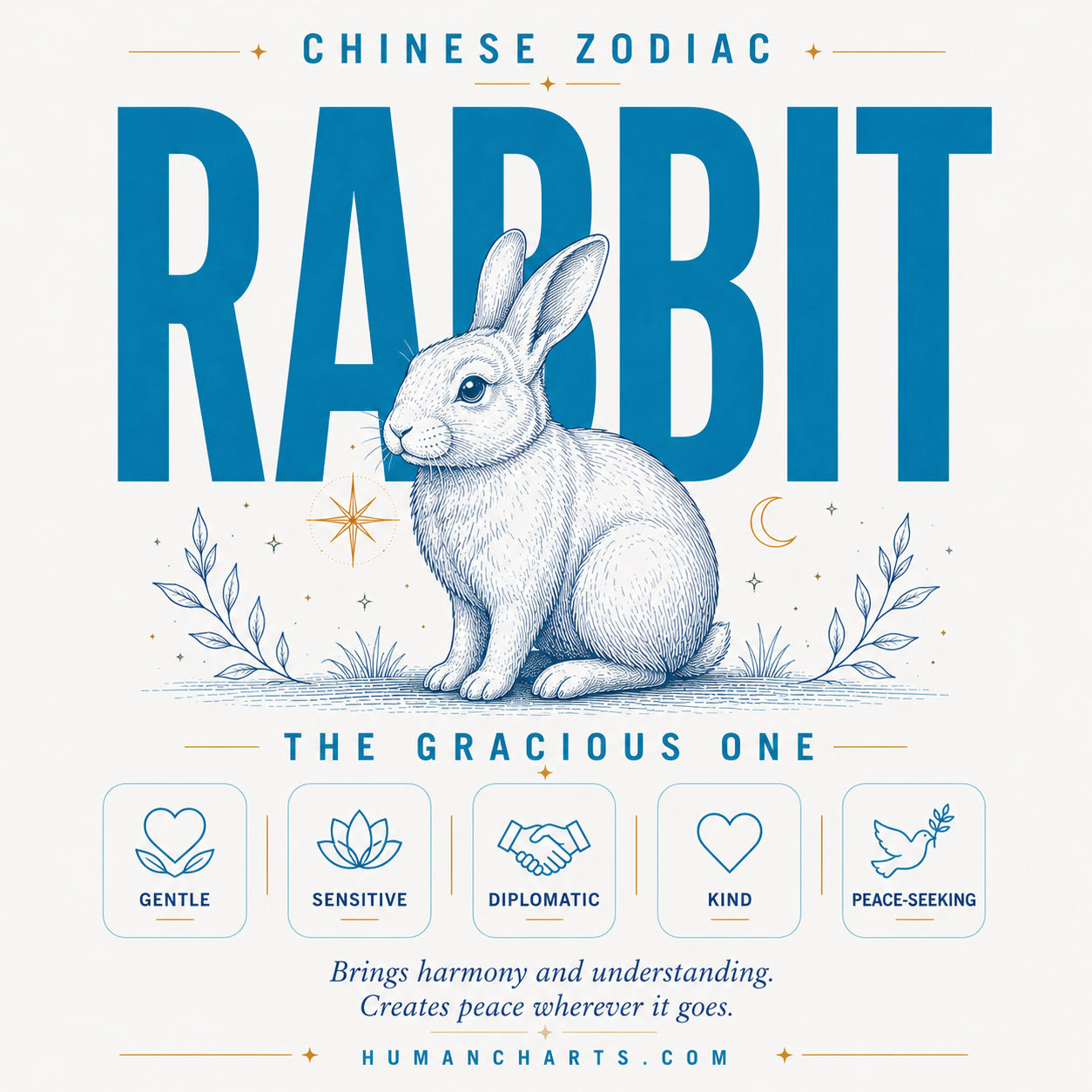
The Rabbit Chinese Zodiac at a Glance
- The Animal: The Rabbit — The Gentle One
- Years: 1927, 1939, 1951, 1963, 1975, 1987, 1999, 2011, 2023
- How It Works: Wood (fixed) · Yin · The Hare · Sense, harmonize, act with care
- Optimal Decision-Making: Sense the field · find the harmonious move · act with care
- “Stop Being So Sensitive” Is Wrong For You: Why the cultural advice misnames your instrument
- Five Elements: Wood · Fire · Earth · Metal · Water variations
- Strengths: Gentle, refined, intuitive, diplomatic, aesthetic
- Challenges: Conflict-avoidant, indirect, withdrawn, over-accommodating
- Career & Business: Diplomat, designer, mediator, artist, therapist, curator
- Relationships: Need partners who can value softness without trying to harden it
- Famous Rabbits: Albert Einstein, Brad Pitt, Michael Jordan, Angelina Jolie
The Rabbit Chinese Zodiac in Plain English
The Rabbit is the Gentle One. Some people are wired to read the field before they move. They feel the temperature of the room, the unspoken tensions, the move that would preserve the peace and the move that would damage it — and they let the harmonious response emerge from the sensitivity. When they act, the action lands softly. The Rabbit’s discipline is care. The Rabbit’s gift is refinement.
Rabbit is the Chinese Astrology label for that wiring. It is the fourth animal in the twelve-year zodiac cycle and one of the most refined, sensitive, and diplomatic of the twelve. The Rabbit (兔, tù) is associated with peace, beauty, and the quiet intelligence that comes from feeling the field accurately.
If you were born in a Rabbit year (1927, 1939, 1951, 1963, 1975, 1987, 1999, 2011, 2023), here is what that usually looks like in practice:
- You feel what is happening in a room before anyone names it. The unspoken weather is information you read at high resolution.
- You move to preserve the peace by default. The harmonious option is the one your body finds first.
- You have a strong aesthetic — environment, clothing, food, music, the look and feel of the spaces you live in. The Rabbit values beauty as a daily need, not a luxury.
- You struggle in environments where conflict is constant, where bluntness is performed as a virtue, or where the field is loud and uncared for.
- You become most yourself when you have a setting, a partnership, or a body of work where your sensitivity is treated as the gift it actually is.
Listen to MATTEEN on the Rabbit Chinese Zodiac — a mechanical breakdown of the fourth animal in the Chinese zodiac, how sensitivity operates as the engine of the path, why the gentleness is the instrument and not the weakness, and how Rabbit carriers learn to trust the field-reading their design is built to do.
Definition: The Rabbit (兔, tù) is the fourth animal in the twelve-year Chinese zodiac cycle. Its fixed element is Wood, its polarity is Yin, and it is associated with gentleness, refinement, peace, diplomacy, intuition, and aesthetic intelligence. Rabbit carriers operate through relational sensitivity and field-reading, finding the harmonious move by sensing what would preserve the room and what would damage it. The Rabbit’s decision-making instrument is high-resolution sensitivity to the field combined with a body that knows what would land softly — the sensitivity IS the mechanism, not a weakness to be overcome.
The Rabbit is the fourth animal in the twelve-year Chinese zodiac cycle, following the Tiger and preceding the Dragon. In Chinese tradition, the Rabbit (兔, tù) is associated with peace, longevity, refinement, and the quiet form of intelligence that reads the field rather than dominating it. The Rabbit is often paired in folklore with the Moon — soft light, reflective rather than radiant, illuminating without forcing.
Before reading further — a synthesis note. Chinese Astrology is one of several systems that describe a full design. Your Western Astrology (Sun, Moon, Rising, and the rest of the placements), Human Design, and Numerology Life Path each add their own structural inputs. The patterns on this page describe what the Rabbit brings — the core orientation around sensitivity, refinement, and diplomatic intelligence. How that orientation actually shows up in your career, your relationships, and your decisions is shaped by the synthesis of all the systems together, not by the Chinese Zodiac alone.
In Chinese cosmology, the twelve animals each represent a distinct developmental pattern. Where the Tiger acts on instinct and the Dragon initiates with power, the Rabbit operates through field-sensitivity, relational attunement, and the patient location of the move that preserves what is worth preserving. The Rabbit is what holds the texture and the peace of a room while everyone else is trying to win it.
The mechanism of the Rabbit is sensitivity combined with care. The engine runs on feeling the field, finding the harmonious move, and acting in a way that protects what is precious. Where the Tiger leads with force and the Snake leads with strategy, the Rabbit leads with relational intelligence. The shadow of the path is the cost of running an unusually sensitive instrument inside a world that often treats sensitivity as weakness — the Rabbit can withdraw, accommodate too much, or avoid the conflict that the situation actually requires.
Rabbit Years. The Rabbit years in the Chinese zodiac fall every 12 years: 1927, 1939, 1951, 1963, 1975, 1987, 1999, 2011, and 2023 are the most recent. The Chinese New Year shifts each year — typically late January or early February — so people born in January or early-to-mid February of a “Rabbit year” may actually belong to the previous animal. If your birth date falls in January or early February of a Rabbit year, check it against the specific Chinese New Year cutoff for that year.
Every Chinese zodiac animal is built from four structural components: its fixed element, its yin/yang polarity, its symbol, and its position in the twelve-year cycle. Here is how the Rabbit is built.
- Symbol. The hare — soft-footed, quick to sense danger, capable of stillness and swift movement, intimately bound to the rhythms of the field around it.
- Fixed element. Wood. The Rabbit’s underlying nature is living, flexible, growth-oriented — bending without breaking, adapting to what the field requires.
- Yin/Yang. Yin. Receptive, internal, attuned. The Rabbit senses before it acts.
- Position in zodiac. Fourth of twelve — early in the cycle, associated with refinement, beauty, and the establishment of harmonious form after the initiating energy of the first three animals.
- Lucky colors. Red, pink, purple, blue.
- Lucky numbers. 3, 4, 9.
The Rabbit’s combination of Wood (life, growth, flexibility) and Yin (receptivity, internalization) is the structural key. Wood by itself reaches and adapts; Wood held under Yin reaches and adapts through sensing rather than asserting. This is the Rabbit’s signature: living intelligence processed through high-resolution attunement, then expressed as the move that fits the field most precisely. The sensitivity is not weakness — it is the work.
Mechanically, the Rabbit operates in three phases: sense the field, find the harmonious move, act with care. The sensing phase collects high-resolution data about the room, the relationships, the unspoken tensions, and what would preserve or damage the situation. The harmonizing phase locates the move that fits — usually below the threshold of conscious analysis, as a body-knowing of what would land softly. The action phase is gentle, careful, and precisely measured. The Rabbit does not act loudly; the Rabbit acts well.
Everything in life is a function of decision-making. Every life unfolds through the decisions made within it. For the Rabbit Chinese Zodiac, the decision-making instrument is relational sensitivity combined with attunement to the field. The Rabbit reads the room at high resolution — the unspoken tensions, what would preserve the peace, what would damage it — and lets the harmonious move emerge from the sensitivity. The body knows what would land softly. The discipline is to trust the sensitivity as data, not to dismiss it as moodiness or weakness.
Most cultures treat decision-making as a process of weighing options abstractly — pros and cons on a list, logic divorced from the relational context. The Rabbit is built differently. For the Rabbit, the relational field is structurally primary. The body picks up information about the room that the analytical mind cannot access directly. The sensitivity integrates the unspoken texture into a coherent sense of what would fit and what would not. By the time the harmonious move arrives, the decision has already been made by the integration — the action is just the careful execution.
How to make decisions well with this instrument:
- Honor the sensitivity as data. When you feel a shift in the room before anyone has named it, that is information. For your design, the field-reading is structurally productive. The body is registering what the analytical mind cannot yet articulate. Trust what you are picking up.
- Find the harmonious move, not the loud move. The Rabbit’s correct decision is rarely the most forceful one. It is the move that fits the field — that preserves what is worth preserving, that lands softly, that opens the next door without slamming the current one. The body knows this move; the analytical mind sometimes tries to override it with a louder option.
- Refuse to decide against your sensitivity. The cultural pressure to “toughen up” or “stop being so sensitive” is structurally wrong for you. Acting against what the field-reading is telling you produces decisions your body would have refused — and the body’s refusal compounds into withdrawal, resentment, or quiet collapse.
- Distinguish accommodation from harmony. Genuine harmony preserves the field including the carrier’s own integrity. Accommodation sacrifices the carrier to keep the peace on the surface. The Rabbit’s discipline is finding the move that holds both — the soft landing for the field AND the carrier’s own ground.
Everyday decisions and major decisions operate on the same instrument; only the texture differs. Small decisions train the carrier in trusting what the body senses across days. Major decisions — career, partnership, structural commitments — require the same sensitivity applied across longer arcs, with the carrier listening for which environments, which people, and which paths the body says “yes” to softly and which it says “no” to even when the analytical mind argues otherwise. The Rabbit who decides by analytical override produces a life shaped by other people’s louder voices. The Rabbit who honors the sensitivity as the actual instrument produces a life of unusual refinement, peace, and relational depth.
The discipline is not gentleness for gentleness’s sake. The discipline is honoring the actual rhythm of how the instrument works.
The phrase “stop being so sensitive” gets used universally — as if sensitivity were a flaw to overcome and as if a thicker skin were always the goal. For you, it is wrong advice. Your instrument is sensitivity, and the field-reading your body performs is the apparatus that turns relational attunement into clarity. What looks like “being too sensitive” from the outside is the actual work your design is built to do.
The cultural advice to “toughen up” or “stop taking everything personally” or “don’t let it bother you” generally describes a different decision-making instrument — the louder, less field-attuned mode that some other animals are built to operate on. For those carriers, the advice may be neutral or even useful. For you, the instrument is different. The sensitivity is not a layer on top of the real work; it is the real work. Suppressing it cuts off the actual mechanism your design runs on. The Rabbit who learns to override the sensitivity produces decisions the body would have refused — and the body’s refusal accumulates as exhaustion, withdrawal, or a slow loss of the carrier’s own ground.
When other people say “stop being so sensitive,” they may be operating from a louder instrument, or they may simply be uncomfortable with the resolution your design reads at. Either way, the advice misnames your work. The sensitivity is not weakness. The field-reading is not over-reaction. They are the structural mechanism your decision-making runs on.
For you, trust the sensitivity. Find the harmonious move. Refuse the cultural pressure to harden into an instrument you were not built to be.
Chinese Astrology pairs each animal’s fixed element with a year-specific element from the Five Elements system (Wood, Fire, Earth, Metal, Water) on a 60-year master cycle. This means every Rabbit is not just a Rabbit — they are a Wood Rabbit, Fire Rabbit, Earth Rabbit, Metal Rabbit, or Water Rabbit depending on which year inside the 60-year cycle they were born. The fixed Wood element gives the Rabbit its core nature; the year-specific element shades how that core is expressed.
- Wood Rabbit (1915, 1975) — the double-wood combination. More creative, expressive, and growth-oriented. Wood on Wood produces the most outwardly flexible and artistically engaged of the Rabbit variations.
- Fire Rabbit (1927, 1987) — more passionate, warm, and socially magnetic. Fire warms the Rabbit’s reserve and produces a more outwardly charismatic version of the path, with more energy in the expressive layer.
- Earth Rabbit (1939, 1999) — more grounded, practical, and steady. Earth stabilizes the Rabbit’s sensitivity and produces carriers who build durable, harmonious structures other people can live inside.
- Metal Rabbit (1951, 2011) — more disciplined, structured, and refined in form. Metal sharpens the Rabbit’s aesthetic precision and produces the most exacting of the variations — taste with structure underneath it.
- Water Rabbit (1963, 2023) — more intuitive, philosophical, and deep. Water deepens the Rabbit’s field-reading and produces the most emotionally attuned of the variations, with an extra layer of receptivity to the unspoken.
When you read about a Rabbit’s traits, the fixed Wood-Yin nature is the foundation. The year-specific element is the modifier. A 1975 Wood Rabbit will read differently than a 1963 Water Rabbit even though both share the underlying mechanism.
The Rabbit carries a consistent set of themes that show up across a carrier’s lifetime, regardless of upbringing, culture, or career. These are the structural traits the sign is built from.
- Gentleness. A built-in tendency to act softly. The carrier moves through the world without unnecessary force — and is often surprised when other people experience this as remarkable.
- Field sensitivity. A high-resolution capacity to feel the room — the moods, the unspoken tensions, the subtle shifts. The carrier registers what most paths cannot perceive.
- Refinement. A strong aesthetic sense. Taste in environment, clothing, food, music, conversation, presentation. The Rabbit treats beauty as a structural need, not a decoration.
- Diplomacy. A native capacity to mediate, to find the move that preserves the relationship, to phrase the hard thing in a way that lands.
- Intuition. A body-knowing about people and situations that arrives before the analytical mind can explain it — and is often correct.
- Peace-seeking. A structural preference for harmony over conflict. The carrier is built to preserve and to protect, not to dominate and to fight.
- Caution. A built-in pause before action. The carrier checks the field before committing — a feature, not a flaw, of the design.
- Kindness. A consistent orientation toward care — for people, for spaces, for animals, for the texture of the daily life around the carrier.
Rabbit carriers are designed to:
- Read the field at a resolution other paths cannot match — what people feel, what the room needs, what would land
- Find the move that preserves the relationship while still moving the situation forward
- Build environments, partnerships, and bodies of work other people actually want to inhabit
- Mediate conflict by sensing what both sides need underneath the positions they have stated
- Cultivate refined taste and aesthetic environments that quietly raise the quality of every day inside them
Strong work shows up where sensitivity and refinement matter. Diplomats, mediators, and negotiators use the path’s field-reading to find moves that less attuned paths would have missed. Designers, artists, and curators use the aesthetic depth to produce work other people return to for its quiet quality. Therapists, counselors, and care workers use the relational intelligence to meet people in places that less attuned paths cannot reach. The Rabbit is not built for high-conflict, high-volume environments where the path’s gentleness is treated as a problem — it is built for situations where the carrier’s specific sensitivity and refined judgment are the value.
When this path is operating cleanly, Rabbit carriers do not need to perform their kindness or their taste. The work itself transmits it — the room that feels good to be in, the conversation that lands without bruising, the design that quietly elevates the daily life of the people inside it. People around the carrier often feel calmer or more at home without being able to name why. The trap of the path is that this transmission is so quiet that the carrier’s contribution is easy to overlook — including by the carrier themselves. The Rabbit who learns to value the contribution at the same resolution other people value louder work is the Rabbit whose life compounds.
The shadow of the Rabbit is the predictable distortion that appears when the path’s mechanics are overdriven or under-honored. Common patterns:
- Gentleness becomes avoidance. The native softness that protects the field becomes a refusal to engage the conflict the situation actually requires. The hard conversation never happens.
- Sensitivity becomes over-accommodation. The field-reading that finds the harmonious move gets used to sacrifice the carrier’s own ground in order to keep everyone else comfortable.
- Diplomacy becomes indirectness. The capacity to phrase the hard thing softly becomes a habit of never quite saying the hard thing at all. The partner, the team, or the friend is left guessing.
- Caution becomes paralysis. The body’s pause before action becomes a permanent stall. The move never gets made.
- Refinement becomes fussiness. The aesthetic sensitivity hardens into rigidity about environment — and the carrier can no longer function in spaces that do not meet a specific standard.
- Withdrawal. When the field becomes too loud or too coarse, the Rabbit retreats into solitude — sometimes for too long, sometimes at the cost of the relationships and projects that needed engagement.
- Resentment under the smile. What was protective gentleness becomes a layer of accommodation underneath which the carrier is quietly angry that their own needs are not being seen.
- Self-erasure. The carrier becomes so attuned to other people’s fields that they lose track of their own — and wakes up years later having lived someone else’s life.
The repair pattern is not to suppress the path’s mechanics. The sensitivity is correct. The repair is in noticing when gentleness has become avoidance, when accommodation has become self-erasure, and when withdrawal has become the carrier’s only mode of self-protection. The earlier in life this discernment develops, the more the path compounds into harmonious bodies of work, partnerships, and environments that the Rabbit’s sensitivity was structurally built to produce. The later it develops, the more the carrier spends decades quietly contributing without ever fully claiming what they brought.
Rabbit carriers are designed to:
- Distinguish between genuine harmony and accommodation dressed up as harmony
- Engage the conflict the situation actually requires, even though the body’s preference is to soften it away
- Honor the carrier’s own needs at the same resolution the carrier honors other people’s
- Recognize withdrawal as it arises and ask whether the retreat is restoring the instrument or hiding from the field
The Rabbit is built for work that has a relational, aesthetic, or care-based layer. The path tends to perform at its peak when the carrier is operating in fields that reward sensitivity, refined judgment, diplomatic intelligence, or the capacity to make environments that other people want to spend time inside. It tends to perform poorly in high-conflict, hard-bargaining tactical work where the path’s gentleness has to be suppressed and the field-reading cannot show through. The actual career format depends on the synthesis with the rest of the chart — the careers below are where the Rabbit’s mechanism is most directly engaged, not the only places it shows up. Many Rabbit carriers do their relational work quietly inside roles that are not officially relational: as the colleague who keeps the team functional, the parent who holds the household’s emotional weather, the friend whose quiet attention shapes everyone else’s lives. The mechanism is the same; the format varies.
Careers where the Rabbit’s mechanism is most directly engaged include:
- Diplomat, mediator, negotiator, conflict resolution specialist
- Designer — interior, graphic, fashion, product, architectural — and aesthetic direction roles
- Therapist, counselor, coach, depth-relational practitioner
- Curator, gallerist, editor, taste-maker, creative director
- Artist, musician, writer of work that prioritizes texture and quality
- HR, people operations, organizational culture and team-care roles
- Hospitality at its highest form — hotelier, restaurateur, host of refined spaces
- Care professional — pediatric medicine, eldercare, animal welfare, social work
- Founder of a venture where the brand, the product, and the team are organized around refinement and care
Misaligned environments include high-conflict negotiation cultures, environments that reward aggression, roles that require constant confrontation, and any culture that treats the Rabbit’s gentleness and sensitivity as problems to be solved.
In careers, Rabbit carriers are designed to:
- Choose environments where the path’s sensitivity is treated as the asset it is, not a liability to be managed
- Negotiate for the conditions the work actually requires — refined, considered environments and the time to do the work well
- Distinguish between accommodation that compounds resentment and harmony that compounds trust
- Bring the carrier’s own taste, judgment, and sensitivity into the work without apologizing for them
In close relationships, the Rabbit tends to show up as a partner who brings unusual sensitivity, refinement, gentleness, and a structural need for the partner to value softness without trying to harden it. The carrier reads the partner at high resolution and often knows what the partner is feeling before the partner has named it. How this plays out in any specific relationship depends on the rest of the chart — but the core Rabbit pattern of relational attunement combined with a fragile-feeling need for harmony shows up consistently across carriers.
Common challenges include difficulty with direct confrontation (the path finds it structurally costly), accommodating the partner so consistently that the carrier’s own needs disappear, withdrawal when the relational field becomes too loud or too coarse, indirect communication that leaves the partner guessing, and resentment that accumulates under the smile when the carrier’s needs are not being met. The partner who experiences the Rabbit as “easy to be with” sometimes does not realize how much the carrier is absorbing.
The release in relationships is the discipline of letting the partner see the carrier — including the carrier’s preferences, needs, and quiet refusals — without performing softness in a way that erases them. The carrier learns to bring the actual ask into the partnership, to engage the conflict that the situation requires, and to honor their own sensitivity as the gift that brought the partner close in the first place. Healthy Rabbit partnerships involve a carrier who has practiced being seen and a partner who can value the gentleness as strength without trying to toughen it away.
Rabbit carriers are designed to:
- Choose partners who can value softness without trying to harden it and who can meet refinement with reciprocal care
- Practice bringing the actual ask into the partnership — clearly, gently, but actually
- Distinguish between protective accommodation and self-erasure dressed up as love
- Recognize withdrawal as it arises and ask whether the retreat is restoring the relationship or quietly ending it
The pattern is consistent across fields: a body of work or a public life built on refinement, sensitivity, and the capacity to read and shape the field. Below are well-documented Rabbit figures across science, film, music, sports, and the arts — each verified against the Chinese New Year cutoffs for their birth years.
A Direct Transmission from MATTEEN
“Everything in your life is a function of decision-making. Every life unfolds through the decisions made within it. The Rabbit’s decision-making instrument is the sensitivity — the field-reading, the body’s knowing of what would land softly, the harmonious move that preserves what is worth preserving. The mistake is thinking the sensitivity is a problem to overcome. The sensitivity IS the work. Most Rabbit carriers spend a decade trying to harden it, because the world told them to. The harder discipline is trusting it — letting the field-reading guide the moves, refusing to act against what the body is telling you, and finding the move that preserves the relationship AND your own ground. Sense the field. Find the harmonious move. Act with care.”
— Matteen Terrany
Frequently Asked Questions About the Rabbit Chinese Zodiac
Unlock Your Full Chinese Zodiac
Your Chinese zodiac animal is one structural layer of your design. Your Western Astrology, Human Design, and Numerology Life Path add the rest. Calculate your full reading and start working with it.
Want to learn about the other Chinese zodiac animals? See the complete guide to all 12 animals →
The sensitivity is the instrument. The harmonious move is the work.