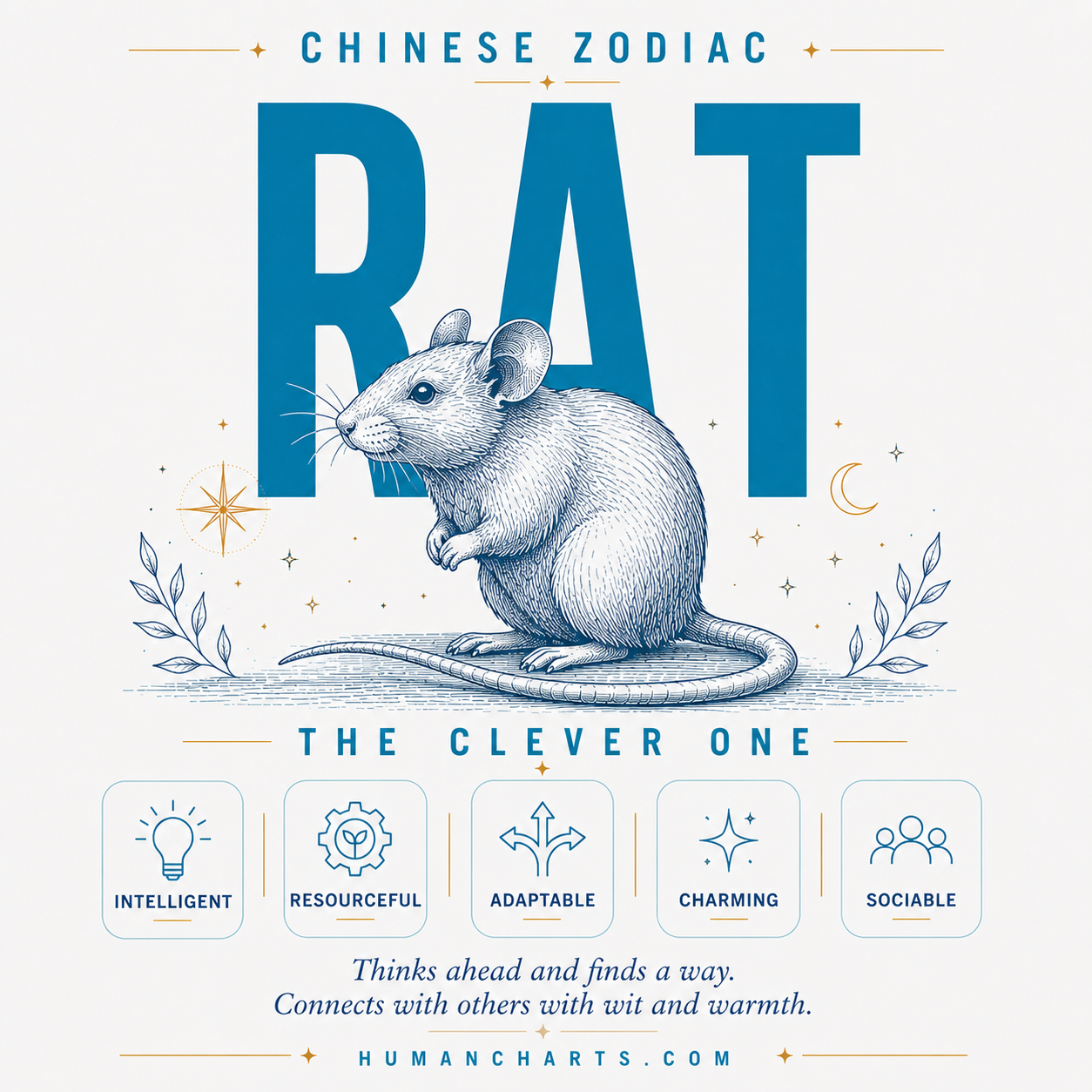
The Rat Chinese Zodiac at a Glance
- The Animal: The Rat — The Resourceful One
- Years: 1924, 1936, 1948, 1960, 1972, 1984, 1996, 2008, 2020
- How It Works: Water (fixed) · Yang · The Rat · Scan, identify the opening, move
- Optimal Decision-Making: Scan the environment · identify the opening · move before the window closes
- “Don’t Be So Opportunistic” Is Wrong For You: Why the cultural advice misnames your instrument
- Five Elements: Wood · Fire · Earth · Metal · Water variations
- Strengths: Intelligent, adaptable, quick-witted, charming, resourceful
- Challenges: Restless, scattered, opportunistic to a fault, anxious under pressure
- Career & Business: Entrepreneur, trader, strategist, writer, networker, operator
- Relationships: Need partners who can match the pace and respect the constant scanning
- Famous Rats: Jimmy Carter, Mark Zuckerberg, Eminem, Scarlett Johansson, LeBron James
The Rat Chinese Zodiac in Plain English
The Rat is the Resourceful One. Some people are wired to see the opening before anyone else does. They read the room at high speed, notice the gap that nobody else has noticed, and move on it while the window is still open. They turn small advantages into compounding ones. The Rat’s discipline is speed. The Rat’s gift is seeing what is actually there.
Rat is the Chinese Astrology label for that wiring. It is the first animal in the twelve-year zodiac cycle and one of the most adaptable, intelligent, and socially capable of the twelve. The Rat (鼠, shǔ) opens the cycle — in the classical Chinese myth, the Rat reached the Jade Emperor first by riding on the Ox’s back and jumping off at the finish line. The story is the path: the Rat wins by reading the situation and moving precisely when the situation rewards moving.
If you were born in a Rat year (1924, 1936, 1948, 1960, 1972, 1984, 1996, 2008, 2020), here is what that usually looks like in practice:
- You scan constantly. The environment is information, and you are reading it whether you mean to be or not.
- You see openings other people miss. Where other paths see a closed situation, you see the gap and the way through.
- You are socially fluent. You read people quickly, adapt your tone to the room, and find rapport almost instantly.
- You struggle in environments that are static, slow, or that punish you for moving on opportunities other people did not notice.
- You become most yourself when you have room to operate — when the work rewards intelligence, speed, and the capacity to pivot when the situation changes.
Listen to MATTEEN on the Rat Chinese Zodiac — a mechanical breakdown of the first animal in the Chinese zodiac, how fast adaptive scanning operates as the engine of the path, why opportunism is a structural feature not a flaw, and how Rat carriers learn to use their speed without scattering inside it.
Definition: The Rat (鼠, shǔ) is the first animal in the twelve-year Chinese zodiac cycle. Its fixed element is Water, its polarity is Yang, and it is associated with intelligence, adaptability, quick wit, charm, resourcefulness, and opportunistic action. Rat carriers operate through fast adaptive scanning combined with decisive movement, identifying the opening that other paths miss and acting on it before the window closes. The Rat’s decision-making instrument is high-speed environmental reading combined with opportunistic action — the seeing-and-taking-the-opening is structurally the work.
The Rat is the first animal in the twelve-year Chinese zodiac cycle, opening the cycle and setting its initiating tone. In Chinese tradition, the Rat (鼠, shǔ) is associated with intelligence, adaptability, charm, resourcefulness, and the capacity to thrive in conditions other paths find limiting. The classical myth places the Rat at the front of the cycle by virtue of cleverness — the Rat understood the rules of the race better than the larger animals did.
Before reading further — a synthesis note. Chinese Astrology is one of several systems that describe a full design. Your Western Astrology (Sun, Moon, Rising, and the rest of the placements), Human Design, and Numerology Life Path each add their own structural inputs. The patterns on this page describe what the Rat brings — the core orientation around fast scanning, adaptability, and opportunistic action. How that orientation actually shows up in your career, your relationships, and your decisions is shaped by the synthesis of all the systems together, not by the Chinese Zodiac alone.
In Chinese cosmology, the twelve animals each represent a distinct developmental pattern. Where the Ox builds through endurance and the Tiger acts on instinct, the Rat operates through observation, social intelligence, and the capacity to see the opening before other paths notice it exists. The Rat is what opens the cycle — what reads the new situation first and figures out how to move inside it.
The mechanism of the Rat is fast scanning combined with adaptive action. The engine runs on seeing, deciding, and moving — usually all three inside a window most other animals would have spent on planning. Where the Snake watches for the precise moment and the Ox plants and waits, the Rat reads and adjusts continuously. The shadow of the path is the cost of running an unusually fast and opportunistic instrument inside a world that often misnames opportunism as a moral failure — the Rat can be misread, judged, or pressured into slowing down past the rhythm the instrument actually requires.
Rat Years. The Rat years in the Chinese zodiac fall every 12 years: 1924, 1936, 1948, 1960, 1972, 1984, 1996, 2008, and 2020 are the most recent. The Chinese New Year shifts each year — typically late January or early February — so people born in January or early-to-mid February of a “Rat year” may actually belong to the previous animal (the Pig). If your birth date falls in January or early February of a Rat year, check it against the specific Chinese New Year cutoff for that year.
Every Chinese zodiac animal is built from four structural components: its fixed element, its yin/yang polarity, its symbol, and its position in the twelve-year cycle. Here is how the Rat is built.
- Symbol. The rat — small, fast, intelligent, capable of moving through structures other animals cannot navigate.
- Fixed element. Water. The Rat’s underlying nature is fluid — adaptive, flowing around obstacles, finding the path of least resistance and the path of fastest movement at once.
- Yin/Yang. Yang. Active, outward, initiating. The Rat moves first.
- Position in zodiac. First of twelve — the opening animal of the cycle, associated with new beginnings, intelligence, and the resourceful start.
- Lucky colors. Blue, gold, green.
- Lucky numbers. 2, 3.
The Rat’s combination of Water (adaptability, intelligence, flow) and Yang (initiating, active, outward) is the structural key. Water on its own moves wherever the terrain allows; Water carried by Yang moves with intention. This is the Rat’s signature: fluid intelligence with directional drive. The carrier reads the environment as water reads terrain — continuously, automatically — and then moves with the deliberate force of someone who has already seen where the opening is.
Mechanically, the Rat operates in three phases: scan the environment, identify the opening, and move before the window closes. The scanning phase is continuous — the Rat is reading the room, the conversation, the market, the relationship at high resolution all the time. The identification phase happens fast — usually below the level of conscious deliberation, the Rat sees the opening as a recognized shape inside the data the scanning has already gathered. The move phase is decisive and quick, because the opening is by definition time-limited. The window closes. The Rat who hesitates loses the move the design was built to make.
Everything in life is a function of decision-making. Every life unfolds through the decisions made within it. For the Rat Chinese Zodiac, the decision-making instrument is fast adaptive scanning combined with opportunistic action. The scanning is not the prelude to the work — the scanning IS the work, and so is the willingness to move on what the scanning shows. The discipline is to take the opening when the scanning reveals it, and to refuse the cultural pressure to wait until the move is comfortable, unanimous, or fully justified to people who do not see what you see.
Most cultures treat decision-making as a deliberation phase followed by a move. The Rat is built differently. For the Rat, the scanning is constant and the integration is fast. The body reads the environment at a higher resolution and a higher speed than other paths can sustain. The opening appears inside the scanning as a recognized pattern — a price mispriced, a person open to a conversation that was not open yesterday, a market about to turn, a door briefly unlocked. By the time the conscious mind is asking “should I move,” the body has already seen the shape of the opening. The discipline is to trust the seeing and to move.
How to make decisions well with this instrument:
- Honor the scanning as the work. When you find yourself reading the room, the situation, the market, or the relationship, do not interpret it as restlessness or distraction. For your design, scanning is structurally productive. The instrument is gathering. Trust the process.
- Recognize the opening when it appears. Clarity announces itself as recognition: the pattern resolves, the move becomes visible, and the body’s resistance to acting drops. When all three line up, move. Do not wait for permission or for the opening to feel safer than it actually is.
- Refuse the pressure to over-deliberate. The cultural advice to “think it through more” or “don’t be so opportunistic” is structurally wrong for you. Deliberating past the point where the opening is visible costs you the window. The window closes whether you move or not.
- Work with the rhythm of openings, not on a fixed schedule. The Rat’s instrument operates on the cadence of when openings actually appear, not on the calendar. Some weeks the scanning finds nothing worth moving on. Some weeks it finds three openings inside seven days. The Rat who tries to force a uniform pace will produce either forced moves or missed ones. Trust the cadence.
Everyday decisions and major decisions operate on the same instrument; only the stakes differ. Small decisions train the instrument across days — the conversation you join, the meeting you take, the asking price you propose, the small bet you place. Major decisions — career pivots, partnerships, capital allocation, structural commitments — use the same fast-scan-and-move mechanism, but the openings appear less often and the stakes of moving correctly are higher. The Rat who tries to make major decisions through committee-style deliberation, or who waits for the opening to become socially uncontroversial, will miss the moves the design was structurally built to make. The Rat who respects the instrument produces a track record of unusually well-timed moves across decades.
The discipline is not speed for speed’s sake. The discipline is honoring the actual rhythm of how the instrument works.
The phrase “don’t be so opportunistic” gets used as if opportunism were a character flaw — as if the person who sees the opening and takes it has done something morally suspect. For you, it is wrong advice. Your instrument is opportunistic by design. The seeing-and-taking-the-opening is not a deviation from how decisions should be made — it is the structural mechanism your decision-making runs on.
The cultural advice to “don’t be so opportunistic” or “wait your turn” or “let it come to you” generally describes a different decision-making instrument — the slower, more deferential cadence that some other animals (and some Human Design authorities) are built to operate on. For those carriers, the advice may be correct. For you, the instrument is different. The opening is real. The window is real. The capacity to read both is the design. Choosing not to move on what you can see, in the name of looking less aggressive or less self-interested, costs you the move your instrument was built to make. The opening closes whether you move or not.
When other people say “don’t be so opportunistic,” they may be operating from a slower instrument, or they may simply be uncomfortable with how quickly you see things they have not yet seen. Either way, the advice misnames your work. The scanning is not predatory. The opening-recognition is not greed. The fast move is not impulsive. They are the structural mechanism your decision-making runs on.
For you, trust the opening. Move when the window is open. Refuse the cultural pressure to wait until the move has been pre-approved by people whose instruments are slower than yours.
Chinese Astrology pairs each animal’s fixed element with a year-specific element from the Five Elements system (Wood, Fire, Earth, Metal, Water) on a 60-year master cycle. This means every Rat is not just a Rat — they are a Wood Rat, Fire Rat, Earth Rat, Metal Rat, or Water Rat depending on which year inside the 60-year cycle they were born. The fixed Water element gives the Rat its core nature; the year-specific element shades how that core is expressed.
- Wood Rat (1924, 1984) — more creative, expansive, and growth-oriented. Wood gives the Rat’s scanning a generative quality and produces a version of the path that builds new things from the openings it spots.
- Fire Rat (1936, 1996) — more dramatic, charismatic, and energetic. Fire heats the Rat’s social fluency and produces the most magnetic, performative version of the path.
- Earth Rat (1948, 2008) — more grounded, practical, and methodical. Earth stabilizes the Rat’s restlessness and produces operators who build durable structures out of the openings they take.
- Metal Rat (1960, 2020) — more disciplined, ambitious, and refined. Metal sharpens the Rat’s precision and produces the most focused, results-driven version of the path.
- Water Rat (1912, 1972) — the double-water combination. Water on Water deepens the intuition and produces the most fluid, perceptive, and adaptive of the Rat variations.
When you read about a Rat’s traits, the fixed Water-Yang nature is the foundation. The year-specific element is the modifier. A 1984 Wood Rat will read differently than a 1972 Water Rat even though both share the underlying mechanism.
The Rat carries a consistent set of themes that show up across a carrier’s lifetime, regardless of upbringing, culture, or career. These are the structural traits the sign is built from.
- Intelligence. A high-speed, pattern-recognizing mind. The carrier reads situations faster than the people around them realize.
- Adaptability. A native capacity to adjust the approach, the tone, or the strategy the moment the situation changes. The Rat does not fight the terrain — the Rat flows through it.
- Quick wit. A fast verbal and conceptual intelligence. The carrier produces the connection, the joke, or the reframe in real time.
- Charm. A built-in social fluency. The Rat reads the person quickly and finds rapport without obvious effort.
- Resourcefulness. A capacity to make use of whatever is available — small budgets, partial information, narrow openings — and produce results other paths could not produce with the same inputs.
- Opportunism. A structural orientation toward openings. The Rat sees the gap and moves on it. This is not a flaw of the design — it is the design.
- Observation. A continuous, low-effort reading of the environment. The Rat is gathering data even when the Rat appears to be doing something else.
- Sociability. A native need for company, conversation, and network. The Rat is one of the more outwardly social signs in the Chinese zodiac.
- Ambition. A drive to build, accumulate, and improve position. The Rat does not stay still by design.
Rat carriers are designed to:
- See openings other people do not see and move on them while the window is open
- Adapt quickly to changing conditions — markets, relationships, jobs, environments — without losing the thread
- Build networks, alliances, and social capital across diverse rooms and contexts
- Translate small inputs into compounding outputs through intelligence and well-timed action
- Initiate — start companies, projects, conversations, and movements that other paths inherit and develop
Strong work shows up where speed, intelligence, and adaptive action matter. Entrepreneurs and traders use the path’s scanning and opportunism to turn small advantages into large positions. Writers, journalists, and analysts use the pattern-recognition to produce work that names what is actually happening before the rest of the field has caught up. Operators, fixers, and connectors use the social fluency to move resources and people through rooms other paths cannot enter. The Rat is not built for static, slow, ceremonial work where the design has to suppress its scanning and its initiative — it is built for situations where the carrier’s specific intelligence and adaptive speed are the value.
When this path is operating cleanly, Rat carriers do not need to perform their intelligence. The work itself transmits it — the company that started from nothing, the trade that nobody else made, the piece of writing that named what everyone else was about to realize, the relationship that opened because the Rat said the right thing at the moment the door was briefly open. People around the carrier often sense that something is being read at a higher speed than they are used to. The trap of the path is that the scanning is so continuous and the openings are so visible that the carrier can scatter — moving on too many openings at once and finishing fewer of them than the design is capable of producing.
The shadow of the Rat is the predictable distortion that appears when the path’s mechanics are overdriven. Common patterns:
- Scanning becomes scattering. The continuous reading of the environment becomes an inability to settle inside any single project or relationship. The carrier moves on too many openings at once.
- Opportunism becomes restlessness. The native orientation toward openings becomes a structural inability to sit with the present situation. The next move is always more attractive than the current one.
- Adaptability becomes inconsistency. The capacity to adjust to the room becomes a tendency to shape-shift past the point of integrity. People around the carrier are not sure which version they are getting.
- Charm becomes manipulation. The social fluency that builds rapport gets used to extract rather than to connect. The room sees the move and the rapport collapses.
- Speed becomes anxiety. The fast scanning runs hot. The body that was built to read the environment cannot stop reading even when there is nothing left to read, and the carrier lives under low-grade hum of restlessness.
- Ambition becomes acquisitiveness. The drive to improve position becomes a treadmill of accumulating without integrating. The carrier has the wins but does not feel them.
- Sociability becomes performance. The native enjoyment of company becomes a need to be in rooms, in conversations, and on platforms — the privacy and recovery the instrument requires get sacrificed.
- Resourcefulness becomes corner-cutting. The capacity to make small inputs work becomes a habit of skipping the harder, slower work that the long-arc result actually requires.
The repair pattern is not to suppress the path’s mechanics. The scanning is correct. The opportunism is correct. The repair is in noticing when scanning has become scattering, when opportunism has become restlessness, and when adaptability has crossed into shape-shifting. The earlier in life this discernment develops, the more the path compounds into companies, bodies of work, networks, and structures the Rat’s speed was structurally built to produce. The later it develops, the more the carrier spends decades quick, busy, and feeling like the wins never quite land.
Rat carriers are designed to:
- Distinguish between productive scanning and anxious scanning that produces no moves
- Take a real opening fully before moving to the next one, even though the next opening is already visible
- Hold the same shape across rooms — adapt the tone, not the integrity
- Recognize when ambition has slipped into acquisition and ask whether the next move is actually serving the design
The Rat is built for work that has a scanning, opportunistic, or adaptive layer. The path tends to perform at its peak when the carrier is operating in fields that reward fast intelligence, social fluency, well-timed initiative, or the capacity to translate partial information into action. It tends to perform poorly in static, slow, ceremonial roles where the path’s scanning has no outlet and the carrier’s initiative is treated as overreach. The actual career format depends on the synthesis with the rest of the chart — the careers below are where the Rat’s mechanism is most directly engaged, not the only places it shows up. Many Rat carriers do their resourceful work quietly inside roles that are not officially entrepreneurial: as the operator who keeps the organization moving, the analyst whose call gets made because the analyst saw what the room missed, the parent who turns a tight budget into a household that compounds advantages over years. The mechanism is the same; the format varies.
Careers where the Rat’s mechanism is most directly engaged include:
- Entrepreneur, founder, startup operator
- Trader, investor, capital allocator working on shorter cycles
- Journalist, writer, analyst, market commentator
- Salesperson, dealmaker, business development lead
- Connector, agent, manager, talent representative
- Strategist, consultant, fixer
- Network builder, community organizer, political operator
- Technologist, product manager, growth operator
- Performer, comedian, on-air personality
Misaligned environments include slow bureaucracies that punish initiative, static roles where nothing changes year to year, cultures that treat the Rat’s scanning and opportunism as moral defects to be reformed, and any environment that requires the carrier to suppress fast intelligence in service of a slower group rhythm.
In careers, Rat carriers are designed to:
- Build a body of work or a body of bets where speed, intelligence, and well-timed action are the assets, not problems
- Negotiate for the autonomy the work actually requires — the Rat produces best output when free to act on what the scanning reveals
- Distinguish between scanning that produces real moves and scanning that produces busyness
- Finish the openings already taken before chasing new ones — the design produces more value across decades when each move is integrated than when every visible opening is half-played
In close relationships, the Rat tends to show up as a partner who brings unusual intelligence, social fluency, playfulness, and a constant low-level scanning the partner can feel even when they cannot name it. The carrier reads the partner at high speed and often knows what the partner is thinking before the partner has said it. How this plays out in any specific relationship depends on the rest of the chart — but the core Rat pattern of fast intimacy combined with restlessness shows up consistently across carriers.
Common challenges include difficulty settling fully into the present relationship when the scanning is still showing other openings, reading the partner so accurately that the carrier responds to what the partner has not yet said (and the partner experiences this as being managed), restlessness when the relationship is stable in a way the Rat’s instrument reads as static, charm that the partner eventually decodes as performance, and a difficulty letting the partner see the Rat’s anxiety — the public self-assurance can mask an internal hum that the partner is not invited into.
The release in relationships is the discipline of staying in the relationship the way the Rat stays in a real opening — fully, intelligently, with the same scanning brought toward the partner rather than past them. The carrier learns to bring the speed and the intelligence into the partnership without using either as a way out, and to let the partner see the inner state without performing it. Healthy Rat partnerships involve a carrier who has practiced letting the relationship be one of the openings the design actually moves on, and a partner who can match the pace without trying to slow the carrier past the rhythm the instrument requires.
Rat carriers are designed to:
- Choose partners who can match the pace and respect the constant scanning without trying to silence it
- Bring the scanning toward the partner — read the partner the way the Rat reads an opportunity, with full attention
- Distinguish between healthy restlessness that signals real misalignment and the structural hum that simply is the instrument running
- Let the partner see the anxiety beneath the charm — the partner cannot meet what stays performed
The pattern is consistent across fields: a body of work or a public life built on intelligence, well-timed initiative, and the capacity to see openings other paths did not see. Below are 14 well-documented Rat figures across politics, science, music, film, sports, business, and literature — each verified against the Chinese New Year cutoffs for their birth years.
A Direct Transmission from MATTEEN
“Everything in your life is a function of decision-making. Every life unfolds through the decisions made within it. The Rat’s decision-making instrument is the scanning — fast environmental reading combined with the willingness to move on what the scanning shows. The mistake is letting other people’s discomfort with how quickly you see things slow you down past the rhythm the instrument actually runs on. The opportunism is not the flaw. The seeing-and-taking-the-opening IS the design. Most Rats spend a decade learning to trust what they are seeing. The harder discipline is finishing the openings already taken before chasing the next one — most Rats scatter at the point where integrating one move would have produced more than starting three. Scan widely. Move precisely. Then finish the move.”
— Matteen Terrany
Frequently Asked Questions About the Rat Chinese Zodiac
Unlock Your Full Chinese Zodiac
Your Chinese zodiac animal is one structural layer of your design. Your Western Astrology, Human Design, and Numerology Life Path add the rest. Calculate your full reading and start working with it.
Want to learn about the other Chinese zodiac animals? See the complete guide to all 12 animals →
The opening is real. The move is everything.