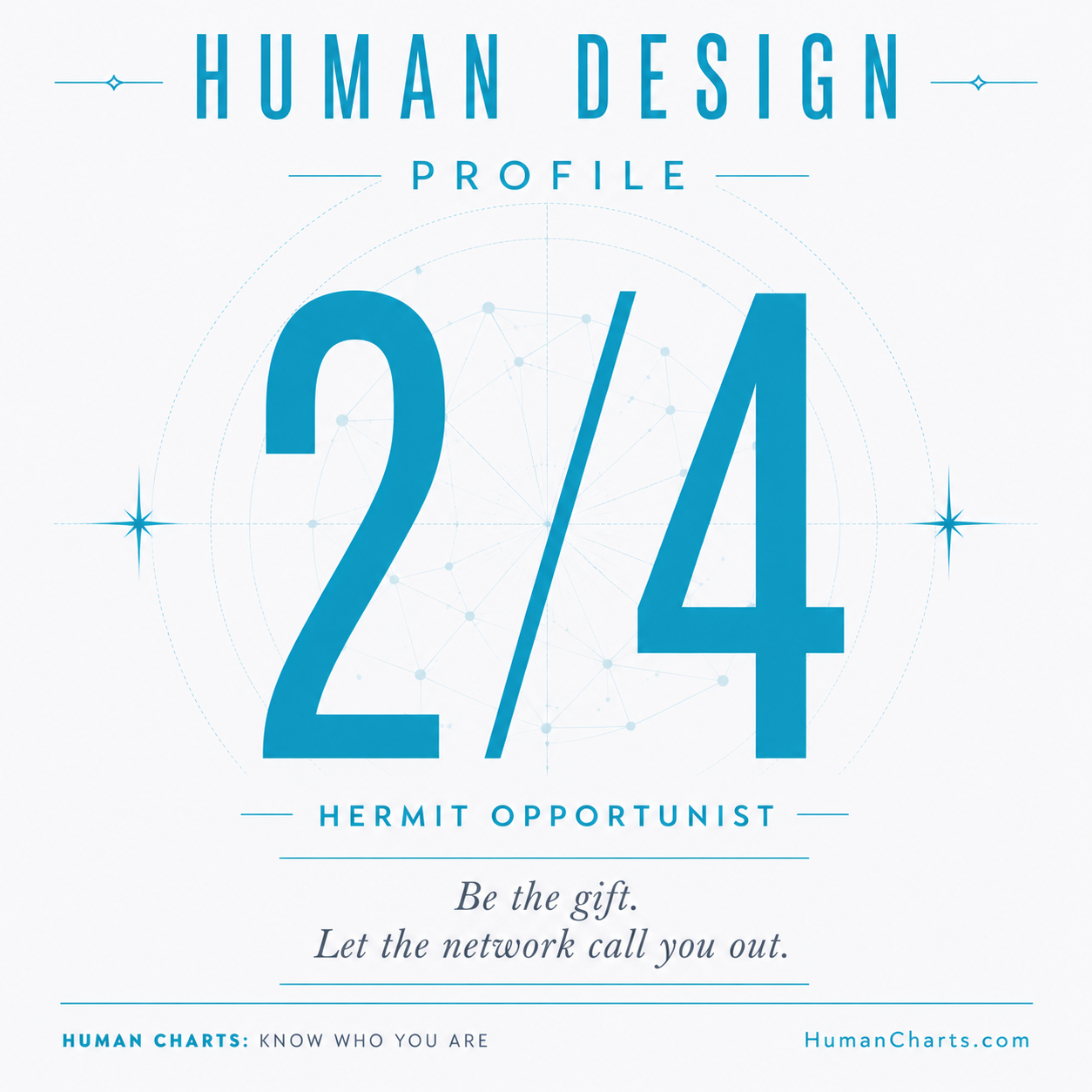
The 2/4 Profile at a Glance
- The Profile: The 2/4 — the Hermit Opportunist — natural gift called out by the network
- Conscious Line: Line 2 — The Hermit · Natural Gift · Called Out
- Unconscious Line: Line 4 — The Opportunist · Network · Foundation through Friendship
- The Pattern: Withdraw and recharge alone, then emerge when the network calls
- How They Appear: As naturally gifted · As needing alone time · As surrounded by people who insist on their talents
- Strengths: Embodied gift · Loyal network · Cyclical sustainability
- Challenges: Calling themselves out · Network pressure · Burnout from over-emerging
- How They Learn: Hands-on practice in private, then expression when the network draws it out
- Career: Wait to be called out into roles that match the gift — do not self-promote
- Relationships: Need alone time as structural — partners who respect the cycle are the right partners
Some people are naturally good at things they did not learn through effort, and they are usually the last to notice.
The 2/4 profile is the Human Design label for that wiring. It is one of twelve profile combinations and is among the most common — many of the people around you who “seem to just have it” carry this profile. If this is your profile, you live two roles simultaneously: the Hermit on the surface (Line 2 — natural talent that emerges when called) and the Opportunist underneath (Line 4 — the network whose job is to do the calling).
If you are wired this way, here is what that usually looks like in practice:
- People tell you you are good at something and you think they are exaggerating — until enough of them say it that you realize they were not.
- You need a lot of alone time, and you stop functioning well without it.
- The opportunities that change your life tend to arrive through people who already know you — not through cold outreach or self-promotion.
- When you try to promote yourself, it feels off in the body. When the network calls you out, the same offering lands cleanly.
Definition: The 2/4 profile is one of twelve profiles in Human Design. The conscious line, 2, is the Hermit — associated with natural, embodied talents that the person carries without effort and often without conscious awareness. The unconscious line, 4, is the Opportunist — associated with network-based foundation and the way the design naturally operates through known relationships. The 2/4 is the natural gift called out by the network: the Hermit possesses the talent, the Opportunist’s network recognizes and demands it, and the gift emerges into expression through that calling.
The 2/4 is one of twelve profiles in Human Design and one of the most common. The two lines are both lines of natural design — the Hermit’s gift is innate, the Opportunist’s network is the natural field. Together they produce a pattern where the gift the 2/4 carries gets drawn out into the world by the people who already know them.
For the 2/4:
- The conscious line is 2 — the Hermit. This is the role the person identifies with. The Hermit is associated with natural, embodied talent — capacities the person possesses without having to study them, often without recognizing them as exceptional. The Hermit also requires significant alone time to recharge.
- The unconscious line is 4 — the Opportunist. This is the role lived from underneath. The Opportunist is associated with network-based foundation, stable friendships, and the externalization of the design through known relationships.
The combination produces a structural dynamic: the Hermit’s gift is naturally present but does not announce itself; the Opportunist’s network sees the gift and demands it. The 2/4 emerges when called. They do not self-promote. The gift speaks through the people who recognize it.
This is one of the most stable profiles in the system. Both lines are about foundation: Line 2 builds it through innate capacity; Line 4 builds it through community. The 2/4 tends to operate from a base of recognized talent and long-standing relationships.
Profile is one structural layer of the full chart. The rest comes from your energy type, your authority, your defined gates and channels, and your incarnation cross.
Your profile is the operating pattern you carry through life. It describes two roles you are designed to live simultaneously — one you consciously identify with, one your body carries underneath whether you name it or not. Together they shape how you actually function: how you learn, how you show up in work, how you move through relationships, how the design lands in real life.
Twelve profiles exist — twelve combinations of these two roles. Each one is a recognizable pattern. Not a personality type. Not a prediction. A structural shape. Two people with the same profile will live very different lives, but the underlying rhythm — what they keep coming back to, what keeps tripping them up, what they keep getting called to do — will rhyme.
Profile is one of several structural layers in your chart. Alongside it sit your energy type (how your energy engine works), your authority (how your body makes decisions correctly), your defined gates and channels (your specific gifts), and your incarnation cross (the life-purpose pattern). Each layer contributes a different reading. The profile is the operating pattern. The rest of the chart is what you are operating on.
In practical terms: knowing your profile tells you the kind of life you are built to live — the rhythm the design wants to move in. It does not tell you what job to take or who to marry. It tells you the pattern your body keeps returning to, no matter how often you try to operate differently.
Each profile combines two lines — one conscious, one unconscious. The first number (conscious) is the role you identify with. The second number (unconscious) is the role your body carries underneath.
For the 2/4, both lines work together to produce a calling-out dynamic. The Hermit has the gift; the Opportunist has the network. The gift gets expressed when the network calls it out.
Line 2 is the line of natural, embodied gift. The Hermit possesses talent that did not require training to acquire — and often does not require ongoing effort to maintain.
What the Hermit line does:
- Carries a natural gift. Something the person does well without effort, often without noticing it as remarkable. Music, language, athletics, social perception, healing presence, technical aptitude — varies by chart but consistently natural.
- Needs alone time to recharge. The Hermit’s energy depletes in constant social engagement and replenishes in solitude. This is not introversion as personality; it is structural recharge.
- Resists being called out. When the network insists on the gift, the Hermit often protests, deflects, or hides. The instinct is to stay in the cave; the design requires emergence.
- Emerges when called rightly. When the right person calls the right gift at the right time, the Hermit can deliver with unusual depth — and then withdraw again.
For the 2/4, the Hermit is conscious — the person identifies with needing alone time, with not wanting to push themselves on others, with the resistance to being publicly visible.
Line 4 is the foundational network line. The Opportunist builds stability through known relationships rather than through novel encounters.
What the Opportunist line does:
- Operates through the network. Opportunities, support, and life movements come through people the 4 already knows.
- Builds durable friendships. Line 4 relationships last decades. The 4 invests in the network because the network is the design’s structural support.
- Transitions through known steps. Major life moves work best when the next network is in place before the current one is left.
- Externalizes the design through people. Line 4 is the design’s outer face — the way the gift reaches the world.
For the 2/4, the Opportunist is unconscious — the network does the calling-out without the person consciously orchestrating it. Friends and colleagues just keep pointing at the gift; the 2/4 just keeps being pulled toward it.
The combination of conscious Line 2 and unconscious Line 4 produces a cyclical pattern: alone time → recognition by the network → emergence to express the gift → return to alone time.
How the pattern operates when aligned:
- The 2/4 spends time alone, pursuing what is interesting, doing what comes naturally
- The natural gift is present whether or not the 2/4 names it
- The network — friends, colleagues, community — sees the gift and demands it
- The 2/4 emerges, expresses the gift, delivers the work
- The 2/4 then withdraws again to recharge
- Over time, the cycle compounds — the gift refines, the network deepens, the calling-out becomes more accurate
How the pattern collapses when misaligned:
- The 2/4 tries to self-promote, marketing the gift to strangers — the design jams
- Or the 2/4 hides too deeply, refusing emergence when the call comes — the gift never reaches the world
- Or the 2/4 over-emerges, taking on too many calls, never returning to alone time — burnout follows
- Each misalignment misreads the cycle as something to push past rather than as the structural rhythm
The aligned 2/4 develops a precise relationship with their own recharge cycle and a discerning relationship with the network’s calls — answering the ones that match the gift, declining the ones that do not.
- Natural gift not consciously claimed. The 2/4 often does not see what others see in them.
- Cyclical energy. Alone-emerge-alone-emerge. Both halves are required.
- Resistance to self-promotion. When the 2/4 tries to sell themselves, it feels wrong in the body.
- Network as the field of recognition. The calling-out comes through the people who already know them.
- Personal destiny. The 2/4 is structured for their own gift and their immediate community.
- Stability through both lines. Both 2 and 4 are foundation lines; the 2/4 tends toward steady, accumulating growth.
- Embodied natural gift. Capacity that does not require constant effort to maintain.
- Loyal, long-standing network. Friends and community who recognize the gift and continue calling it out across years.
- Cyclical sustainability. When the rhythm of alone-time and emergence is honored, the 2/4 can do this work for decades without burnout.
- Authentic public expression. When the gift comes out because the network called it, the expression lands cleanly.
- Resistance to forced effort. The Hermit will not be pushed into work that does not match the gift — and the resistance is structurally accurate.
- Trying to self-promote. The most common 2/4 misalignment. The design is not built for it; the body resists; the work does not land.
- Hiding from the call. The Hermit’s instinct to withdraw can become avoidance, refusing emergence even when the right call comes.
- Over-emerging. Saying yes to too many calls, never returning to alone time, burning out fast.
- Discounting the gift. The 2/4 often genuinely does not see what others see, and can dismiss compliments and calls as flattery.
- Wrong calls from the wrong network. Not every call is the right call. The network sometimes asks for things outside the actual gift; the 2/4 must learn to decline these.
- Stop trying to self-promote
- Trust the recharge cycle as structural, not laziness
- Let the network do the calling-out
- Decline calls that do not match the actual gift
- Build the alone time into the calendar as non-negotiable
The 2/4 learns through embodied practice in solitude, then expression when called.
- The Hermit practices in private. Whatever the gift is, it gets refined in alone time — through play, exploration, hands-on engagement.
- The network draws it out. When the gift is ready, the network notices and calls it forward.
- Expression deepens the gift. Each emergence refines what was practiced in solitude.
- Withdrawal integrates. Returning to alone time after expression lets the body integrate what was offered.
- The cycle compounds. Over years, the 2/4’s gift becomes both more refined and more recognized.
Career fit is a synthesis of the full chart — your energy type, your authority, your defined gates and channels, your incarnation cross. The profile is one structural input among many. The patterns below describe what the 2/4 design often gravitates toward — kinds of work the profile creates affinity for, not prescriptions or guarantees of fit.
The 2/4 tends to resonate with roles where the gift gets called out rather than sold.
Career patterns the 2/4 often resonates with:
- Creative and performative work where the gift is recognized by the community
- Teaching, coaching, and healing roles where clients arrive through referral
- Independent practice (writing, art, craft) sustained by an audience that already knows them
- Specialist work within a stable team where the gift gets used as needed
- Any role where the network does the calling-out and the 2/4 delivers
Misaligned environments include: high-pressure self-promotion (sales roles, marketing-heavy work), jobs that require constant public visibility, environments that punish withdrawal and recharge. The body resists these.
In careers, the 2/4 is designed to:
- Let the gift refine in private
- Respond to calls from the network rather than initiate to strangers
- Build alone time into the work pattern
- Decline calls that do not match the actual gift
Relational life is also a synthesis of the full chart — attachment patterns, attraction dynamics, specific gifts and frictions all come from the rest of the design. The patterns below describe what the 2/4 profile contributes to relational space, not the whole picture of who you are in relationships.
In close relationships, the 2/4’s recharge cycle contributes a structurally significant rhythm to the relational space.
- Alone time is non-negotiable. Partners who cannot respect the Hermit’s need for solitude create chronic friction.
- The network is part of the relationship. Old friends, family, community are part of the 2/4’s foundation — partners are integrated into that field, not asked to replace it.
- The right partner sees the gift the 2/4 cannot see. Often the partner is part of the network doing the calling-out.
- Self-emergence into a relationship is wrong; being called into it is right. The 2/4 who chases partners often ends up with the wrong ones; the 2/4 who lets the right person see them tends to end up with the right one.
The teaching of the 2/4 profile is that the gift is real even when you do not see it. The Hermit possesses something the world needs; the network is structurally positioned to point at it; the work is to emerge when called, deliver, and return to recharge. Self-promotion is not the design. Hiding is not the design. The cycle is the design.
For most 2/4s, the teaching arrives the hard way — through years of dismissing the gift as nothing special, through pressure to self-promote that always felt wrong, through guilt about needing so much alone time. The release is not motivation. It is the discipline of trusting the cycle, letting the network do the calling, and treating the alone time as the structural recharge it is.
What does the 2/4 profile mean in Human Design?
The 2/4 is one of twelve profiles. The conscious line (2) is the Hermit — associated with natural, embodied talent and the need for alone time. The unconscious line (4) is the Opportunist — associated with network-based foundation and stable friendship. The 2/4 carries a natural gift that the network calls out into the world.
Why does the 2/4 need so much alone time?
Because Line 2 — the conscious Hermit line — recharges in solitude. This is not introversion as personality; it is the structural design. Constant social engagement depletes the 2/4; alone time replenishes them. Without enough alone time, the gift cannot refine and emergence cannot happen cleanly.
Why does self-promotion feel wrong for the 2/4?
Because the design is not built for it. The 2/4’s gift gets expressed when the network calls it out — not when the 2/4 pushes it onto strangers. Self-promotion runs against the structural mechanism. When the 2/4 tries it, the body resists and the work does not land. The same offering, presented because the network demanded it, lands cleanly.
What kind of work does the 2/4 thrive in?
Roles where the gift is recognized and called out by the community rather than sold by the 2/4. Creative work, performative work, teaching, coaching, healing, specialist roles where clients arrive through referral. The work needs to allow the alone-time recharge cycle and to operate through known networks rather than cold outreach.
What is the most common 2/4 misalignment?
Trying to self-promote. The 2/4 who pushes their work onto strangers, markets aggressively, or tries to operate outside their network meets predictable resistance — and often misreads the resistance as a failure of effort rather than a structural mismatch. The fix is to stop self-promoting and trust the network’s calling-out.
Is the 2/4 personal or transpersonal?
Personal. The 2/4 belongs to the family of profiles associated with personal destiny — the life is structured around the person’s own gift and their immediate relational field.
A Direct Transmission from MATTEEN
“What you do naturally is the gift. You do not see it because it is too easy for you to feel like value — but everyone around you sees it. Stop trying to sell yourself. Stop trying to push the gift on strangers. Let the people who already see it call you out. When they do, emerge. Deliver. Then go back to the cave and recharge. The cycle is not laziness. The cycle is the design. Honor it, and the gift gets to be what it actually is.”
— Matteen Terrany
Unlock Your Human Design Chart
Your profile is one of several structural layers in your chart. The full chart also reveals your energy type, your authority, your defined gates and channels, and your incarnation cross.
To see your full design, generate your free chart on HumanCharts.
Want to learn about the other profiles? See the complete guide to all 12 Human Design profiles →
If you want to keep going, MATTEEN is the community where the work continues — free to join.
Be the gift. Let the network call you out.