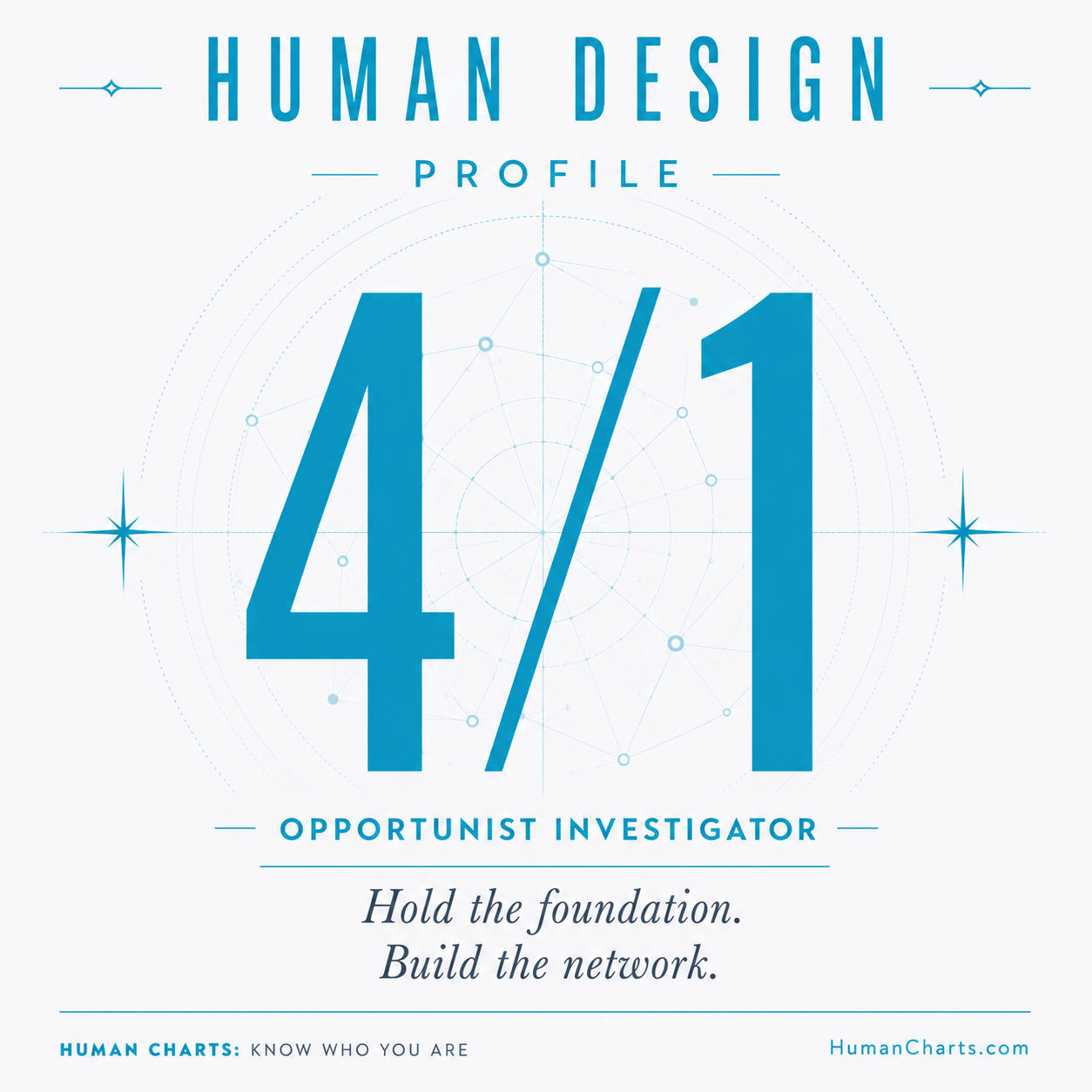
The 4/1 Profile at a Glance
- The Profile: The 4/1 — the Opportunist Investigator — the Juxtaposition profile of fixed fate
- Conscious Line: Line 4 — The Opportunist · Network · Foundation through Friendship
- Unconscious Line: Line 1 — The Investigator · Foundation · Security through Knowledge
- The Juxtaposition: The only profile where the two lines do not share a harmonic gate — the design is structurally fixed
- The Pattern: Network on the surface, deep knowledge underneath — both lines stabilize, neither moves easily
- Strengths: Unusual stability · Deep transmission to the network · Foundational authority
- Challenges: Inflexibility · Difficulty changing direction · Mistaking fixedness for stuck
- How They Learn: Study alone deeply, transmit to the network steadily
- Career: Long-arc roles within stable communities — the network is the audience for the foundational depth
- Relationships: Deep, durable, structurally non-negotiable
Some lives are built around being who you are and not changing much. Not stuck — structured. The pattern is the pattern, the network is the network, the depth is the depth.
The 4/1 profile is the Human Design label for that wiring. It is the rarest and most structurally distinctive of the twelve profiles — the only “Juxtaposition” profile, sometimes called “Fixed Fate” because the two lines do not have the harmonic relationship that all other profiles’ lines share. If this is your profile, you carry two roles simultaneously: the Opportunist on the surface (Line 4 — network, friendship, externalized foundation) and the Investigator underneath (Line 1 — deep study, internal foundation, security through knowledge).
If you are wired this way, here is what that usually looks like in practice:
- You are who you are. People who try to change you tend to fail; you do not change easily.
- Your foundations — your knowledge, your network, your way of operating — are unusually durable.
- You move through life in a steady arc rather than through dramatic shifts.
- The combination of deep study (1) and stable network (4) makes you an unusually reliable transmitter — your people trust your depth.
Definition: The 4/1 profile is one of twelve profiles in Human Design and the only “Juxtaposition” profile — the only one in which the conscious and unconscious lines do not share a harmonic gate relationship. This structural feature is sometimes called Fixed Fate, because the design does not flex the way other profiles’ do. The conscious line, 4, is the Opportunist — network-based foundation. The unconscious line, 1, is the Investigator — foundational knowledge. Both lines are stabilizing foundation lines. The 4/1 is unusually steady: deep study underneath, stable network on the surface, and a structural resistance to changing direction.
The 4/1 is structurally distinct from all other profiles because the conscious and unconscious lines (4 and 1) do not share a harmonic relationship in the underlying structural framework. Every other profile combines two lines that relate harmonically; the 4/1 combines two lines that do not.
This structural feature has a name and a consequence:
- Juxtaposition. The technical name for the 4/1 configuration.
- Fixed Fate. The descriptive name. The 4/1’s pattern is more inflexible than the patterns of other profiles. The design holds its shape unusually firmly.
“Fixed Fate” does not mean predetermined outcomes or a deterministic life. It means the structural pattern itself does not flex easily. Other profiles can be moved by environment, relationships, or experience into versions of themselves that differ from the default. The 4/1’s default is what the 4/1 lives. The pattern is the pattern.
The practical implication: the 4/1 is more themselves than other profiles tend to be. The work is not to try to change the structure. The work is to honor the structure and operate within it cleanly.
The 4/1 is one of twelve profiles in Human Design. The combination produces a structurally fixed life pattern built on two foundation lines — Line 4 (network) and Line 1 (knowledge). Both lines stabilize; neither moves easily.
For the 4/1:
- The conscious line is 4 — the Opportunist. Network-based foundation, long friendships, the externalization of the design through known relationships.
- The unconscious line is 1 — the Investigator. Deep foundational knowledge, security through study, the internal base from which the design operates.
The 4/1 belongs to the family of profiles associated with transpersonal karma, though its fixed nature makes the transmission different from other transpersonal profiles. The wisdom that the Investigator builds gets transmitted through the network the Opportunist maintains, and the combination is unusually durable across decades.
Your profile is the operating pattern you carry through life. It describes two roles you are designed to live simultaneously — one you consciously identify with, one your body carries underneath whether you name it or not. Together they shape how you actually function: how you learn, how you show up in work, how you move through relationships, how the design lands in real life.
Twelve profiles exist — twelve combinations of these two roles. Each one is a recognizable pattern. Not a personality type. Not a prediction. A structural shape. Two people with the same profile will live very different lives, but the underlying rhythm — what they keep coming back to, what keeps tripping them up, what they keep getting called to do — will rhyme.
Profile is one of several structural layers in your chart. Alongside it sit your energy type (how your energy engine works), your authority (how your body makes decisions correctly), your defined gates and channels (your specific gifts), and your incarnation cross (the life-purpose pattern). Each layer contributes a different reading. The profile is the operating pattern. The rest of the chart is what you are operating on.
In practical terms: knowing your profile tells you the kind of life you are built to live — the rhythm the design wants to move in. It does not tell you what job to take or who to marry. It tells you the pattern your body keeps returning to, no matter how often you try to operate differently.
Each profile combines two lines — one conscious, one unconscious. The first number (conscious) is the role you identify with. The second number (unconscious) is the role your body carries underneath.
For the 4/1, both lines are foundation lines. Line 4 is external foundation (network); Line 1 is internal foundation (knowledge). Together they produce a doubly-stabilized design with little structural flex.
Line 4 is the foundational network line.
- Operates through the network. Opportunities, support, and life movements come through known people.
- Builds long-standing friendships. Line 4 relationships last decades.
- Transitions through known steps. Major moves work best when the next network is in place first.
- Externalizes the design through people.
For the 4/1, the Opportunist is conscious — the person identifies with the network as part of who they are.
Line 1 is the foundation line of deep study.
- Researches deeply. Foundational knowledge is the design’s drive.
- Pursues security through knowledge. Until the foundation is clear, discomfort persists.
- Operates as an introspective base. Internal work as much as external.
- Builds the depth other elements rest on.
For the 4/1, the Investigator is unconscious — the depth is there without being constantly named. The 4/1 often does not realize how much foundational knowledge they have accumulated until someone points it out.
The combination of conscious Line 4 and unconscious Line 1 produces a design with foundation on both sides — network outside, knowledge inside.
How the pattern operates when aligned:
- The 4/1 builds deep knowledge over years through their introspective study (1)
- The 4/1 builds and maintains a long-standing network (4)
- The knowledge gets transmitted to the network steadily over time
- The network supports the continued study by providing the structural field
- Across decades, both halves compound into unusual depth and stability
How the pattern collapses when misaligned:
- The 4/1 tries to change the structure — change direction dramatically, leave the network, abandon the field of study — and meets unusual resistance because the structure does not want to flex
- The 4/1 internalizes the fixedness as stuckness, treating the design’s stability as a problem rather than the structural feature it is
- The 4/1 tries to broadcast their depth to strangers rather than transmitting to the network
- Each misalignment fights the design’s actual shape
The aligned 4/1 stops fighting the structure and operates within it cleanly. The depth gets developed; the network gets maintained; the transmission happens naturally over time.
- Unusual structural stability. The 4/1 holds shape across decades.
- Both foundation lines defined. Internal and external foundations both built.
- Resistance to dramatic change. The pattern is the pattern.
- Steady transmission to the network. Knowledge moves outward through the relationships.
- Self-containment. The 4/1 is unusually rooted in who they are.
- Transpersonal but stable. The wisdom is meant for sharing, but the sharing happens through stability rather than dramatic emergence.
- Unusual stability. The 4/1 is who they are; the foundations hold.
- Deep network transmission. Knowledge flows out steadily through long-standing relationships.
- Foundational authority. The 1 line’s depth and the 4 line’s network combine into authority that lasts.
- Resistance to manipulation. The fixed structure makes the 4/1 hard to push off-course.
- Long-arc compounding. Both lines reward decades of building.
- Inflexibility. The same fixedness that produces stability can produce stuckness when life requires actual change.
- Difficulty changing direction. Career shifts, relocations, relational endings are harder for the 4/1 than for other profiles.
- Mistaking fixedness for stuck. The 4/1 may internalize the structure as a problem rather than as the design.
- Resistance to non-network transmission. Trying to share with strangers tends to fail; the 4/1 design transmits through the network.
- Pressure to be more flexible than the design allows. Cultural expectation of reinvention can produce friction.
- Accept the structural fixedness as the design, not a problem
- Operate within the network and depth you have built
- When change is necessary, allow it to happen slowly through the existing structure
- Stop trying to be a different profile
- Investigator goes deep alone. Reading, studying, building internal foundation.
- Opportunist transmits through the network. What was studied becomes part of the relational field.
- Stability allows compounding. Both halves grow over years rather than through dramatic leaps.
Career fit is a synthesis of the full chart — your energy type, your authority, your defined gates and channels, your incarnation cross. The profile is one structural input among many. The patterns below describe what the 4/1 design often gravitates toward — kinds of work the profile creates affinity for, not prescriptions or guarantees of fit.
The 4/1 tends to resonate with long-arc roles within stable communities or institutions.
Career patterns the 4/1 often resonates with:
- Long-arc careers in a single field or institution
- Teaching, mentoring, advising within a defined community
- Research roles that combine depth with institutional support
- Writing and publishing within a known audience
- Subject-matter expertise that builds over decades
Misaligned environments include: high-turnover roles, fields requiring constant reinvention, jobs that demand network changes faster than the design can absorb. The 4/1 in such environments often feels chronically wrong even when surface metrics look fine.
Relational life is also a synthesis of the full chart — attachment patterns, attraction dynamics, specific gifts and frictions all come from the rest of the design. The patterns below describe what the 4/1 profile contributes to relational space, not the whole picture of who you are in relationships.
The 4/1’s foundational structure contributes exceptional durability to relationships.
- Deep, long-standing relationships. Friendships and partnerships that go decades.
- Difficulty changing relational structure. Leaving a relationship is harder than for other profiles.
- Network as relational field. Partner integrates into the network, not as a replacement for it.
- Stability as relational asset. Partners often experience the 4/1 as solid in a way other profiles are not.
The teaching of the 4/1 profile is that the structure is the design. Not a problem to overcome. The fixedness produces unusual stability, deep transmission, and long-arc compounding — and the work is to honor the structure rather than fight it. The Opportunist’s network and the Investigator’s depth are both foundation; the 4/1’s life is built on both.
For most 4/1s, the teaching arrives through trying to be something else and meeting predictable resistance. The release is not motivation. It is the discipline of accepting the design as it is — fixed, deep, networked, durable — and operating within it.
What does the 4/1 profile mean in Human Design?
The 4/1 combines the Opportunist (Line 4 — network-based foundation) and the Investigator (Line 1 — deep foundational knowledge). It is the only “Juxtaposition” profile in Human Design — the only one in which the two lines do not share a harmonic gate connection. This makes the 4/1 unusually fixed in structure, sometimes called “Fixed Fate.”
What does “Juxtaposition” mean for the 4/1?
It is the technical name for the structural relationship between Lines 4 and 1. The two lines do not share a harmonic connection the way every other profile’s lines do. This produces a structurally fixed design — the 4/1 holds its shape more firmly than other profiles.
Is “Fixed Fate” deterministic?
No. Fixed Fate refers to the structural pattern, not to predetermined outcomes. The 4/1’s design does not flex the way other profiles’ do, but the life still unfolds through choices, relationships, and circumstances. The fixedness is about the pattern, not about destiny.
What kind of work does the 4/1 thrive in?
Long-arc careers within stable communities or institutions. Teaching, mentoring, research, writing, subject-matter expertise that builds over decades. The work needs to allow both the deep study (1) and the network maintenance (4) to operate steadily.
What is the most common 4/1 misalignment?
Trying to change the structure. The 4/1 who attempts dramatic shifts — career pivots, relational restructuring, network changes — tends to meet predictable resistance because the design does not want to flex. The discipline is to operate within the structure rather than fight it.
Is the 4/1 personal or transpersonal?
Transpersonal in family. The 4/1 belongs to the broader transpersonal group, though its fixed nature makes the transmission different from other transpersonal profiles — slower, more stable, less dramatic in emergence.
A Direct Transmission from MATTEEN
“You are not stuck. You are structured. The depth you have built and the network you have maintained are both foundations — and both are doing exactly what your design is built to do. Other profiles flex more; you flex less. That is not a flaw. It is the design. Stop trying to be a different shape. Operate within the structure you have. The transmission happens through stability, not through change.”
— Matteen Terrany
Unlock Your Human Design Chart
Your profile is one of several structural layers in your chart. The full chart also reveals your energy type, your authority, your defined gates and channels, and your incarnation cross.
To see your full design, generate your free chart on HumanCharts.
Want to learn about the other profiles? See the complete guide to all 12 Human Design profiles →
If you want to keep going, MATTEEN is the community where the work continues — free to join.
Hold the foundation. Build the network.