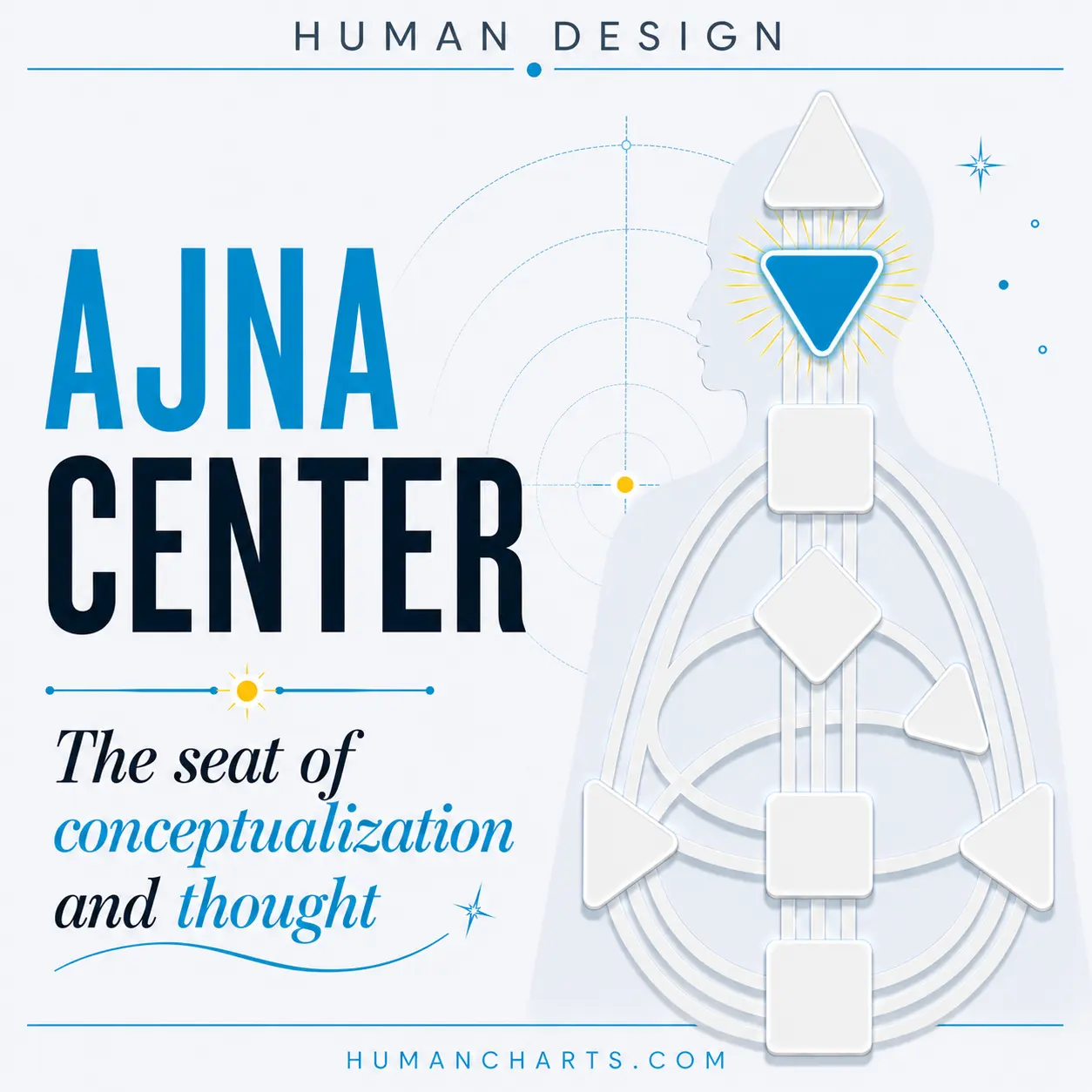
The Ajna Center at a Glance
- What It Is: The Ajna Center, the mind, the seat of conceptualization and one of the three awareness centers in your BodyGraph
- Defined vs Undefined Ajna Center: The two states the Ajna Center can be in and what each one means for you
- What You Unlock With a Defined Ajna Center: A fixed way of thinking, consistent mental processing, certainty about what you believe
- What You Unlock With an Undefined Ajna Center: Flexibility of thought, the capacity to hold many perspectives, wisdom about which opinions are real and which are borrowed
- Strengths of the Ajna Center: What the Ajna Center does at full power in both states
- Challenges of the Ajna Center: The predictable distortions that show up in both states when the design is forced
- The 6 Gates of the Ajna Center: Gates 4, 11, 17, 24, 43, 47 and what each carries
- The 6 Channels of the Ajna Center: The Channels that pass through the Ajna and what defines them
- Optimal Decision-Making: How your Ajna Center informs decisions correctly
- Why “You Should Know What You Think” Is Wrong For You: The advice this center gets that contradicts its actual mechanics
- The Ajna Center vs Western Astrology: The closest astrological parallel and why the mapping is not clean
- The Nine Centers in Human Design: Navigate to the other eight Centers in the BodyGraph
The Ajna Center is the mind. It sits in the upper triangle of your BodyGraph, just below the Head Center and above the Throat. It is where thoughts become concepts, where pressure from the Head turns into opinions, beliefs, and certainty.
In Human Design, every chart has nine Centers. Each Center is either Defined (colored in) or Undefined (white). Defined means the energy of that Center is consistent in you. It is who you are. Undefined means the energy of that Center is not fixed in you. You take it on from the environment, from other people, from the rooms you sit in.
The Ajna Center is one of three awareness centers in the BodyGraph, along with the Splenic Center and the Solar Plexus Center. Each awareness center processes a different kind of intelligence. The Ajna processes thought. It is the awareness of the mind itself, the place where ideas crystallize into something you can name and articulate.
Whether your Ajna Center is Defined or Undefined determines whether you have a fixed way of thinking that you can rely on, or whether your thinking flexes with the input around you. Both designs are correct. Both are valuable. They are different operating systems, and living each one cleanly requires understanding which one you have.
You do not have to calculate any of this. Generate your free chart on HumanCharts and your Ajna Center state will be displayed for you, ready to read.
Definition: The Ajna Center in Human Design is one of nine energy centers in the BodyGraph and one of three awareness centers. It is the mind, the center of conceptualization that turns mental pressure from the Head Center into concepts, opinions, and certainty. The Ajna Center contains 6 Gates: Gate 4 (Formulization), Gate 11 (Ideas), Gate 17 (Opinions), Gate 24 (Rationalization), Gate 43 (Insight), and Gate 47 (Realization). A Defined Ajna Center carries a fixed way of thinking, consistent mental processing, and certainty about what it believes. An Undefined Ajna Center takes on others’ ways of thinking, can hold multiple perspectives at once, and becomes wise over time about which opinions are actually its own. Generate your free Human Design chart on HumanCharts to find out yours.
The Ajna Center is one of the nine Centers in the Human Design BodyGraph. The Centers are energy hubs, each one carrying a specific function in the design. The Ajna sits in the upper triangle of the chart, below the Head Center and above the Throat Center. It is the second of the three awareness centers in the design.
The Ajna Center carries three core functions:
- Conceptualization. Turning raw mental pressure into a concept you can think with.
- Opinions and beliefs. Forming a position you hold about how the world works.
- Certainty. The mental sense of knowing what you think and being able to articulate it.
The Ajna is paired with the Head Center above it. The Head Center is the source of mental pressure, the inspiration and the question. The Ajna is what does something with that pressure. The Head asks. The Ajna answers, organizes, and forms the answer into a concept.
Ra Uru Hu, who founded Human Design in 1987, taught that the Ajna is one of the three awareness centers in the human design. The other two are the Splenic Center, which carries instinctual awareness in the now, and the Solar Plexus Center, which carries emotional awareness over time. The Ajna is mental awareness. Its intelligence is conceptual, not instinctual and not emotional. It is the awareness that thinks.
The Ajna Center has 6 Gates. These 6 Gates are the specific positions through which conceptualization, opinion, and certainty express in your chart. Whether the Ajna Center is Defined depends on whether any of these Gates are activated and connected to other Centers through a Channel.
A note on language. Human Design calls each of these 6 positions a Gate, but you can also think of each Gate as a Gift. The 64 Gates in your chart are 64 archetypal gifts your design carries, drawn from the 64 hexagrams of the I Ching. The Gene Keys system, developed by Richard Rudd, uses the same 64 patterns and calls them Gene Keys. Gate, Gift, and Gene Key all point to the same thing. We use the term Gate throughout because that is the primary Human Design term, but the reframe matters: a Gate is a Gift you are here to live.
This is the most important distinction on this page. Whether your Ajna Center is Defined or Undefined fundamentally changes how you experience your own mind, and the advice that helps one state often hurts the other.
Practice: No need to be certain
Defined Ajna Center (About 47 Percent of People)
A Defined Ajna Center is colored in on the BodyGraph. The energy of the Ajna is consistent in you. You have a fixed way of thinking, a reliable mental process, and a steady capacity for certainty about what you believe.
People with a Defined Ajna Center:
- Think in a consistent way across time and across topics
- Can articulate the same idea in the same way again and again
- Hold opinions that feel stable and known to them
- Provide mental reference points for Undefined Ajna people, often without realizing it
- Should not be told they need to “stay open-minded” in the way Undefined Ajnas can. Their minds are designed to be fixed.
Undefined Ajna Center (About 53 Percent of People)
An Undefined Ajna Center is white on the BodyGraph. The energy of the Ajna is not fixed in you. You take on ways of thinking from the people and information around you.
People with an Undefined Ajna Center:
- Think in different ways depending on whom they are around
- Can hold multiple perspectives at once without committing to any of them
- Feel pressure to “know” or have an opinion that comes from outside, not from inside
- Are deeply sensitive to the mental atmosphere of the people they spend time with
- Should not be forced to have a fixed opinion. The flexibility is the design.
The single most important truth for an Undefined Ajna Center: you are not built to be certain. The wisdom of the Undefined Ajna comes from seeing through opinions, including your own, and recognizing which ones are actually yours and which ones you picked up from the room.
When you know your Ajna Center is Defined, you unlock the following pieces of yourself:
- A fixed way of thinking. Your mental process is consistent. The way you analyze a problem today is the way you will analyze a similar problem tomorrow. The mind has a shape, and the shape is yours.
- Consistent opinions and beliefs. What you think about how the world works does not fluctuate based on whom you are sitting next to. The position is yours and it travels with you.
- The capacity to articulate the same idea repeatedly. You can teach. You can explain. You can put the same concept into words again and again because the conceptualization itself is fixed.
- A reliable mental reference point. When you need to think something through, the apparatus is steady. You can use your own mind as a known instrument.
- Certainty others can borrow. People with Undefined Ajna Centers may come to you for clarity and feel less mental pressure around you. That is the design working, not a problem.
- A mind that does not need to defend itself. You are not built to absorb every passing thought from the room. You bring your own thinking into the room.
You do not have to calculate any of this. Generate your free Human Design chart on HumanCharts and we will tell you whether your Ajna Center is Defined and what that unlocks.
When you know your Ajna Center is Undefined, you unlock the following pieces of yourself:
- Flexibility of thought. You are built to take on the thinking of the people and information around you. You can think one way in the morning and another way in the afternoon. This is not confusion. It is the design.
- The capacity to hold multiple perspectives at once. You can see an idea from many sides because you are not anchored to one fixed mental position. You can sit inside a viewpoint without owning it.
- Wisdom about which opinions are real. Over a lifetime, you see through more opinions than someone with a Defined Ajna. You learn which mental positions are actually held with substance and which ones are picked up and put down again. That is wisdom.
- The capacity to read other people’s thinking. Because you are not locked into one way of processing, you can sense how someone else’s mind is working at a depth that Defined Ajnas cannot.
- The gift of not having to be certain. Certainty is not your design. The pressure to know what you think comes from outside. When you stop carrying that pressure, the mind relaxes and the wisdom shows up.
- A mind that can change. You are not built to defend a fixed position. You are built to think alongside the world, change your mind in response to better information, and not lose anything by doing so.
Generate your free Human Design chart on HumanCharts to find out whether your Ajna Center is Undefined and how to work with it correctly.
The Ajna Center has different strengths depending on whether it is Defined or Undefined. Both sets are real. Both are valuable. They are not better or worse than each other.
Strengths of a Defined Ajna Center
- A stable, repeatable mental process others can rely on
- Consistent opinions and beliefs that travel with you across environments
- The ability to teach the same concept the same way and have it land
- A reliable inner reference for what you think
- The capacity to anchor a conversation with steady conceptual clarity
Strengths of an Undefined Ajna Center
- Wisdom about thinking through encountering many ways of thinking
- The capacity to read other people’s mental processes deeply
- Flexibility to engage with many ideas without being captured by any of them
- Sensitivity to the mental atmosphere of a room as a navigational instrument
- The ability to see through opinions, including your own, and notice which ones are borrowed
The Ajna Center also has different challenges depending on whether it is Defined or Undefined. These are not character flaws. They are predictable distortions that show up when one state tries to act like the other, or when the culture pushes the wrong advice onto the design.
Challenges a Defined Ajna Center Runs Into
- Mistaking your fixed way of thinking for the only correct way of thinking
- Judging Undefined Ajna people as wishy-washy or unable to make up their minds
- Becoming rigid in the name of “knowing what you think”
- Resisting input that would refine the concept because the concept is already set
- Forgetting that other people’s minds may be built to flex by design
Challenges an Undefined Ajna Center Runs Into
- Pretending to be certain about things you are not actually certain about
- Mistaking mental flexibility for personal weakness or “not having opinions”
- Adopting the opinions of the last person you spoke with and calling them your own
- Feeling pressure to “know what you think” and forcing positions that are not yours
- Trying to be the smart one in the room when the design is built to learn from the room
The repair pattern is the reverse of the distortion. A Defined Ajna Center stays in alignment by living its consistent mental process and letting Undefined Ajna people benefit from that consistency. An Undefined Ajna Center stays in alignment by releasing the pressure to be certain, letting opinions pass through without claiming them, and trusting that wisdom shows up over time, not on demand.
The Ajna Center has six Gates. Each one carries a specific theme of conceptualization, opinion, or mental processing. If you have one or more of these Gates activated in your chart, that Gate is operating in you as a Gift you carry.
- Gate 4, The Gate of Formulization. Also called the Gate of Youthful Folly. The mental answer to mental pressure, the formula offered to a question that may or may not yet be ready for an answer. Read the full breakdown of Gate 4, The Gate of Formulization.
- Gate 11, The Gate of Ideas. Also called the Gate of Peace. The mind as a vessel for ideas that pass through, considered and then released or shared. Read the full breakdown of Gate 11, The Gate of Ideas.
- Gate 17, The Gate of Opinions. Also called the Gate of Following. The mind that organizes thought into opinions others can follow. Read the full breakdown of Gate 17, The Gate of Opinions.
- Gate 24, The Gate of Rationalization. Also called the Gate of Return. The mind that returns to the same question again and again until clarity surfaces. Read the full breakdown of Gate 24, The Gate of Rationalization.
- Gate 43, The Gate of Insight. Also called the Gate of Breakthrough. The individual mental knowing that arrives whole, ahead of the rest of the room, and waits for the right moment to be expressed. Read the full breakdown of Gate 43, The Gate of Insight.
- Gate 47, The Gate of Realization. Also called the Gate of Oppression. The mental process of arriving at insight through sitting with confusion until the realization comes. Read the full breakdown of Gate 47, The Gate of Realization.
Each of these Gates, whether activated in your chart or not, sits in the Ajna Center and contributes to the larger theme of conceptualization, opinion, and certainty.
The Ajna Center is connected to the Head Center above and the Throat Center below through six Channels. A Channel requires both of its Gates to be activated. When that happens, both Centers it connects become Defined, and the Channel itself becomes a fixed circuit in your design. The Ajna participates in six Channels: three running up to the Head and three running down to the Throat.
- Channel 4-63, The Channel of Logic. Connects Gate 4 (Formulization) in the Ajna to Gate 63 (Doubt) in the Head. The mental circuit of logical pattern recognition, the mind that doubts in order to verify and then formulates a proof. Read the full breakdown of Channel 4-63, The Channel of Logic.
- Channel 11-56, The Channel of Curiosity. Connects Gate 11 (Ideas) in the Ajna to Gate 56 (Stimulation) in the Throat. The seeker’s circuit of ideas told as stories, the mind that gathers and the voice that shares to stimulate others. Read the full breakdown of Channel 11-56, The Channel of Curiosity.
- Channel 17-62, The Channel of Acceptance. Connects Gate 17 (Opinions) in the Ajna to Gate 62 (Detail) in the Throat. The organizational circuit of opinions backed by detail, the mind that arranges and the voice that articulates the facts. Read the full breakdown of Channel 17-62, The Channel of Acceptance.
- Channel 61-24, The Channel of Awareness. Connects Gate 24 (Rationalization) in the Ajna to Gate 61 (Mystery) in the Head. The individual mental circuit of thinking through to a knowing, the mind that sits with mystery until rationalization brings the answer. Read the full breakdown of Channel 61-24, The Channel of Awareness.
- Channel 43-23, The Channel of Structuring. Connects Gate 43 (Insight) in the Ajna to Gate 23 (Assimilation) in the Throat. The individual knowing circuit of insight expressed as language, the mind that knows and the voice that explains it in a way the room can assimilate. Read the full breakdown of Channel 43-23, The Channel of Structuring.
- Channel 64-47, The Channel of Abstraction. Connects Gate 47 (Realization) in the Ajna to Gate 64 (Confusion) in the Head. The abstract mental circuit of replaying images until realization surfaces, the mind that sits in confusion and waits for the picture to resolve. Read the full breakdown of Channel 64-47, The Channel of Abstraction.
If any one of these Channels is fully activated in your chart, both your Ajna Center and the Center it connects to (Head or Throat) are Defined, and the specific mental circuit of that Channel runs in you as a consistent design.
Everything in life is a function of decision-making. Every life unfolds through the decisions made within it.
The Ajna Center is the mind. And here is the central teaching of Human Design about the mind: the mind is not the decision-maker. The mind is for outer authority, for thinking about things that do not concern your own life. The mind is not for deciding your life. Your Strategy and your Authority are.
This is true for both Defined and Undefined Ajna Centers, but it lands differently for each one.
For people with a Defined Ajna Center, the principle is: respect the mind, but do not let it run the show. Your fixed way of thinking is reliable for analyzing the world, teaching others, and forming positions. It is not reliable for telling you what is correct for your life. Strong minds tend to assume they should make the call. They should not. The Defined Ajna is a brilliant tool. It is not the driver.
For people with an Undefined Ajna Center, the principle is harder but more important. The Undefined Ajna will pick up the thinking of the room and present it as a decision-making input. It will say “I think I should” when really it is reflecting a thought it picked up earlier that day. Do not make life decisions from the Undefined Ajna. The mind is amplifying the room, not reporting what is correct for you.
In both cases, the Ajna Center is not the decision-maker. Your Authority is. The Ajna provides concepts, options, and analysis. Your Authority decides.
To work with your Ajna Center correctly:
- Know whether your Ajna Center is Defined or Undefined. Generate your free chart and find out.
- Defined Ajna Center: use your fixed mental process for analysis and teaching, not for deciding your life.
- Undefined Ajna Center: notice the pressure to “know” and let it pass, do not act on borrowed opinions as if they were yours.
- Both: let your Strategy and Authority make the actual decisions.
Read more in the complete guide to all 5 Human Design energy types, the complete guide to all 7 Human Design authorities, and the Strategy hub.
This is the advice the modern world hands out by default. You should know what you think. Have an opinion. Be certain. Speak up. If you cannot articulate your position, you have not done the work.
The advice is wrong for half the population. And it is right but oddly missing the point for the other half.
If you have a Defined Ajna Center, you already know what you think. Your mind is fixed in your design. You do not need to manufacture certainty. You have it. The work is not “form an opinion.” The work is to notice that your opinion is your opinion, not the only correct opinion, and to use the clarity without weaponizing it. The “know what you think” advice misframes what is actually happening for you, which is that your thinking is already organized, and the risk is treating that organization as universal truth instead of as your specific design.
If you have an Undefined Ajna Center, the advice is mechanically incompatible with your design. You are not built to have a fixed position to know. You are built to take on thinking from the environment, hold multiple perspectives at once, and become wise about opinions over time. Trying to be certain forces you to claim a position that is not actually yours. You end up defending opinions you picked up an hour ago in conversation, mistaking that for conviction, and exhausting yourself trying to maintain a mental fixity the design does not have.
What is actually correct for an Undefined Ajna Center is not “know what you think” but “notice what you are thinking and where it came from.” The wisdom is in seeing through the opinion, not committing to it. You do not have to know. You are allowed to say “I am not sure” and have that be a sign of clarity rather than failure.
The cultural advice was built for a population that assumed everyone had a fixed mind. About half of you do. About half of you do not. Knowing which half you are in changes how you use your mind, how you speak, and how much pressure you put on yourself to perform certainty you were never designed to carry.
The Ajna Center has no direct equivalent in Western Astrology. The closest parallel is Mercury, the planet of mind, thinking, and communication. Mercury is the Western Astrology body that corresponds most closely to the mental processing function of the Ajna.
But the mapping is not clean. In Western Astrology, Mercury describes how you think, by sign and by aspect, as a single fixed thing for everyone. The assumption is that you have a mind, that mind has a particular shape, and that shape is yours. Human Design splits mental processing into Defined or Undefined and treats the two as fundamentally different operating systems. There is no Western Astrology equivalent to the Undefined Ajna Center, because Western Astrology does not have a category for “a mind that takes its shape from the environment.”
This is one of the places where Human Design says something Western Astrology does not. If your Ajna Center is Undefined, the cultural assumption (echoed by Western Astrology) that everyone has a fixed way of thinking does not apply to you. The mechanics of your mind are different from the mechanics any sun-sign or Mercury-sign system describes.
People who study both systems often find that Western Astrology gives them the flavor and tone of their thinking through Mercury, while the Human Design Ajna Center tells them whether that thinking is actually fixed in their design or whether they are built to take on thinking from the world.
If you want the Western Astrology read on your mind, see Mercury in Western Astrology and the 12 Western Astrology Sun Signs.
The Ajna Center is one of nine Centers in the Human Design BodyGraph. Each Center carries its own themes, its own Gates, and its own Defined or Undefined state in your specific chart. Together they describe the energetic architecture of your design.
- The Head Center, the source of inspiration and mental pressure
- The Ajna Center, the seat of conceptualization and thought (this page)
- The Throat Center, the mechanical exit for expression and manifestation
- The G Center, the seat of identity, love, and direction
- The Heart Center, also called the Will or Ego Center, the source of willpower
- The Solar Plexus Center, the seat of emotional awareness and feeling
- The Sacral Center, the engine of life force and creativity
- The Splenic Center, the seat of intuition, instinct, and immune awareness
- The Root Center, the source of adrenal pressure and drive
A Direct Transmission from MATTEEN
“Your Ajna is not the decider. It never was. The mind is here to think about the world, not to run your life. If your Ajna is fixed, your thinking is a tool you can use to teach, to analyze, to articulate. Use it. But do not mistake the clarity of your thought for the rightness of your direction. If your Ajna is open, you were never built to be certain. The pressure to know what you think is not yours. It is the room. Let the opinions pass through. Notice which ones you keep wearing and where you picked them up. Wisdom is in seeing through the thoughts, not in holding them. In both designs, the answer is the same: let your Strategy and Authority decide, and let the mind do what it was actually built to do.”
Matteen Terrany