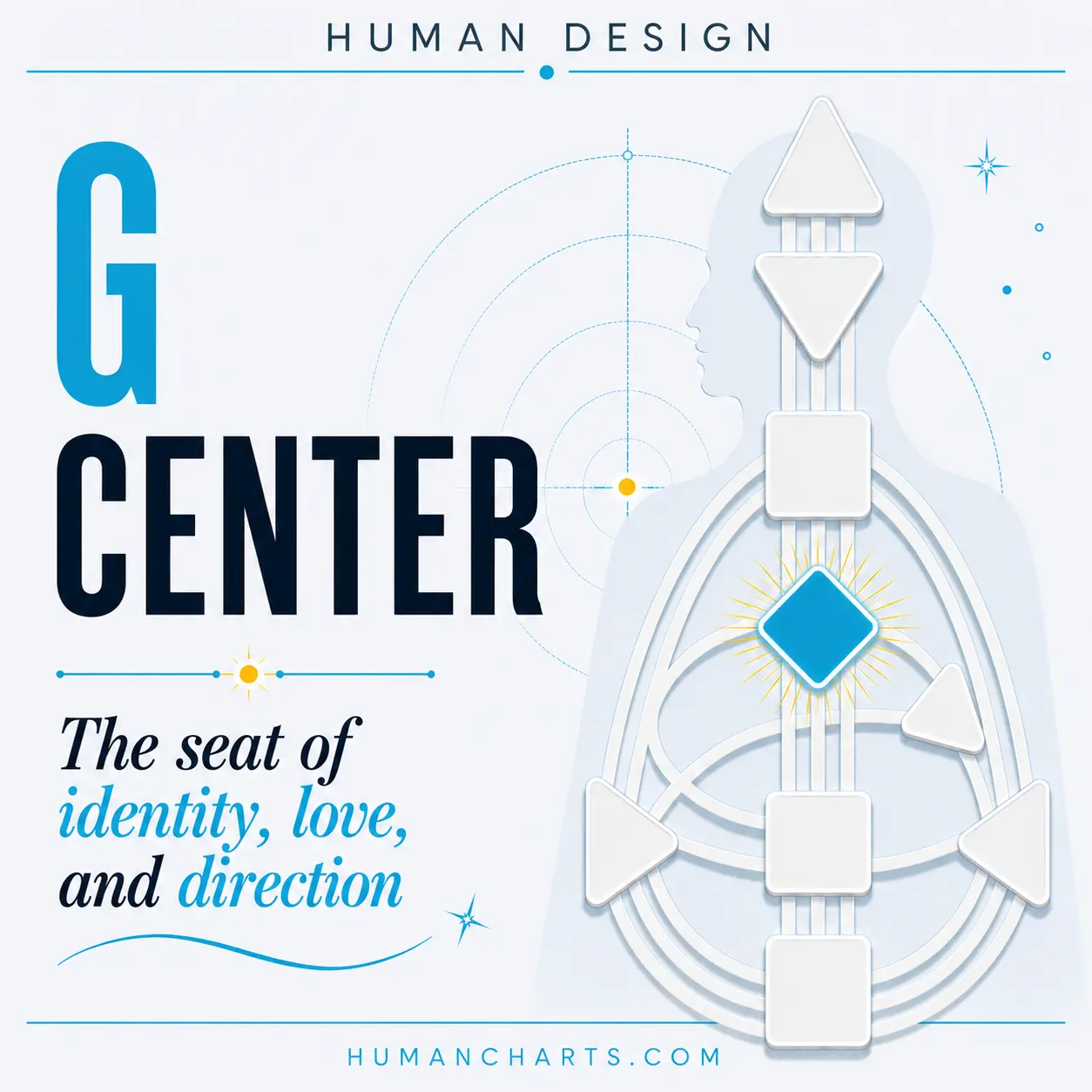
The G Center at a Glance
- What It Is: The G Center, the central position in your BodyGraph and the seat of identity, love, and direction
- Defined vs Undefined G Center: The two states the G Center can be in and what each one means for you
- What You Unlock With a Defined G Center: A fixed sense of who you are, stable direction in life, a consistent capacity for love
- What You Unlock With an Undefined G Center: Flexibility of identity, wisdom about love and direction through many forms, sensitivity to environment
- Strengths of the G Center: What the G Center does at full power in both states
- Challenges of the G Center: The predictable distortions that show up in both states when the design is forced
- The 8 Gates of the G Center: Gates 1, 2, 7, 10, 13, 15, 25, 46 and what each carries
- The 10 Channels That Connect Through the G Center: The Channels that wire the G Center to the rest of the BodyGraph
- Optimal Decision-Making: How your G Center informs decisions correctly
- Why “Find Yourself” Is Wrong For You: The advice this center gets that contradicts its actual mechanics
- The G Center vs Western Astrology: The closest astrological parallel and why the mapping is not clean
- The Nine Centers in Human Design: Navigate to the other eight Centers in the BodyGraph
The G Center is the center of your BodyGraph. Literally the center, geometrically. It sits in the middle of the chart, and it carries three of the most fundamental themes in Human Design: identity (who you are), love (what you love and how you love), and direction (where you are going).
In Human Design, every chart has nine Centers. Each Center is either Defined (colored in) or Undefined (white). Defined means the energy of that Center is consistent in you. It is who you are. Undefined means the energy of that Center is not fixed in you. You take it on from the environment, from other people, from the rooms you sit in.
The G Center is where this matters most. Of all nine Centers, the G Center is the one that shapes how you experience yourself most directly. Whether your G Center is Defined or Undefined determines whether you are someone with a fixed identity that travels with you, or someone whose identity shifts with the environment.
Both designs are correct. Both are valuable. They are not better or worse versions of each other. They are different. And living each one cleanly requires understanding which one you have.
You do not have to calculate any of this. Generate your free chart on HumanCharts and your G Center state will be displayed for you, ready to read.
Definition: The G Center in Human Design is one of nine energy centers in the BodyGraph. It carries identity, love, and direction in life. The G Center contains 8 Gates (more than any other Center except the Throat): Gate 1 (Self-Expression), Gate 2 (Direction of the Self), Gate 7 (Role of the Self), Gate 10 (Behavior of the Self), Gate 13 (The Listener), Gate 15 (Extremes), Gate 25 (Spirit of the Self), and Gate 46 (Determination of the Self / Love of the Body). Four of these (Gates 10, 15, 25, 46) are traditionally called the love gates. A Defined G Center carries a fixed identity, stable direction, and a consistent way of loving. An Undefined G Center takes on identity from the environment and becomes wise about love and direction through experiencing many forms. The G Center also houses what Ra Uru Hu called the Magnetic Monopole, the mechanism that draws toward you the people, places, and events that are correct for your design. The G Center is the seat of Self-Projected Authority. Generate your free Human Design chart on HumanCharts to find out yours.
The G Center is one of the nine Centers in the Human Design BodyGraph. The Centers are energy hubs, each one carrying a specific function in the design. The G Center sits in the geometric center of the chart, which is not an accident. Of all nine Centers, the G Center is the most central to the experience of being a self.
The G Center carries three core themes:
- Identity. Who you are, the sense of self you experience as continuous.
- Love. How you love, what you love, and the frequency at which love operates in your design.
- Direction. Where your life is oriented, the direction the design is moving in.
Ra Uru Hu, who founded Human Design in 1987, taught that the G Center also houses what he called the Magnetic Monopole. The Magnetic Monopole is the mechanism that draws toward you the people, places, and events that are correct for your design. It is the gravity of your incarnation. You do not steer your life with your mind. The Magnetic Monopole does the steering. Your job is to be in the body so the mechanism can do its work.
The G Center has 8 Gates, the second-highest gate count of any Center in the BodyGraph (only the Throat carries more). These 8 Gates are the specific positions through which identity, love, and direction express in your chart. Whether the G Center is Defined depends on whether any of these Gates are activated and connected to other Centers through a Channel.
A note on language. Human Design calls each of these 8 positions a Gate, but you can also think of each Gate as a Gift. The 64 Gates in your chart are 64 archetypal gifts your design carries, drawn from the 64 hexagrams of the I Ching. The Gene Keys system, developed by Richard Rudd, uses the same 64 patterns and calls them Gene Keys. Gate, Gift, and Gene Key all point to the same thing. We use the term Gate throughout because that is the primary Human Design term, but the reframe matters: a Gate is a Gift you are here to live.
This is the most important distinction on this page. Whether your G Center is Defined or Undefined fundamentally changes how you experience yourself, and the advice that helps one state often hurts the other.
Practice: Place changes everything
Defined G Center (About 57 Percent of People)
A Defined G Center is colored in on the BodyGraph. The energy of the G Center is consistent in you. You have a fixed sense of identity, a stable direction in life, and a reliable way of loving.
People with a Defined G Center:
- Are the same person across different environments
- Know who they are and where they are going
- Carry their identity into the room with them
- Provide identity reference points for Undefined G Center people, often without realizing it
- Should not be told they need to find themselves. They already have themselves.
Undefined G Center (About 43 Percent of People)
An Undefined G Center is white on the BodyGraph. The energy of the G Center is not fixed in you. You take on identity, love, and direction from the environment.
People with an Undefined G Center:
- Become a different self in different rooms
- Are deeply sensitive to where they live and who they spend time with
- Become wise about love and direction through experiencing many forms
- Can read other people’s identities with unusual depth
- Should not be told to have a fixed identity. The flexibility is the design.
The single most important truth for an Undefined G Center: place matters. Where you live and who you spend time with determines who you become. This is the design working, not a malfunction.
When you know your G Center is Defined, you unlock the following pieces of yourself:
- A fixed sense of who you are. Your identity is consistent across environments. You are the same person at work, at home, with strangers, and with family. The you that walks into a new room is the you that walks into every room.
- A stable direction in life. Your sense of where you are going does not change based on who you are around. The direction is yours, regardless of the environment.
- A consistent capacity for love. You know how you love, who you love, and what love feels like to you. The frequency does not fluctuate based on conditions.
- A reliable inner compass. You can use your own identity as a reference point. When something feels right or wrong for you, the reading is steady.
- Direction you transmit to others. People with Undefined G Centers may borrow direction from your presence and feel found around you. That is the design working, not a problem.
- An identity that does not need external validation. You are not built to absorb who you are from the room. You bring who you are into the room.
You do not have to calculate any of this. Generate your free Human Design chart on HumanCharts and we will tell you whether your G Center is Defined and what that unlocks.
When you know your G Center is Undefined, you unlock the following pieces of yourself:
- Flexibility of identity. You are built to take on the identity of the environment you are in. You become a different self in a different room. This is not inconsistency. It is the design.
- Wisdom about love and direction through living many forms. Over a lifetime, you encounter many versions of love and many directions. You become wise about what is real because you have lived more variations than someone with a Defined G Center.
- The capacity to read identity in others. Because you are not anchored to a fixed identity, you can sense who someone else is at a depth that defined people cannot.
- A sensitivity to environment and place. Place matters enormously for an Undefined G Center. Living in the right place and being around the right people is not optional. It is the operating system.
- The risk and the gift of identity confusion. Confusion about who you are is not a malfunction. It is the open space asking you to wait for the right environment instead of forcing an identity that is not yours.
- The capacity to love in many shapes. You are not built to have one fixed way of loving. You are built to love correctly in response to the situation in front of you.
Generate your free Human Design chart on HumanCharts to find out whether your G Center is Undefined and how to work with it correctly.
The G Center has different strengths depending on whether it is Defined or Undefined. Both sets are real. Both are valuable. They are not better or worse than each other.
Strengths of a Defined G Center
- A stable, transmissible identity others can rest in
- Consistent direction across changing environments
- A reliable inner reference point for decisions about who you are
- Capacity to love in a fixed, recognizable way
- The ability to anchor a room simply by being in it
Strengths of an Undefined G Center
- Wisdom about identity through living many forms over time
- Capacity to read other people’s identities deeply
- Flexibility to meet many kinds of love and many kinds of direction
- Sensitivity to environment that, used correctly, is a navigational instrument
- The ability to become exactly who a moment requires without losing yourself
The G Center also has different challenges depending on whether it is Defined or Undefined. These are not character flaws. They are predictable distortions that show up when one state tries to act like the other, or when the culture pushes the wrong advice onto the design.
Challenges a Defined G Center Runs Into
- Mistaking your fixed identity for the only correct identity
- Judging Undefined G Center people as lost or inconsistent
- Becoming rigid in the name of being “who you are”
- Resisting environments where your fixed self needs to soften
- Forgetting that other people’s identities may be more flexible by design
Challenges an Undefined G Center Runs Into
- Forcing a fixed identity that is not yours to have
- Mistaking environmental sensitivity for personal weakness
- Ending up in the wrong place, with the wrong people, because identity was decided too early
- Confusing the openness of the design with not knowing who you are
- Trying to “build a personal brand” when the design is built to live many forms
The repair pattern is the reverse of the distortion. A Defined G Center stays in alignment by remaining itself and letting Undefined people benefit from that consistency. An Undefined G Center stays in alignment by slowing down, choosing the right environment, and trusting the flexibility as a design feature.
The G Center has eight Gates, more than any other Center in the BodyGraph except the Throat. Four of them (Gates 10, 15, 25, 46) are traditionally grouped as the love gates, the positions in the design where love most directly expresses. Each of these Gates carries a specific theme of identity, love, or direction. If you have one or more of these Gates activated in your chart, that Gate is operating in you as a Gift you carry.
- Gate 1, The Gate of Self-Expression. The creative expression of the individual self. Self as creator. Read the full breakdown of Gate 1, The Gate of Self-Expression.
- Gate 2, The Gate of the Direction of the Self. The receptive direction of the self. Self as the one who knows where to go without effort. Read the full breakdown of Gate 2, The Gate of the Direction of the Self.
- Gate 7, The Gate of the Role of the Self. The role you play in interaction with others. How you serve. Read the full breakdown of Gate 7, The Gate of the Role of the Self.
- Gate 10, The Gate of the Behavior of the Self. Self-love expressed as behavior. The way you carry yourself through life. One of the four love gates. Read the full breakdown of Gate 10, The Gate of the Behavior of the Self.
- Gate 13, The Gate of the Listener. Self as witness. The keeper of stories, the one others confide in. Read the full breakdown of Gate 13, The Gate of the Listener.
- Gate 15, The Gate of Extremes. Self in the flow of humanity. Love of the rhythm of life and its variations. One of the four love gates. Read the full breakdown of Gate 15, The Gate of Extremes.
- Gate 25, The Gate of the Spirit of the Self. Universal love. Innocence as the frequency of contact. One of the four love gates. Read the full breakdown of Gate 25, The Gate of the Spirit of the Self.
- Gate 46, The Gate of the Determination of the Self (Love of the Body). Determination of the self through embodiment. Being in the body as the correct way to live. One of the four love gates. Read the full breakdown of Gate 46, The Gate of the Determination of the Self.
Each of these Gates, whether activated in your chart or not, sits in the G Center and contributes to the larger theme of identity, love, and direction.
The G Center has 8 Gates, and those Gates form 10 Channels that wire the G Center to other Centers in the BodyGraph. When you have both Gates of a Channel activated, the Channel is defined and energy flows continuously between the two Centers. The 10 Channels of the G Center are:
- Channel 1-8, The Channel of Inspiration. G Center to Throat. The creative role model.
- Channel 2-14, The Channel of the Beat. G Center to Sacral. The keeper of the keys, direction through resources.
- Channel 5-15, The Channel of Rhythm. Sacral to G Center. Being in the flow of life.
- Channel 7-31, The Channel of the Alpha. G Center to Throat. Leadership for the now or for the future.
- Channel 10-20, The Channel of Awakening. G Center to Throat. Being in the now as the commitment to higher principles.
- Channel 10-34, The Channel of Exploration. G Center to Sacral. Following one’s convictions.
- Channel 10-57, The Channel of Perfected Form. G Center to Spleen. Survival through intuitive behavior.
- Channel 13-33, The Channel of the Prodigal. G Center to Throat. The witness, the keeper of secrets.
- Channel 25-51, The Channel of Initiation. G Center to Heart. The shock that initiates the spirit.
- Channel 29-46, The Channel of Discovery. Sacral to G Center. Success against the odds through commitment to the body.
If any of these Channels are colored in on your chart, your G Center is Defined through that Channel. Generate your free Human Design chart on HumanCharts to see which of your G Center Channels are activated.
Everything in life is a function of decision-making. Every life unfolds through the decisions made within it.
The G Center carries identity and direction. Most people try to make identity and direction decisions with their mind. That is the misuse. The mind is not the seat of decision in any Human Design. Your Strategy and your Authority are.
For some people, the G Center is directly involved in the decision-making process. If your only definition connecting to the Throat runs through the G Center, your Authority is Self-Projected Authority, and you decide by speaking out loud and listening for the truth of your own voice. The G Center is literally the seat of that Authority.
For people with a Defined G Center, the principle is: trust the fixed identity. When a decision involves identity, the Defined G Center is a reliable internal reference. You can ask “does this match who I am?” and get a steady reading. The risk is letting environments rewrite that identity, which they will try to do if you let them.
For people with an Undefined G Center, the principle is harder but more important. Do not make permanent identity decisions in unfamiliar environments. Do not let a single conversation, a single relationship, or a single bad week convince you that you have figured out who you are. The Undefined G Center needs time and varied environments to know what is actually yours and what is being picked up from the room.
In all cases, the G Center is not the decision-maker by itself. Your Authority is. The G Center provides context. Your Authority decides.
To work with your G Center correctly:
- Know whether your G Center is Defined or Undefined. Generate your free chart and find out.
- Defined G Center: trust your identity, do not let environments rewrite it.
- Undefined G Center: trust the flexibility, do not force fixed identity decisions.
- All: let your Strategy and Authority make the actual decisions.
This is the advice the modern world hands out by default. Find yourself. Know who you are. Have a clear identity. Build a personal brand. Live your truth.
The advice is wrong for half the population. And it is right but oddly missing the point for the other half.
If you have a Defined G Center, you already have yourself. Your identity is fixed in your design. You do not need to find it. You need to live it. The work is not search. The work is expression. The “find yourself” advice misframes what is actually happening for you, which is that you already are someone, and your job is to let that someone exist in the world without apology.
If you have an Undefined G Center, the advice is mechanically incompatible with your design. You are not built to have a fixed self to find. You are built to take on identity from your environment. Trying to find a permanent self forces you to manufacture a “you” that is not actually yours. The result is often years of identity work that ends in burnout, because the design is searching for something it was never meant to have.
What is actually correct for an Undefined G Center is not “find yourself” but “find the right environment.” Place matters more than identity. Who you spend time with matters more than what you call yourself. Trust the flexibility. The wisdom comes from living many forms, not from settling on one.
The cultural advice was built for a population that assumed everyone had a fixed identity. Half of you do. Half of you do not. Knowing which half you are in changes everything.
The G Center has no direct equivalent in Western Astrology. The closest parallels are the Sun (which carries identity and self-expression) and the Ascendant (which represents how you show up in the world). But neither maps cleanly to the G Center.
In Western Astrology, identity tends to be treated as a single fixed thing for everyone, anchored in the Sun sign and elaborated by the Ascendant. Human Design splits identity into Defined or Undefined and treats the two as fundamentally different operating systems. There is no Western Astrology equivalent to the Undefined G Center, because Western Astrology does not have a category for “identity that takes its shape from the environment.”
This is one of the places where Human Design says something Western Astrology does not. If your G Center is Undefined, the cultural assumption that everyone has a fixed self does not apply to you. The mechanics of your identity are different from the mechanics described in any sun-sign-based system.
People who study both systems often find that Western Astrology gives them their cultural identity layer, while the Human Design G Center tells them whether that identity is actually fixed in their design or whether they are built to take on identity from the world.
The G Center is one of nine Centers in the Human Design BodyGraph. Each Center carries its own themes, its own Gates, and its own Defined or Undefined state in your specific chart. Together they describe the energetic architecture of your design.
- The Head Center, the source of inspiration and mental pressure
- The Ajna Center, the seat of conceptualization and thought
- The Throat Center, the mechanical exit for expression and manifestation
- The G Center, the seat of identity, love, and direction (this page)
- The Heart Center, also called the Will or Ego Center, the source of willpower
- The Solar Plexus Center, the seat of emotional awareness and feeling
- The Sacral Center, the engine of life force and creativity
- The Splenic Center, the seat of intuition, instinct, and immune awareness
- The Root Center, the source of adrenal pressure and drive
Return to the Human Design hub for the full system map.
A Direct Transmission from MATTEEN
“Your G Center is not a thing you build. It is a thing you either have fixed in your design or you have left open by design. If you have it fixed, your identity is yours and the work is to let it exist without apology. If you have it open, your identity is not something you find. It is something you live, in many forms, across many environments, over time. Place matters. The people you sleep next to matter. The rooms you sit in matter. The advice the world hands out about finding yourself was built for one half of the population. Find out which half you are in. Then live the design you actually have, not the one the culture told you to want.”
Matteen Terrany