The Spleen Center at a Glance
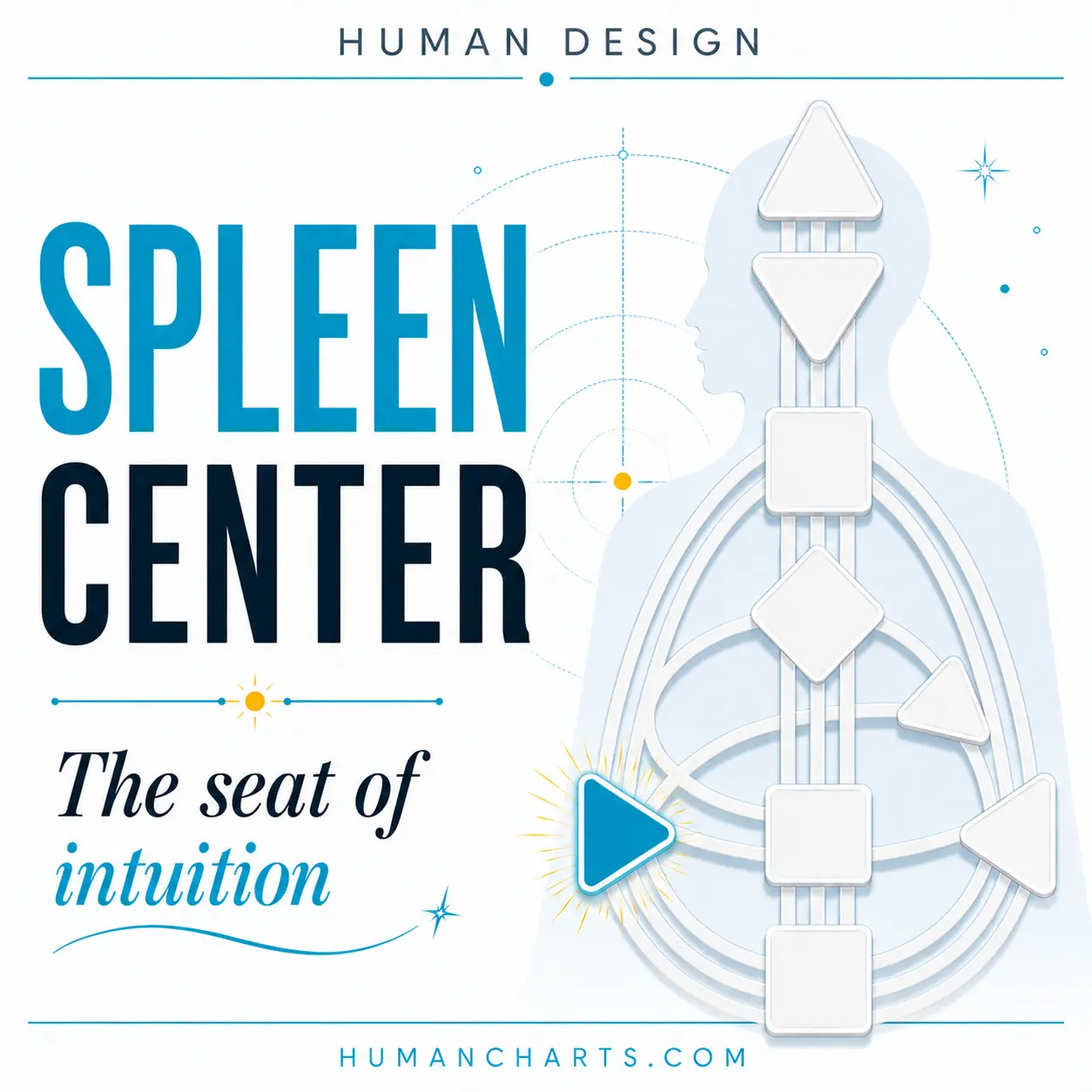
- What It Is: The Spleen Center, also called the Splenic Center, the oldest awareness center in the BodyGraph and the seat of intuition, instinct, and immune awareness
- Defined vs Undefined Spleen Center: The two states the Spleen Center can be in and what each one means for you
- What You Unlock With a Defined Spleen Center: Consistent in-the-moment intuition, reliable instinct about safety and health, a quiet inner voice that speaks once
- What You Unlock With an Undefined Spleen Center: Wisdom about what is actually healthy through time, sensitivity to fear, the capacity to recognize unhealthy patterns in others
- Strengths of the Spleen Center: What the Spleen Center does at full power in both states
- Challenges of the Spleen Center: The predictable distortions that show up in both states when the design is forced
- The 7 Gates of the Spleen Center: Gates 48, 57, 44, 50, 32, 28, 18 and what each carries
- Optimal Decision-Making: How your Spleen Center informs decisions correctly, including the link to Splenic Authority
- Why “Always Trust Your First Instinct” Is Wrong For You: The advice this center gets that contradicts its actual mechanics
- The Spleen Center vs Western Astrology: The closest astrological parallels and why the mapping is not clean
- The Nine Centers in Human Design: Navigate to the other eight Centers in the BodyGraph
The Spleen Center is the oldest awareness system in your BodyGraph. It is the part of you that knows, in the moment, whether something is safe, healthy, and correct for you to be in contact with. It does not think. It does not weigh options. It registers and speaks, once, quietly, and then it goes silent.
In Human Design, every chart has nine Centers. Each Center is either Defined (colored in) or Undefined (white). Defined means the energy of that Center is consistent in you. It is who you are. Undefined means the energy of that Center is not fixed in you. You take it on from the environment, from other people, from the rooms you sit in.
The Spleen Center is where survival lives. Of all nine Centers, it is the most ancient. It evolved long before the mind. Whether your Spleen Center is Defined or Undefined determines whether you have a consistent in-the-moment intuition that warns you about danger and points you toward what is healthy, or whether you experience that awareness inconsistently and have to learn what is actually safe and healthy by paying attention over time.
Both designs are correct. Both are valuable. They are not better or worse versions of each other. They are different. And living each one cleanly requires understanding which one you have.
You do not have to calculate any of this. Generate your free chart on HumanCharts and your Spleen Center state will be displayed for you, ready to read.
Definition: The Spleen Center in Human Design, also called the Splenic Center, is one of nine energy centers in the BodyGraph. It carries intuition, instinct, immune awareness, and the felt sense of safety, health, and fear in the present moment. The Spleen Center is the oldest awareness center in the design. It contains 7 Gates: Gate 48 (Depth), Gate 57 (Intuition), Gate 44 (Alertness), Gate 50 (Values), Gate 32 (Continuity), Gate 28 (The Game Player), and Gate 18 (Correction). A Defined Spleen Center carries consistent in-the-moment intuition that speaks once, quietly, and does not repeat itself. An Undefined Spleen Center does not have that consistent voice and often holds onto things, people, and situations that should be released, out of a fear of feeling unsafe. For some designs, the Spleen Center is the Authority, called Splenic Authority. Generate your free Human Design chart on HumanCharts to find out yours.
The Spleen Center is one of the nine Centers in the Human Design BodyGraph. It is also called the Splenic Center, and both names refer to the same Center. We use Spleen Center as the primary term on this page. The Centers are energy hubs, each one carrying a specific function in the design. The Spleen Center sits on the left side of the BodyGraph and is the oldest awareness center in the design.
The Spleen Center carries three core themes:
- Intuition. The in-the-moment knowing about what is correct, safe, and healthy. It does not arrive as a thought. It arrives as a hit, a quiet voice, a body signal that registers and then is gone.
- Instinct. The survival awareness that orients you toward what keeps you alive and away from what does not. The immune system lives here, both literally and metaphorically.
- Fear. The Spleen Center is the home of fear in the design. Fear in the Spleen is not pathology. It is the awareness system noticing something that needs attention. The fears of the Spleen are about survival, health, and safety.
Ra Uru Hu, who founded Human Design in 1987, taught that the Spleen Center is the most ancient awareness system in the body. It evolved before the mind, before language, before any capacity for reflection. It is the awareness that kept your ancestors alive. It speaks in the present tense only. It does not look forward or back. It tells you what is correct, right now, and if you do not act on it, it does not repeat itself.
The Spleen Center has 7 Gates. These 7 Gates are the specific channels through which intuition, instinct, and survival awareness express in your chart. Whether the Spleen Center is Defined depends on whether any of these Gates are activated and connected to other Centers through a Channel.
A note on language. Human Design calls each of these 7 positions a Gate, but you can also think of each Gate as a Gift. The 64 Gates in your chart are 64 archetypal gifts your design carries, drawn from the 64 hexagrams of the I Ching. The Gene Keys system, developed by Richard Rudd, uses the same 64 patterns and calls them Gene Keys. Gate, Gift, and Gene Key all point to the same thing. We use the term Gate throughout because that is the primary Human Design term, but the reframe matters: a Gate is a Gift you are here to live.
This is the most important distinction on this page. Whether your Spleen Center is Defined or Undefined fundamentally changes how you experience intuition, fear, and the felt sense of what is healthy, and the advice that helps one state often hurts the other.
Practice: Let go of what is not healthy
Defined Spleen Center (About 55 Percent of People)
A Defined Spleen Center is colored in on the BodyGraph. The energy of the Spleen Center is consistent in you. You have a reliable in-the-moment intuition about safety, health, and what is correct for you to be in contact with right now.
People with a Defined Spleen Center:
- Receive intuitive hits in the moment, quietly, and only once
- Have a consistent instinct about what is healthy and what is not
- Carry a steady immune awareness, both physical and energetic
- Provide a felt sense of safety to people around them, often without realizing it
- Should not be taught to second-guess the quiet voice. If they miss it the first time, it does not come back.
Undefined Spleen Center (About 45 Percent of People)
An Undefined Spleen Center is white on the BodyGraph. The energy of the Spleen Center is not fixed in you. You do not have a consistent in-the-moment intuition. You take on intuition, fear, and the sense of safety from the environment and the people around you.
People with an Undefined Spleen Center:
- Hold onto things, people, jobs, and situations that should have been released long ago
- Do this out of a fear of feeling unsafe alone, not out of a lack of intelligence
- Are deeply sensitive to other people’s fears and intuitions
- Become wise about what is actually unhealthy by watching it unfold over time
- Should not be told to “always trust your gut” as if their gut were consistent. It is not, by design.
The single most important truth for an Undefined Spleen Center: the design challenge is the fear of letting go. The wisdom is in recognizing, over time, what is actually unhealthy. This is the design working, not a malfunction.
When you know your Spleen Center is Defined, you unlock the following pieces of yourself:
- A consistent in-the-moment intuition. Your awareness of what is safe, healthy, and correct registers in real time. It does not arrive as a thought. It arrives as a quiet hit in the body. The reading is reliable.
- A voice that speaks once. Your Spleen does not repeat itself. The hit comes once, quietly, and then it is gone. If you do not act on it, the intuition does not come back. This is the design, not a flaw.
- A steady felt sense of safety. You know, in your body, when a person, a place, or a situation is safe to be in. You also know when it is not. The reading is immediate.
- A reliable instinct about health. You have a built-in sense of what is healthy for you to eat, who is healthy for you to be around, and what environments are healthy for you to live in. This sense does not come from research. It comes from the body.
- Splenic Authority for some designs. If you have a Defined Spleen and a specific configuration, your Authority is the Spleen itself. Your decisions are made through that quiet, in-the-moment intuition. See the Splenic Authority guide for the full breakdown.
- A presence others can rest in. People with Undefined Spleen Centers often feel safer around you. That is the design working, not a problem.
You do not have to calculate any of this. Generate your free Human Design chart on HumanCharts and we will tell you whether your Spleen Center is Defined and what that unlocks.
When you know your Spleen Center is Undefined, you unlock the following pieces of yourself:
- Wisdom about what is actually healthy through time. You are not built to know in the moment. You are built to learn, over time, by watching patterns play out. The wisdom is real, and it is deeper than the in-the-moment hit of a Defined Spleen.
- The capacity to recognize unhealthy patterns in others. Because you are not anchored to a fixed reading of safety, you can sense when something is off in someone else’s body, situation, or behavior with unusual depth.
- A sensitivity to fear that, used correctly, is information. Fear in an Undefined Spleen is amplified and inconsistent. It does not always belong to you. Recognizing which fears are yours and which are picked up from the environment is part of the design.
- The risk and the gift of holding on. You will be tempted to hold onto things, people, and situations longer than is healthy. Knowing this is the design, you can build the practice of letting go anyway, once you have seen the pattern clearly.
- Discernment about who is actually safe. Because you take on the Spleen energy of the people around you, you will eventually notice the difference between people who genuinely feel safe in their bodies and people who project that they do.
- The capacity to live without a constant survival voice. You are not designed to be on alert. The Undefined Spleen, lived correctly, is freer of the constant in-the-moment survival monitoring that runs in Defined Spleens.
Generate your free Human Design chart on HumanCharts to find out whether your Spleen Center is Undefined and how to work with it correctly.
The Spleen Center has different strengths depending on whether it is Defined or Undefined. Both sets are real. Both are valuable. They are not better or worse than each other.
Strengths of a Defined Spleen Center
- A reliable in-the-moment intuition about safety, health, and correctness
- A quiet inner voice that speaks once and is trustworthy
- A steady immune awareness, both physical and energetic
- The ability to read the safety of a person, place, or situation immediately
- A presence that gives Undefined Spleen Centers a felt sense of safety
Strengths of an Undefined Spleen Center
- Wisdom about what is actually healthy gained through observing patterns over time
- Capacity to read unhealth and unsafety in others at depth
- Freedom from the constant in-the-moment survival monitoring
- Sensitivity to fear that, used correctly, becomes a navigational instrument
- The ability to recognize, eventually, what should have been released
The Spleen Center also has different challenges depending on whether it is Defined or Undefined. These are not character flaws. They are predictable distortions that show up when one state tries to act like the other, or when the culture pushes the wrong advice onto the design.
Challenges a Defined Spleen Center Runs Into
- Ignoring the quiet voice because it does not repeat itself
- Talking yourself out of the intuitive hit with the mind
- Judging Undefined Spleen people as ungrounded or unsafe
- Assuming everyone has the same consistent intuition you do
- Letting the steady survival voice become a low-grade anxiety instead of a tool
Challenges an Undefined Spleen Center Runs Into
- Holding onto things, people, jobs, and situations long past their expiration date
- Doing so out of a fear of feeling unsafe alone
- Mistaking environmental fear for personal fear
- Forcing yourself to “trust your gut” when the design does not have a consistent gut to trust
- Confusing the openness of the design with a personal failure of intuition
The repair pattern is the reverse of the distortion. A Defined Spleen Center stays in alignment by listening to the quiet voice the first time it speaks. An Undefined Spleen Center stays in alignment by slowing down, watching patterns over time, and choosing to let go even when the fear of letting go is loud.
The Spleen Center has seven Gates. Each of these Gates carries a specific theme of intuition, instinct, or survival awareness. If you have one or more of these Gates activated in your chart, that Gate is operating in you as a Gift you carry.
- Gate 48, The Gate of Depth. Also called The Well. The depth of intuitive knowing that life draws on. The reservoir of insight under the surface. Read the full breakdown of Gate 48, The Gate of Depth.
- Gate 57, The Gate of Intuitive Clarity. Also called The Gentle. The clearest intuitive Gate in the design. The in-the-moment awareness of what is correct, registered as a quiet hit. Read the full breakdown of Gate 57, The Gate of Intuitive Clarity.
- Gate 44, The Gate of Alertness. Instinctive awareness of the past, of patterns, of who someone is by how they show up. The Gate that recognizes whether a situation has been encountered before. Read the full breakdown of Gate 44, The Gate of Alertness.
- Gate 50, The Gate of Values. Also called The Cauldron. The instinct that preserves what is valuable for the tribe. The guardian of values that keep the collective healthy. Read the full breakdown of Gate 50, The Gate of Values.
- Gate 32, The Gate of Continuity. Also called Duration. The instinct about what will last and what will not. The Gate that recognizes durable foundations and unsustainable ones. Read the full breakdown of Gate 32, The Gate of Continuity.
- Gate 28, The Gate of the Game Player. Also called Preponderance of the Great. The instinct that knows which risks are worth taking. The Gate of the struggle to find what is worth living for. Read the full breakdown of Gate 28, The Gate of the Game Player.
- Gate 18, The Gate of Correction. Also called Work on What Has Been Spoiled. The instinct that recognizes what is not working and corrects it. The Gate of pattern recognition in service of health. Read the full breakdown of Gate 18, The Gate of Correction.
Each of these Gates, whether activated in your chart or not, sits in the Spleen Center and contributes to the larger theme of intuition, instinct, and in-the-moment awareness.
Everything in life is a function of decision-making. Every life unfolds through the decisions made within it.
The Spleen Center carries intuition and survival awareness. Most people try to make survival and safety decisions with their mind. That is the misuse. The mind is not the seat of decision in any Human Design. Your Strategy and your Authority are.
For people with a Defined Spleen Center, the principle is: listen the first time. When the quiet voice speaks, that is the decision. The Spleen does not negotiate. It does not repeat itself. The risk is letting the mind talk you out of the hit, which it will try to do if you let it. For some designs with a Defined Spleen, the Spleen itself is your Authority, called Splenic Authority. When that is the case, the in-the-moment intuitive hit is literally how you make decisions.
For people with an Undefined Spleen Center, the principle is harder but more important. Do not make survival or health decisions in a panic. The fear you feel is often amplified or borrowed from the environment, not a reliable signal about what is actually unsafe. Wait, watch the pattern over time, and let your actual Authority decide. The Undefined Spleen is wise about health, but the wisdom comes from observation, not from a single in-the-moment reading.
In both cases, the Spleen Center is not always the decision-maker. Unless you have Splenic Authority, your Authority is something else, and the Spleen provides context. Your Authority decides.
To work with your Spleen Center correctly:
- Know whether your Spleen Center is Defined or Undefined. Generate your free chart and find out.
- Defined Spleen Center: listen the first time, do not let the mind override the quiet voice.
- Undefined Spleen Center: do not decide from fear, watch the pattern over time, let go even when it is hard.
- Both: let your Strategy and Authority make the actual decisions. If you have Splenic Authority, the Spleen is the Authority.
Read more in the complete guide to all 5 Human Design energy types, the complete guide to all 7 Human Design authorities, and the Strategy hub.
This is the advice the modern world hands out by default. Trust your gut. Go with your first instinct. Your body knows. Don’t overthink it.
The advice is wrong for half the population. And it is right but oddly framed for the other half.
If you have a Defined Spleen Center, the advice is closer to correct, but it is still misframed. Your Spleen does not speak as a “first instinct” in the loud, urgent sense the phrase implies. It speaks once, quietly, often so quietly that you can miss it if you are not paying attention. The correction is not “trust your first instinct” but “listen to the quiet voice the first time it speaks, because it will not repeat itself.” The advice as the culture phrases it makes people think intuition is a strong gut feeling. For a Defined Spleen, it is usually the opposite. It is the small thing the mind almost talked you out of.
If you have an Undefined Spleen Center, the advice is mechanically incompatible with your design. You do not have a consistent in-the-moment intuition. Your “first instinct” is often borrowed from the environment, or it is fear of letting go disguised as a gut feeling. Trusting your first instinct as an Undefined Spleen often means clinging to what should be released, because the fear of feeling unsafe is louder than the actual signal. The correct advice for an Undefined Spleen is “watch the pattern over time and let go anyway.” The wisdom is in observation, not in the immediate hit.
The cultural advice was built on the assumption that everyone has a consistent gut. About 55 percent of people do. About 45 percent of people do not. Knowing which group you are in changes how you make decisions. It also changes how you treat your fears.
The Spleen Center has no clean equivalent in Western Astrology. The closest parallels are Mars (which carries instinct, survival, and action) and the natal Moon (which carries the subconscious and the felt sense of safety). But neither maps cleanly to the Spleen Center.
In Western Astrology, instinct and safety tend to be scattered across several placements (Mars, the Moon, the 4th house, the 8th house) rather than gathered into a single awareness center. Human Design isolates in-the-moment intuition and survival awareness into one specific Center and treats it as Defined or Undefined in a way Western Astrology does not. There is no Western Astrology equivalent to the Undefined Spleen Center, because Western Astrology does not have a category for “intuition that is not consistent in this person by design.”
This is one of the places where the pluralistic “trust your gut” advice in the culture gets confused. What people mean by “gut” is sometimes the Sacral Center (the Generator’s “uh-huh / un-uh” response) and sometimes the Spleen Center (the in-the-moment intuitive hit). The two are different mechanics. Western Astrology does not distinguish between them. Human Design does, and the distinction matters for how you make decisions.
People who study both systems often find that Western Astrology gives them their broader temperamental and survival themes, while the Human Design Spleen Center tells them whether their in-the-moment intuition is actually consistent in their design or whether they are built to gain wisdom about safety and health over time instead.
If you want the Western Astrology read on instinct and survival, see Mars in Western Astrology and The Moon in Western Astrology.
The Spleen Center is one of nine Centers in the Human Design BodyGraph. Each Center carries its own themes, its own Gates, and its own Defined or Undefined state in your specific chart. Together they describe the energetic architecture of your design.
- The Head Center, the source of inspiration and mental pressure
- The Ajna Center, the seat of conceptualization and thought
- The Throat Center, the mechanical exit for expression and manifestation
- The G Center, the seat of identity, love, and direction
- The Heart Center, also called the Will or Ego Center, the source of willpower
- The Solar Plexus Center, the seat of emotional awareness and feeling
- The Sacral Center, the engine of life force and creativity
- The Spleen Center, also called the Splenic Center, the seat of intuition, instinct, and immune awareness (this page)
- The Root Center, the source of adrenal pressure and drive
A Direct Transmission from MATTEEN
“The Spleen is the oldest voice in you. It is the one that kept your ancestors alive. If you have a Defined Spleen, listen the first time. It will not raise its voice. It will not repeat itself. If you miss the quiet hit, the mind will move in and fill the space, and you will lose the signal. If you have an Undefined Spleen, you were not built to trust your first instinct. You were built to watch the pattern, see it for what it is, and let go anyway. The fear of letting go is loud. Let go anyway. The wisdom of the Undefined Spleen is in what you eventually recognize about what is actually unhealthy, not in what you felt in the first second. Half of you have a quiet voice that knows. Half of you have a slow wisdom that knows. Find out which half you are in. Then live the design you actually have, not the one the culture told you to want.”
Matteen Terrany